



The right white-label landing page builder rebrands the surfaces your clients see. We’ve evaluated seven platforms to help you future-proof your service model, from seamless client onboarding to profitable, scalable billing.
A white-label landing page builder lets agencies, freelancers, and SaaS platforms use a third-party page-creation engine while showing clients their own brand logo, custom domain, and color scheme.
These white-label landing page builders differ on two things that decide the money: how much of the client-facing surface you can rebrand, and how they price and bill it, from flat monthly fees to per-project wholesale rates you mark up or per-site charges that climb with the roster.
This guide compares seven top platforms to help you choose the one that best aligns with your service model.
Key takeaways:
- Duda offers the broadest rebranding coverage, putting your logo on the login screen, editor, dashboard, and outbound email, though the branded template gallery requires custom pricing.
- GoHighLevel supports automated software resale, so a client subscription can automatically create a sub-account, and Stripe can rebill usage with your markup.
- Simvoly publishes wholesale and retail per-project prices, so you can calculate margin per client before selling a subscription.
- Landingi swaps its logo for yours, but the client login stays under new.landingi.com, so the vendor is visible at the front door.
- Instapage, Unbounce, and Leadpages keep their brand on the dashboard, and their testing systems cover server-side experiments, visitor routing, and an AI rebuild-and-retest process.
Criteria: How we evaluated white-label landing page builders
We assessed the following aspects of each landing page builder:
- Whether vendor branding can be removed or replaced in the editor and dashboard
- Whether the editor or login can sit on your domain
- Whether client sub-accounts exist
- What the entry-level plan includes
Here’s a quick overview of our top 7 options:
| Tool | Best for | White-label depth | Starting price | G2 rating (as of September 2026) | Standout feature |
|---|---|---|---|---|---|
| Duda | Agencies selling client-editable sites under one brand | Full: login, editor, dashboard, email | $25 per month (or $19 per month billed annually) | 4.6 | Client content collection inside the editor |
| GoHighLevel | Retainer agencies bundling follow-up, booking, and funnels | Full: desktop app on your domain, SaaS Mode | $97 per month | 4.6 | Funnel AI builds a funnel from a five-field brief |
| Simvoly | Resellers setting their own client prices | Full: custom domain, Platform Skin, emails | $69 per month (or $59 per month billed annually) | - | Contact database, funnels, and email inside each client project |
| Landingi | Pay-per-click (PPC) agencies shipping many pages per client | Near-full: your logo, login on a Landingi subdomain | $29 per month (or $24 per month billed annually) | 4.5 | Smart Sections update one header across every page |
| Instapage | Enterprise-facing paid-media agencies | Workspaces only; branding removal undocumented | $99 per month (or $79 per month billed annually) | 4.3 | Instablocks propagate one block across thousands of pages |
| Unbounce | Performance agencies selling conversion lift | Client accounts only; no branding removal listed | $29 per month (or $22 per month billed annually) | 4.3 | Reports and variant routing controlled from an AI assistant |
| Leadpages | Small lead-gen retainers | Published pages only; dashboard not white-labeled | $5 per month | 4.3 | No traffic caps or overage fees on any plan |
| Tool → Best for → White-label depth → Starting price → G2 rating (as of September 2026) → Standout feature |
|---|
| Duda |
| Agencies selling client-editable sites under one brand |
| Full: login, editor, dashboard, email |
| $25 per month (or $19 per month billed annually) |
| 4.6 |
| Client content collection inside the editor |
| GoHighLevel |
| Retainer agencies bundling follow-up, booking, and funnels |
| Full: desktop app on your domain, SaaS Mode |
| $97 per month |
| 4.6 |
| Funnel AI builds a funnel from a five-field brief |
| Simvoly |
| Resellers setting their own client prices |
| Full: custom domain, Platform Skin, emails |
| $69 per month (or $59 per month billed annually) |
| - |
| Contact database, funnels, and email inside each client project |
| Landingi |
| Pay-per-click (PPC) agencies shipping many pages per client |
| Near-full: your logo, login on a Landingi subdomain |
| $29 per month (or $24 per month billed annually) |
| 4.5 |
| Smart Sections update one header across every page |
| Instapage |
| Enterprise-facing paid-media agencies |
| Workspaces only; branding removal undocumented |
| $99 per month (or $79 per month billed annually) |
| 4.3 |
| Instablocks propagate one block across thousands of pages |
| Unbounce |
| Performance agencies selling conversion lift |
| Client accounts only; no branding removal listed |
| $29 per month (or $22 per month billed annually) |
| 4.3 |
| Reports and variant routing controlled from an AI assistant |
| Leadpages |
| Small lead-gen retainers |
| Published pages only; dashboard not white-labeled |
| $5 per month |
| 4.3 |
| No traffic caps or overage fees on any plan |
Let’s take a deeper look at each tool, starting with the full-rebrand platforms an agency can put entirely under its own brand.
1. Duda
Duda is the pick for agencies that run many client sites and want the client to see a single brand. Its white-label offering puts your logo, colors, and domain on every surface a client touches, including the login screen and outbound email.
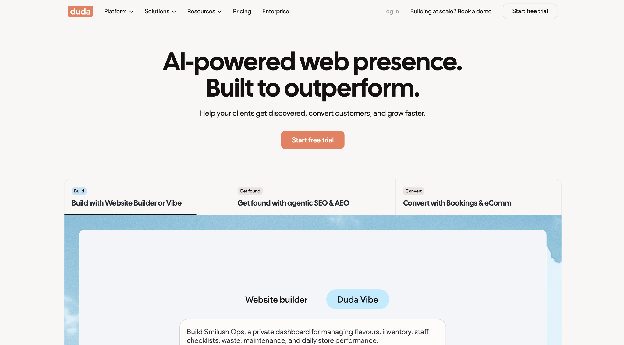
The client-management layer sits below the rebranding controls. It includes custom roles, in-editor Site Comments, and a content collection flow where clients upload their own text and images.
Duda is a site builder first, so its client tooling assumes the deliverable is a site the client edits and updates. Agencies reporting campaign lift will need separate experimentation software.
Duda pros:
- Template fill with AI: "Populate Template with AI," released January 28, 2026, drops client-specific generated content into your own custom template inside the editor, with no API access required.
- Four rebrandable domain surfaces: The platform domain (the editor and dashboard URL, such as editor.example.com), the published site domain, the email domain, and auto-generated SSL are each configured separately, so the editor and the live site can both resolve to your domain.
- Granular client editing: Permissions run from editing every element, to simple tweaks only, to a view-only experience, set per site manager.
Duda cons:
- A/B testing is not a listed feature: Duda's features, pricing, and agency pages do not mention A/B testing, so treat it as unavailable; agencies that promise conversion experiments should plan on a separate testing product.
- Branded template gallery requires custom pricing: Clients cannot browse templates under your brand with the standard rebranding package.
- Email white-labeling has exceptions: Duda's help center documents that membership, e-commerce, and auto-reply emails continue to send from multiscreensite.com, Duda's default system domain, even with white-labeling.
What users say about Duda
Reviewers agree that Duda ships sites fast, and disagree over how much design control it leaves:
- Production volume: One agency describes launching around 20 sites a month, and credits the drag-and-drop editor with letting non-technical staff ship without help.
- Client tooling replaces other tools: Content collection forms, in-editor commenting, and client logins replace separate intake and approval software.
- Rigid layouts: Customization limits are the most frequent complaint G2 reviewers raise; very specific visual changes need workarounds, and highly custom builds are described as a poor fit.
- Pricing surprises: Reviewers report per-site prices rising after they committed to white-label, and some integrations require a higher tier than they expected.
User sentiment sourced fromG2, Capterra andRedditdiscussions. Sources checked September 2026.
Duda pricing
Duda's White Label plan costs $199 per month (or $149 per month billed annually) and includes four published sites and six team seats.
At the lowest level, the Basic plan is $25 per month ($19 per month billed annually), for one site and no team seats. The Team plan is $39 per month ($29 per month billed annually) with three seats. And the Agency plan is $69 per month ($52 per month billed annually) with four sites and six seats.
None of those three include white-labeling. Each additional published site costs $19 per month on Basic and $17 per month on the other tiers. For API access, template-gallery branding, and advanced white-labeling, you’ll need to move to the quote-priced Custom plan.
The 14-day trial needs no credit card and includes the White Label feature set.
Best for: Pay-monthly website and landing-page services for local and SMB clients who need to see one brand from login to invoice, and whose reporting promise is traffic and uptime. Agencies with fewer than four client sites can start with the client-management tools and add the rebrand when the roster justifies it.
2. GoHighLevel
GoHighLevel is an all-in-one sales, marketing, and customer relationship management (CRM) platform built to help agencies and small businesses replace multiple disconnected software subscriptions. The landing page builder is one module among many, and the packaging is why agencies buy it.
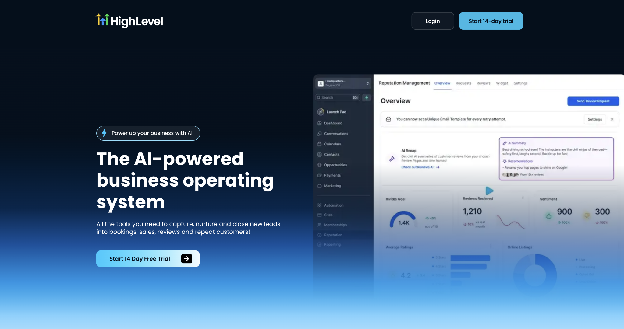
White-labeling covers the desktop app on a custom domain, and a white-label mobile app is a separate add-on outside the enterprise package. The page builder is the suite's main limitation. PPC clients that judge pages on precise visual control and load times may require custom CSS work that a dedicated builder avoids.
GoHighLevel pros:
- SaaS Mode rebilling: The platform can automate sub-account creation and rebill usage with your own markup through Stripe. Simvoly documents wholesale-versus-retail markup, while Duda, Landingi, Instapage, Unbounce, and Leadpages do not document automated rebilling with markup.
- Unlimited sub-accounts without seat fees: Higher subscriptions add clients without a per-client charge (unlike Simvoly's per-project wholesale fee or Duda's per-site fee).
- Funnel AI from a brief: Funnel AI generates each funnel section from a business name, niche, goal, audience, and offer in about 40 seconds.
GoHighLevel cons:
- Vendor branding appears before setup: New funnels publish on a .hlpages.co suffix, and emails are sent from mg.msgsndr.com until you configure a branded domain and a dedicated sending domain. Agencies must complete those steps before clients receive a fully branded experience.
- Variable AI costs: Conversation AI, Voice AI, and Reviews AI bill per token or through a per-location add-on on top of the subscription, so AI-heavy client accounts are hard to price in advance.
- The entry subscription caps sub-accounts: A fourth client forces an upgrade to a subscription with unlimited sub-accounts.
What users say about GoHighLevel
Agency owners on G2 and Capterra, and reviewers in r/agency and r/PPC, praise the bundle and criticize the pages it produces:
- Consolidation is the draw: CRM, automation, sub-accounts, and funnels in one place replace several subscriptions, and one agency user in July 2025 rated the automation builder ahead of n8n.
- White-label as a revenue line: Reddit agency users describe SaaS Mode with markup on SMS, email, and AI as a genuine revenue source, and say the mid-tier subscription is enough for basic white-labeling.
- Page output quality: Funnels are described as flat, code-heavy, and dependent on custom CSS for precise placement; PPC users report PageSpeed Insights scores below 50 despite repeated tuning.
- Support and reliability: Customer service ties with ease of use as the lowest of Capterra's four sub-scores, and r/agency threads recount outages, including one where every client site lost its images at once.
Sources checked September 2026.
GoHighLevel pricing
GoHighLevel offers a Starter plan at $97 per month, an Unlimited plan at $297 per month, and an Agency Pro plan at $497 per month. Annual billing is published as a yearly total rather than a per-month equivalent: $970, $2,970, and $4,970, respectively.
The Starter plan includes three sub-accounts and all core features. The Unlimited plan adds unlimited sub-accounts, the white-label desktop app, and basic API access.
The Agency Pro tier adds SaaS Mode, automated sub-account creation, rebilling with markup, and advanced API access. The Enterprise plan is quote-priced and includes the white-label mobile app, which is otherwise a $ 497-per-month add-on. Usage charges for phone numbers, SMS, email, and AI are billed separately.
The AI Employee Unlimited add-on is $97 per month per location, and the Branded Client Portal App is $49 per month per sub-account. The 14-day trial gives full access to the chosen tier.
Best for: Choose GoHighLevel for an ongoing retainer for local service businesses where the landing page is the top of a funnel the agency also runs, including follow-up texts, review requests, booking, and pipeline management. It also fits agencies that want to sell the platform as software with their own monthly price.
3. Simvoly
With Simvoly, the agency sets the client's price while the platform supplies a website and funnel builder, CRM, email, SMS and WhatsApp campaigns, e-commerce, scheduling, and communities.
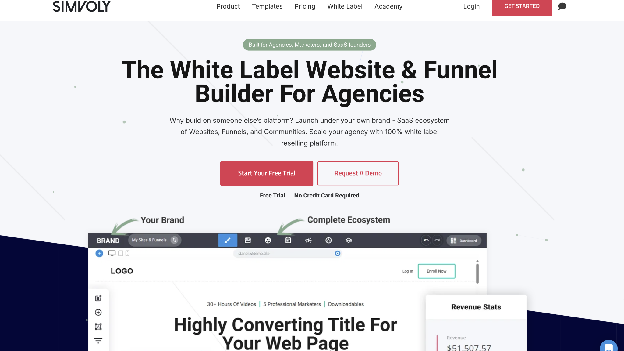
Every white-label subscription rebrands the builder dashboard with your domain and a Platform Skin, and extends that branding to your emails, API, and webhooks; higher subscriptions add an affiliate system on top. Because Simvoly has the lowest-priced entry into the full-rebrand group, you keep pricing, billing, and the client relationship for less upfront. However, its own comparison pages acknowledge less design control and shallower automation than some alternatives.
Simvoly pros:
- Published wholesale and retail prices: The reseller page lists what you pay per project and the suggested retail price, so per-client margin is visible before your first sale.
- Rebranding begins with the lowest white-label subscription: Custom domain, Platform Skin, branded emails, and API access are included without requiring several preliminary subscriptions.
- CRM, funnels, and email inside client projects: Eligible projects include a tag-and-segment CRM, funnels with upsells and bump offers, and subscriptions, so lead-gen clients do not need a separate CRM.
Simvoly cons:
- Email volume is metered: Subscriber capacity is a paid add-on that scales with list size, so an email-heavy client raises your cost independent of the project fee.
- Automation depth: Simvoly's own GoHighLevel comparison concedes weaker multi-branch automation, so complex nurture workflows are a poor fit.
- Design control: The editor exposes fewer layout controls than Landingi's, so design-led pages need workarounds.
What users say about Simvoly
Simvoly has no G2, Capterra, or Gartner Peer Insights listing, so evidence comes from AppSumo buyer reviews and the r/SaaS threads where resellers compare white-label platforms:
- Scope for the money: Websites, funnels, forms, email, e-commerce, CRM, and scheduling in one product is the most-cited reason to buy.
- Reseller traction: In an r/SaaS thread, the company calls white-label its biggest success and cites thousands of reseller partners, and AppSumo reviewers confirm the rebrand works on the subscriptions they bought.
- Per-user and per-site pricing: Two separate r/SaaS threads in 2024 criticize how costs scale with users and sites, and commenters steer readers toward GoHighLevel's flat fee instead.
Sources checked September 2026.
Simvoly pricing
Monthly pricing begins with the WL Basic plan at $69 per month (or $59 per month billed annually) and includes one project (two websites and ten funnels). The WL Advanced plan is $149 per month (or $129 per month billed annually) with one project of five websites and unlimited funnels. The WL Ultimate plan is $497 per month (or $429 per month billed annually) and includes one project with unlimited websites and funnels. Additional client projects are billed wholesale by tier.
A Starter project (one website or community) is $8, $7, or $5 per month on the Basic, Advanced, or Ultimate plans, respectively, and a Premium project (one website, ten funnels, and e-commerce) is $25, $22, or $15 per month. The Elite and Ultimate project tiers add more websites, funnels, and e-commerce capacity at higher wholesale rates: an Elite project is $55, $50, or $35, and an Ultimate project is $195, $180, or $100, against the $195 retail price Simvoly suggests you charge.
Email is an add-on starting at $9 per month for 500 subscribers and $19 per month for 1,000, up to $1,499 per month for 500,000. The 14-day trial per project needs no credit card, annual plans carry a 14-day money-back guarantee, and monthly plans are non-refundable.
Best for: The reseller model fits a productized "site plus funnel plus CRM" subscription for many small clients when the agency wants to set the price. The published wholesale project fee and suggested retail price make the spread visible. The fit weakens when clients run large email lists inside the platform or expect bespoke design.
4. Landingi
Landingi combines a landing-page-only platform with two AI systems for agencies that ship many campaign pages a month: Solis, launched January 2026, reads page design and visitor behavior for EventTracker users and suggests changes.
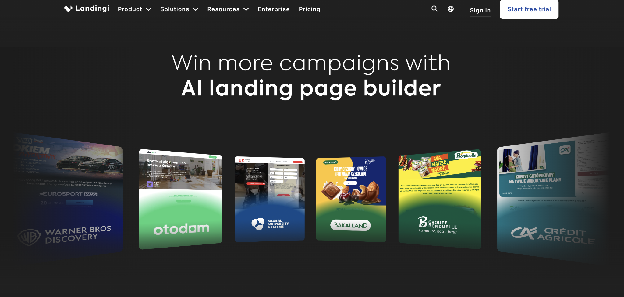
The platform has no CRM or email broadcast, and client sub-accounts, agency branding, and programmatic pages are grouped in a higher subscription.
Your logo replaces Landingi's for clients, and there’s a custom login page, but that login lives at a path under new.landingi.com instead of your own domain. This places Landingi below Duda, GoHighLevel, and Simvoly for rebranding depth. In return, Landingi provides testing and behavior data that full-rebrand tools don't sell.
Landingi pros:
- AI generation on every paid subscription: Lunar generates full pages from a prompt on the entry subscription with credit limits, and the May 2026 Edit Mode lets you hand-edit generated pages without re-prompting.
- Agency tools are packaged together: Unlimited active landing pages, client sub-accounts, Programmatic Landing Pages (bulk pages from one dynamic layout), and agency branding arrive in the same subscription.
- Behavior data precedes agency branding: Server-side A/B tests plus EventTracker heatmaps, scroll maps, and micro-conversion tracking are available before the rebranding tools.
Landingi cons:
- No overage path on traffic: Each subscription's visit allowance is a hard ceiling, so a client campaign that spikes stops serving rather than billing extra, while Leadpages sells plans without caps.
- Nothing after the form: With no built-in CRM or email broadcast, every lead handoff depends on an external tool and a working connector.
- MCP access is gated to the top self-serve tier: The Orbit Model Context Protocol (MCP) Server is available only on Landingi's Scale plan. At the same time, Unbounce exposes its MCP server during the trial, and Leadpages includes one on its lower-cost publishing line.
What users say about Landingi
PPC agencies converge on Smart Sections and diverge sharply on price:
- Smart Sections save hours: Updating a header or offer once across many pages is called a killer feature for agencies, and growth-agency users on Reddit report hours saved per update cycle.
- Integrations hold up: GA4, Meta, HubSpot, Google Sheets, WhatsApp, and Google Tag Manager are reported to connect without hacks, though some G2 reviewers hit apps with no native connector.
- Pricing experiences split: A Capterra reviewer praises price stability against rivals, while an r/PPC poster reported a 415% subscription increase in 2024 after usage caps arrived.
- Editor rigidity: A user who switched from Unbounce found the editor more rigid for advanced customization, and an April 2026 r/PPC commenter advises testing it before committing.
User sentiment sourced fromG2, Capterra andRedditdiscussions. Sources checked September 2026.
Landingi pricing
Landingi lists both monthly and annual pricing, and states that annual billing includes two months free compared with monthly billing.
The Build plan is $29 per month (or $24 per month, billed annually) for 10 active pages, 2,000 visits, 1 domain, and 5 users. The Optimize plan is $149 per month (or $119 per month, billed annually) for 100 pages, 30,000 visits, 3 domains, server-side A/B testing, and EventTracker.
The Scale plan is $299 per month (or $229 per month, billed annually) and includes unlimited pages, 100,000 to 500,000 visits, 10 domains, unlimited users, sub-accounts, agency branding, and Programmatic Pages.
The Enterprise plan starts at $1,499 per month (or $1,199 per month, billed annually) and adds single sign-on (SSO), audit logs, and 100 domains.
Traffic caps are hard limits. Extra AI credits cost $15 for 5,000, $25 for 10,000, and $40 for 20,000, and each extra domain is $5 per month. The 14-day trial is capped at 200 visits.
Best for: Landingi fits PPC and growth agencies that ship many campaign pages per client, want programmatic keyword variants, and can accept a Landingi-branded login URL in exchange for server-side testing and behavior data. Agencies whose clients never log in avoid the login caveat entirely.
5. Instapage
With Instapage, each paid ad can connect to its own page, which then measures which version wins. Its AI Experiments feature shifts traffic to winning variants. The platform is designed to improve conversion rates across paid acquisition campaigns and manages clients through workspaces. On white-labeling, Instapage provides no documentation on removing its name from the dashboard.
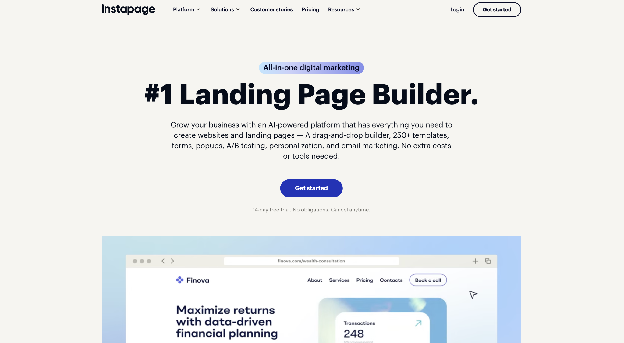
Four permission levels (Viewer, Editor, Manager, Owner) cover client access. Instablocks lets one block update propagate across hundreds or thousands of pages with a click, helping an agency keep a legal footer or offer consistent across a client roster.
Many agency features require custom pricing. And ad-to-page personalization, heatmaps, global elements, root-domain publishing, and a dedicated customer success manager (CSM) aren't available on published self-serve subscriptions.
Instapage pros:
- Server-side testing without flicker: The testing system runs multiple variants server-side and changes traffic splits with no page-load delay, a technical step above client-side testing tools.
- AdMap keeps ads and pages in sync: Two-way synchronization with advertising platforms shows which page each ad points to, so a PPC agency can audit ad-to-page match across an entire account.
- Programmatic pages from a CSV: Collections, added April 30, 2026, create and update a set of pages from a connected content table, with page allowances that vary by subscription.
Instapage cons:
- AI traffic routing requires custom pricing: Self-serve agencies cannot access AI Experiments, while Unbounce and Leadpages sell AI routing through published subscriptions.
- Visitor ceilings on both self-serve subscriptions: Unique-visitor allowances cap both published options. Instapage documents no way to buy past the limit, while Unbounce bills overages as a one-time charge.
- White-labeling is undocumented: Neither branding removal nor per-subscription sub-account counts appear on Instapage's plans or feature pages, so you cannot confirm what a client will see without a sales call.
What users say about Instapage
Price is the complaint that recurs most across Instapage's G2 reviews and the r/PPC agency threads, while the editor and template reuse garner the praise:
- Reusable blocks across clients: Saving and replicating sections across campaigns is credited with rapid multi-client deployment in a 2026 r/PPC agency thread.
- Page speed for Quality Score: PPC users describe Instapage as focused on page speed and tie that directly to Google Ads Quality Score.
- Enterprise repositioning: The most common Reddit complaint is price; users describe leaving after increases aimed at the enterprise market, and one was quoted an enterprise price far above the self-serve subscriptions.
- Editor gaps: No tablet view, no image rotation on the canvas, incomplete multi-step form components, and manual alignment in the mobile builder recur across G2 reviews.
Sources checked September 2026.
Instapage pricing
The self-serve plans include Create at $99 per month ($79 per month billed annually) with 15,000 unique monthly visitors, 10 team members, and one workspace, and Optimize at $199 per month ($159 per month billed annually) with 30,000 to 50,000 visitors, five workspaces, server-side A/B testing, dynamic text replacement, multi-step forms, and scheduling.
The Convert plan is custom-priced and includes ad-to-page personalization, heatmaps, global elements, root domain publishing, a CSM, SSO, audit logs, and a 99.9% uptime SLA. The 14-day trial requires a credit card and is capped at 2,500 unique visitors.
Best for: Larger paid-media agencies serving enterprise advertisers can use Instapage when they need account-level ad-to-page personalization and have procurement teams that ask about SOC 2 Type II and an uptime SLA. Agencies using the self-serve subscriptions must plan around visitor caps.
6. Unbounce
Using location, timezone, device, browser, and OS, Unbounce routes each visitor to the variant most likely to convert. Its MCP server lets you pull reports or switch Smart Traffic on from Claude or ChatGPT, and the pages come from a drag-and-drop builder. Client accounts keep projects, domains, and users separate.
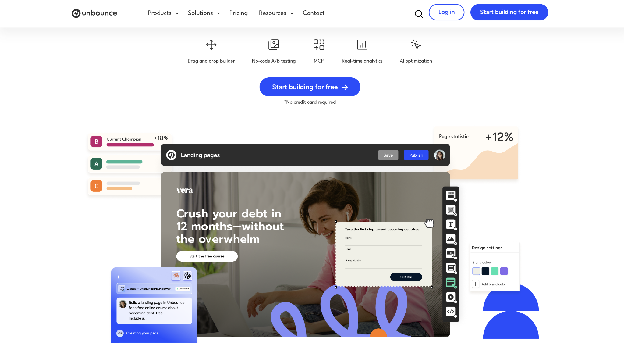
Unbounce supports agency workflows while leaving its own branding in place. Published subscriptions include no branding-removal controls. The contact-sales agency package adds a partner directory listing, implementation services, and a dedicated CSM.
The pricing page lists sub-accounts under that package, while the help center lists client accounts on self-serve subscriptions, so agencies should confirm availability with sales.
Unbounce pros:
- Smart Traffic ramps fast: Unbounce states routing begins improving results in as few as 50 visits, a fraction of the sample a manual A/B test needs.
- MCP is broadly available: Traffic source, conversion rate, and lead volume reports are pullable from an AI assistant, including during the trial.
- Client accounts on self-serve subscriptions: Unbounce's help center states you can add as many clients as you like on its published subscriptions, each with viewer, author, and admin roles.
Unbounce cons:
- Testing and AI routing are split across subscriptions: The first subscription with A/B testing lacks Smart Traffic, so agencies must move higher to combine both capabilities. Landingi puts server-side testing in its second subscription tier.
- Overage charges sit on top of the subscription: Traffic past a visitor allowance bills as a one-time charge, so a client campaign that spikes costs more than the subscription price.
- Certifications stop at SOC 2 Type I: Unbounce's security page lists SOC 2 Type I and states that any certification absent from the list is unavailable. Compliance-sensitive clients cannot obtain ISO 27001 or SOC 2 Type II coverage from Unbounce.
What users say about Unbounce
Marketers reviewing Unbounce on G2 and Capterra, plus posters in r/marketing and r/PPC, credit the builder and blame the invoice.
- No-code launches: Marketers publish without developers, and the visual editor is described as far more intuitive than HubSpot's.
- Testing for paid search: Per-page split-test reporting is called a huge benefit for clients with large monthly ad budgets.
- Price escalation with higher usage: Cost growing with usage is the most consistent Reddit complaint, and value for money is the weakest of Capterra's four sub-scores.
- Mobile editing friction: Desktop edits do not carry over to mobile, and absolutely positioned markup makes mobile load scores hard to improve.
Sources checked September 2026.
Unbounce pricing
The Starter plan costs $29 per month ($22 per month billed annually) and is limited to five pages, 500 visitors, one user, and one domain. The Build plan costs $99 per month ($74 per month billed annually) and includes unlimited pages, 20,000 visitors, and in-builder AI copy. The Experiment plan is $149 per month ($112 per month billed annually) for 30,000 visitors, three users, two root domains, A/B testing, and dynamic text replacement.
The Optimize plan is $249 per month ($187 per month billed annually) for 50,000 visitors, five users, three domains, and Smart Traffic. The Concierge (from 100,000 visitors, 15 users) and Agency (from 50,000 visitors, 10 root domains, dedicated CSM) plans are priced via a sales call. The 14-day trial requires no credit card.
Best for: Performance agencies that get judged on conversion lift, small traffic samples that need AI routing, and leads that must flow natively into Salesforce or Marketo. The contact-sales agency package is useful when the partner directory listing and CSM matter to your pipeline; it does not change what the client sees.
7. Leadpages
Describe a page in Leadpages chat and a branded, mobile-responsive result arrives in about 60 seconds, with logo, colors, fonts, and tone pulled from the client's URL. Manual A/B testing is available in the conversion line. At the same time, the highest-subscription plans include scroll and click heatmaps, rebuilding the losing section with AI, and launching the revision as a new test.
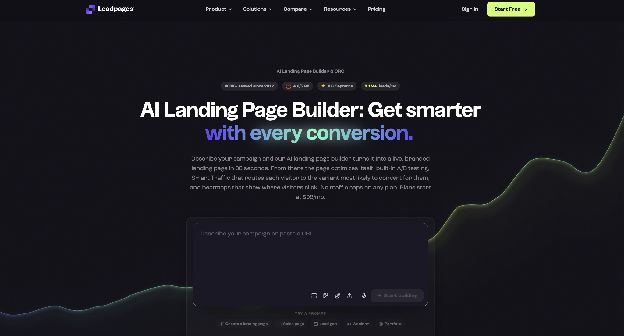
Leadpages removes its branding from client-facing assets while keeping it in the dashboard. The agency page says all client-facing assets are brand-clean on custom domains, and the "Powered by Leadpages" banner is removed on paid subscriptions.
Its free partner program includes a "White-Label Pages" track for agencies that build and manage pages under their own brand. Workspaces, audit logs, and a dedicated CSM are limited to the highest self-serve subscription.
Leadpages pros:
- Brand kit from a URL: Paste a client's URL and the AI extracts the logo, colors, fonts, and tone, so every generated page matches without manual style setup; subscriptions include 3 to 10 brand kits.
- No traffic caps: Leadpages subscriptions have no traffic caps and no overage fees, unlike the visitor limits on Unbounce and Instapage.
- MCP publishing to your domain: Pages publish from Claude, ChatGPT, Cursor, or any MCP-compatible assistant straight to a custom domain, including through the lower-cost publishing line.
Leadpages cons:
- Workspaces require the highest self-serve subscription: Lower subscriptions cannot separate clients into distinct workspaces, whereas Unbounce's help center lists client accounts on its self-serve subscriptions.
- Integration caps vary by subscription: An agency stack with a client's CRM and two ad platforms can quickly approach the entry conversion subscription's limit.
- No team seats on the entry conversion subscription: Any multi-person agency must move to a higher subscription.
What users say about Leadpages
G2 reviewers and posters in r/marketing and r/smallbusiness treat Leadpages as the low-friction option and question its depth.
- Hardly any learning curve: Visual editing and drag-and-drop sit at or near the top of G2's feature ratings for Leadpages, and Reddit users describe it as the easiest to start with.
- Conversion guidance built in: The template library sorted by historical conversion rate and the Leadmeter real-time conversion score are singled out as decision aids.
- Support gated by tier: Reviewers describe support as effectively unavailable unless you pay for a higher subscription, and report unexpected renewal charges.
- Testing depth: A/B testing is the lowest of G2's Leadpages feature scores, and an r/Entrepreneur poster found testing across several brands uneconomical at Leadpages' price points.
Sources checked September 2026.
Leadpages pricing
Leadpages sells two lines: HTML Pub by Leadpages costs $5 per month for the Starter plan (5 pages, 1 domain), $15 per month for the Pro plan (25 pages), and $25 per month for the Business plan (50 pages, 2 domains). None of the HTML Pub plans include A/B testing.
The Leadpages conversion line starts with the Grow plan at $50 per month, covering unlimited pages, 4 domains, two-variant manual A/B testing, 5 integrations, and 2,000 IP enrichments.
The Optimize plan is $100 per month and includes 6 domains, Smart Traffic, heatmaps, four-variant tests, and 3 seats. The Scale plan is $200 per month and includes 10 domains, the full automatic testing loop, workspaces, audit logs, 10 seats, and a dedicated CSM.
Best for: Small agencies and freelancers running lead-generation retainers for a handful of clients can use Leadpages when clients never log in, making dashboard branding irrelevant, and traffic swings enough that no-cap pricing matters. Agencies reselling a client-editable page product under their own brand should choose a platform with editor and dashboard rebranding.
How to choose the right white-label landing page builder
Choose based on the client workflow before comparing secondary features. A client who edits pages needs a different platform from one who receives finished pages and reports.
Here are the right questions to ask:
- Will clients log in, and what must they never see? If clients edit their own pages, check whether the editor can use your domain and whether the vendor appears in the login URL. If clients only receive finished pages and reports, dashboard branding matters less.
- Is your deliverable a page or a conversion rate? Agencies that report lift need server-side tests, traffic routing, or automatic retesting. Agencies that deliver editable sites should prioritize permissions, content collection, and a branded editor.
- How will you bill clients? Flat platform fees make the next client easier to forecast, while per-project wholesale fees expose the margin on each account. Per-site billing fits agencies whose published site count stays close to the subscription limit.
These platforms bundle hosting, SSL, and platform updates into the subscription. A self-hosted stack puts hosting, certificates, plugin updates, and staging on your team for every client site, and that cost never appears on a vendor's pricing page.
Build brand-forward client sites on Webflow and hand off billing without a rebuild
If your agency's product is a designed marketing site with campaign pages attached, and the client expects to own it when the engagement ends, the handoff matters more than full interface rebranding.
Webflow is a visual website platform where designers and marketers build on the Designer canvas, manage content in a structured content management system (CMS), and publish to managed hosting without a developer queue.
Webflow also announced Campaigns at WebflowConf in September 2026. With Webflow Campaigns, an agent reads a live site URL, whether Webflow-built or external, extracts colors, fonts, and interface elements into a brand system, and refines your brief by audience and channel.
Campaigns then generates the main landing page, variants by audience, target account, or keyword, and the associated ad creative. Deployment covers Google Ads, conversion tracking, and HubSpot or Salesforce pipeline measurement. Leadpages, Landingi, and GoHighLevel generate pages from a prompt; Campaigns also generates variants and ad creative in the same workflow.
Build a first client site on the free plan and start a Webflow Workspace when the roster justifies client payments.

Unlock growth with SEO
Join Webflow and leading growth agency Graphite as they discuss actionable insights for scaling and achieving growth with SEO
Frequently asked questions
How much does a white-label landing page builder cost?
Published entry prices in this list run from $5 per month for Leadpages HTML Pub Starter to $1,199 per month when billed annually for Landingi Enterprise. The lower endpoint covers five pages and one domain without A/B testing. The upper endpoint adds single sign-on, audit logs, and 100 domains. Costs rise with client projects, traffic overages, email volume, extra domains, AI usage, and mobile-app add-ons, so the subscription price alone does not show the effective per-client cost.
What is the difference between an agency plan and a white-label plan?
An agency plan adds multi-client management features such as sub-accounts, team permissions, or separate workspaces. A white-label plan also removes or replaces the vendor's identity across client-facing surfaces. Published-page badge removal does not mean the login, editor, dashboard, emails, and preview URLs carry the agency's brand.
Can ChatGPT build a landing page?
ChatGPT's Canvas can draft copy and generate HTML for a landing page concept. Publishing, custom-domain setup, brand controls, form storage, A/B testing, traffic routing, CRM connections, and conversion tracking require a builder or additional services. Leadpages can publish from ChatGPT through MCP, while Unbounce lets an AI assistant retrieve reports and control Smart Traffic.
What is the best website builder for agencies?
The best fit depends on the service the agency sells. Duda emphasizes branded client editing, GoHighLevel and Simvoly combine pages with CRM-backed funnels, and Instapage, Unbounce, and Leadpages emphasize campaign testing. Webflow fits designed marketing sites where client billing and ownership transfer matter more than an agency-branded interface.
Do clients see the vendor's name in emails and page URLs?
They can if you leave the default sending or publishing domains in place. Before launch, send a test form submission to your own inbox, inspect the From and Return-Path fields, and open every login, preview, and published URL in a private browser window. Repeat the check after domain or email settings change.
Can you transfer a client's landing pages to them when the engagement ends?
Transfer support varies by vendor. Webflow can move a site with an active plan to the client's card and Workspace while preserving its settings, custom domain, and indexing. If a platform offers continued access instead of ownership transfer, keep each client's pages, domains, integrations, and assets isolated so you can separate the account without rebuilding the campaign.

Choose the right CMS for a scaling enterprise
Discover how the right CMS can allow teams to efficiently scale rich, complex content – all without writing code.