



Matching content to your prospect’s current funnel stage can make the difference between ‘yes’ and ‘maybe later.’
A typical consumer might only need one compelling advertisement to buy a product or sign up for a service. In B2B settings, a purchase goes through multiple teams and stakeholders, taking months of meetings to define the problem, compare solutions, and choose the best fit.
Matching your content to the B2B marketing funnel stages your buyers move through puts them on a clear, pre-set track that ends in a sales contract.
This article breaks down the five modern stages of the B2B marketing funnel, the content that fits each stage, and how to use the whole funnel to fuel conversions.
Why your B2B marketing funnel matters
The B2B marketing funnel helps guide your marketing team through the long sales cycles that are typical in B2B. It clarifies what kinds of actions are most likely to catch a visitor’s attention and the types of content it takes to convince them to purchase your product or service rather than the competition’s.
In short, the funnel helps ensure that the content you serve prospects matches their current place in the buyer’s journey. Without it, you might push too early, like asking for a 15-minute chat after someone left a comment on the company’s LinkedIn post. You also risk missing signals that a prospect is ready to convert, like handing them another how-to guide when they’ve already received pricing and package information.
Signs your B2B marketing funnel works include:
- High conversion rates. When every touch aligns with the visitor’s intent, the next step becomes easier.
- Strong leads. You meet prospects while they’re searching for answers, positioning your brand for their shortlist.
- Leads who are engaged long-term. Providing something useful at each step keeps your brand in mind throughout a long sales cycle.
- Aligned messaging. Instead of pitching a contract to someone still naming their problem, you give them the data that earns a high-stakes buyer’s trust.
- Materials ready for each stage. Someone fixing their invoicing system isn’t ready for your accounting packages, but you have a guide to invoicing best practices for their niche and tools that fits their needs.
What are the stages of the B2B marketing funnel?
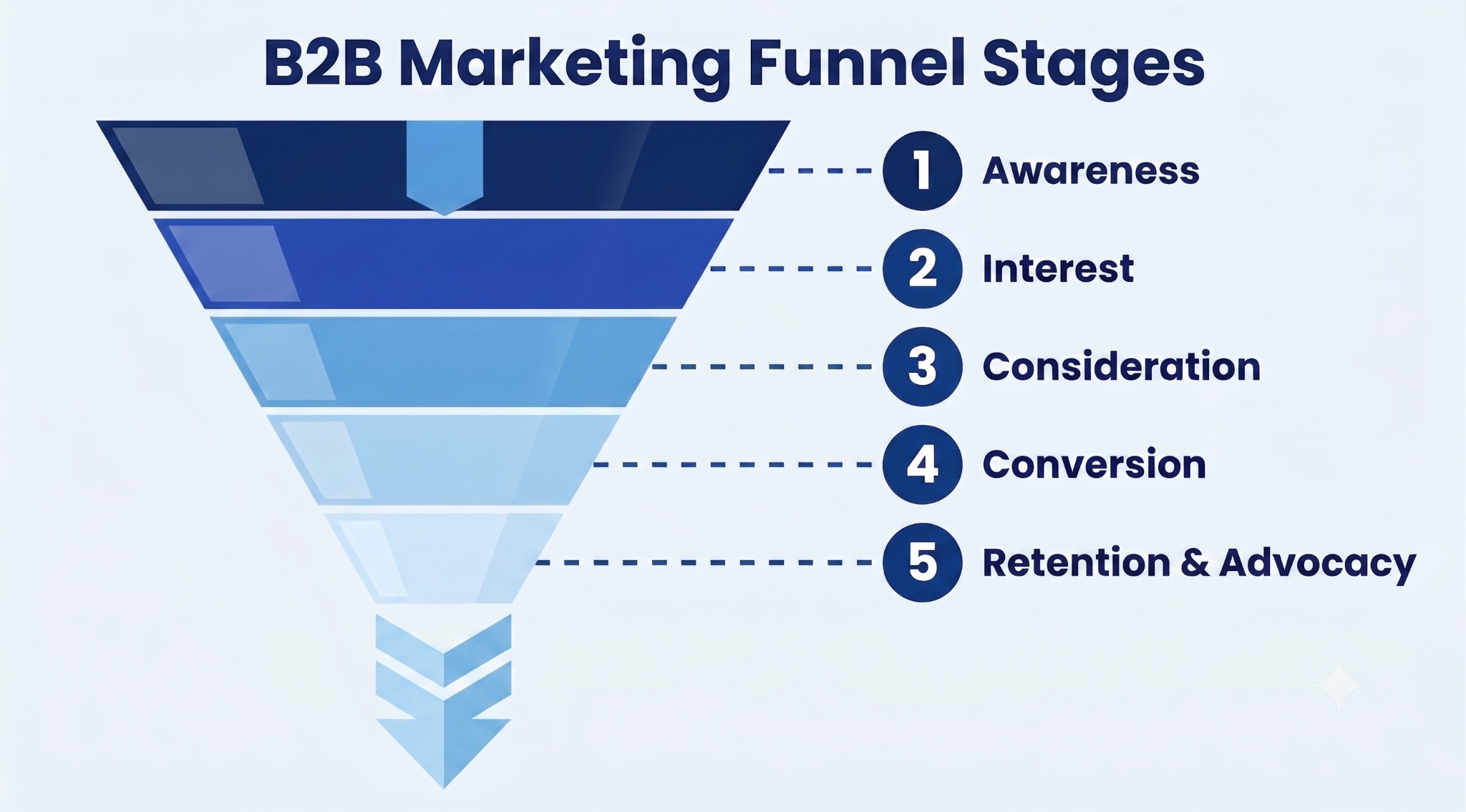
With longer sales cycles and bigger buying committees, the B2B marketing funnel has expanded over time. It includes five stages:
- Awareness or top of funnel (TOFU)
- Interest and consideration or middle of funnel (MOFU)
- Evaluation and intent (mid-to-bottom of funnel)
- Decision and purchase or bottom of funnel (BOFU)
- Retention and advocacy (post-purchase)
Here are the B2B marketing funnel stages, explained alongside what your goals, prospect’s mindset, and calls to action (CTAs) look like in each.
1. Awareness (TOFU)
At the top of the funnel, a potential buyer senses a problem and starts searching for answers. They’re not looking for your solution, because they don't yet know they need one. Your content should help prospects name the problem, but it needs to capture a wide audience (and be genuinely useful) without leaning too heavily into branding:
- Industry guides and blog posts: Answers the broad problem they're searching for and establishes topical authority.
- Landing pages: Captures high-volume, problem-aware searches with strong search engine optimization (SEO).
- Social posts: Improves brand awareness by introducing your content to a broader audience (often with a CTA to learn more).
A buyer this early in the funnel won't book a demo or a consultation, and asking them to will only push them away. They move deeper into the funnel if there’s a reason to come back, such as a newsletter subscription, a follow on LinkedIn, or a click through an internal link.
2. Interest and consideration (MOFU)
In the second stage, your prospective buyer gathers information about your brand. They see how your offering could potentially solve their pain points. Content that works here includes:
- Case studies: Shows you've solved this exact problem for similar companies.
- Comparison guides: Breaks down the approaches and tools they're evaluating in detail.
- Webinars and gated templates: Demonstrates your work in practice.
This stage is where social proof can convert a known lead. Give a visitor evidence that your offering has worked for other people, and they’ll be more likely to move with you toward evaluation.
3. Evaluation and intent (mid-to-bottom of funnel)
By the time you reach mid-to-bottom of the funnel, your content has done its job to catch prospects’ interest. They’ve likely brought information about your offering to the broader team and stakeholders, who all weigh in with domain-specific questions.
Evaluation content has to lean on rhetoric to convince each part of the team:
- Technical documentation answers questions around your offering’s capabilities in practice for IT teams.
- Detailed customer success stories and testimonials showcase numbers that reassure finance the budget will stay balanced.
- An ROI calculator gives stakeholders figures that suggest your work will be worth the investment.

The future of marketing is now
Thought leaders from Silversmith, Accel and Webflow discuss the current and future impact of artificial intelligence on the marketing landscape
4. Decision and purchase (BOFU)
At the bottom of the funnel, the committee knows and generally thinks positively of your work. Even at this stage, you’ll still have questions to answer about pricing details or specific use cases, and proof that choosing you is the smart move.
Content that helps close the deal includes:
- Pricing and packages pages: Includes all relevant detail in transparent tiers, so the numbers are never a question.
- Product FAQs: Answers lingering common questions, so committee members can feel confident in their decision.
- Free trials or demos: Lets buyers see how your offering fits into their daily workflows.
5. Retention and advocacy (post-purchase)
A new client wants to get value from your product or service fast. Onboarding guides, tutorials, and certification carry the most weight here, when churn risk is at its highest.
In this stage, long-term goals shift from keeping clients to activating them and turning them into brand advocates. Advocates champion your business and refer you to their network, increasing your visibility without any extra effort (with the added bonus of built-in social proof). Invite them into a community, keep them current with product updates, and offer referral or partner programs.
Done well, the final stage of the funnel feeds the first one and creates a new source of leads.
How to develop a B2B marketing funnel: 5 steps
Here's a five-step framework for building a high-performing B2B content marketing funnel with a tracking system for continuous improvement.
1. Define your ideal customer profile
In order to capture a specific audience, you have to know who you’re addressing first. Consider the demographics, pain points, or decision drivers that you are already targeting in your B2B marketing strategy.
Your ideal customer profile should contain plenty of details about who these people might be, so you can research and develop the kinds of content that attract and hold those visitors’ attention.
Say you run an organization that sells an AI marketing assistant to small businesses. A blog post about how to generate leads from social media engagement may rank, and it’s likely to pull in young business owners and budding marketing teams. Without understanding your ideal customer, you won’t have a way to identify who the right segment is and connect with them to move them into step two.
2. Set conversion goals and success metrics
Tie B2B funnel stages to the signals that reflect progress. Here are some examples of website-specific conversion metrics you can track to get started.
3. Choose distribution channels
Great content that’s undiscoverable won’t convert anyone. Match each channel to where your buyers already exist:
- Organic and AI search: Awareness content earns its traffic by positioning your brand as an answer when buyers type their problem into a search engine or ask an LLM. Anchor here if your buyers research before they reach out.
- Linkedin and social media: You can build an individual, such as your CEO, into a thought leader to gain momentum and brand awareness through social media to create topical authority and get discovered between searches. However, it’s not as strong for direct response marketing.
- Email: The workhorse of the middle, email carries communication across a months-long decision cycle and is useful for sending reminders and segmented marketing campaigns to second and third-stage prospects.
- Video hosting sites: As another vehicle for content, sites like YouTube and Vimeo can host content for every stage, such as explainers for awareness, walkthroughs for comparison, and demos for decision-making. You can also embed videos into your website to keep prospects’ focus for longer.
- Webinars, events, and communities: Bringing people together increases the odds that a brand advocate will be able to support your pitch. Events are trusted, high-intent experiences into a focused audience, worth most when the purchase is large and relationship-driven.
- Retargeting: Ads can re-engage past visitors across the web, keeping you visible through the long gaps between touches.
4. Implement lead nurturing and automation
With so many touchpoints before a B2B deal closes, you can't move every lead by hand. Automation sends the content that answers prospects’ next question.
The logic is simple to map. Someone downloads a comparison guide, so a few days later, they get a case study in their email showing that approach working for a similar company. They open it and read the whole thing, which signals strong interest, so the next email the following week includes a CTA for a demo or a consultation. Go quiet for seven days, and a re-engagement email including insights from your last conference brings them back.
To run all this, you need your lead data in one place. An effective CRM or DPX tool keeps every interaction, note, and score on a lead in one place, so you can personalize B2B content to what that person did and where they are in the funnel.
5. Measure and optimize
Pull your stage metrics into one dashboard so you can see exactly where prospects drop off. Then, test one fix at a time, keeping what works and cutting what doesn't. That steady refinement turns a marketing funnel for B2B SaaS teams into an automatic process that improves your organization’s overall sales strategies.
Build high-performing B2B funnels with Webflow
Running a B2B marketing funnel across five stages is a lot to coordinate. It gets more manageable when all the important customer context lives in one place.
With Webflow’s agentic web marketing platform, you can publish and scale the right content for each stage, with built-in SEO and AEO tools to help the right buyers find you in search and LLM answers. Forms capture leads and sync into the tools like HubSpot and Marketo, so the right follow-up goes out the moment a prospect acts. Then, see your results on one dashboard with Analyze.
Host content for every stage of your funnel with Webflow.

Driving marketing team efficiency with AI
Your roadmap to smarter marketing workflows