



Whether you need a feature-rich DXP or a streamlined content tool, a modern solution empowers your team to ship campaigns faster, reduce overhead, and focus on high-impact customer experiences.
Most teams leave Sitecore for three reasons: cost, complexity, and delivery speed. Sitecore's real cost can balloon when you factor in licensing, a long implementation, and specialized developers, and marketers often depend on engineering for even routine changes.
Sitecore alternatives fall into three groups:
- A full digital experience platform (DXP) from a different vendor that matches Sitecore's scope, with similar cost and complexity.
- A composable, headless content management system (CMS) that hands the front end to your developers and trades built-in convenience for flexibility.
- A leaner, visual platform for teams whose Sitecore install is, in practice, a marketing and content website carrying enterprise overhead.
We cover them in that order: the full DXPs first (Optimizely, Adobe Experience Manager, Acquia), then the headless options (Contentful, Contentstack, Storyblok), and finally Webflow, the leaner visual alternative.
Key takeaways:
- For a full DXP replacement, Optimizely, Adobe Experience Manager, and Acquia match Sitecore most closely, at similar cost and complexity.
- For a composable, headless content backend, Contentful, Contentstack, and Storyblok hand the front end to developers in exchange for flexibility.
- Contentful and Storyblok publish some of their pricing; the full DXPs and Contentstack price by enterprise quote, like Sitecore.
- If your Sitecore install is really a marketing and content site, Webflow can deliver it faster and for far less.
The 6 best Sitecore alternatives at a glance
When comparing potential Sitecore replacements, consider these four critical factors:
- How close a replacement you need (i.e., a full DXP with personalization and commerce or a leaner content platform).
- Who builds and runs it (i.e., a large engineering team or marketers with less developer support).
- Price.
- The total cost of ownership (counting implementation and developer time as well as the license fee).
Below are the six most viable Sitecore alternatives, spanning traditional DXPs and modern headless CMS solutions, along with details about their respective architectures, required technical investment, and pricing:
| Tool | Best for | Type | Pricing | Standout feature |
|---|---|---|---|---|
| Optimizely | Enterprises wanting a direct Sitecore swap | Full DXP | Custom quote | CMS plus testing and personalization |
| Adobe Experience Manager | Enterprises already on Adobe | Full DXP | Custom quote | Deep DXP tied to Adobe tools |
| Acquia | Teams that want open-source Drupal | Full DXP | Custom quote | Drupal flexibility with enterprise support |
| Contentful | Developer-led teams going headless | Headless CMS | Free, then $300/month, billed monthly | Structured content for many front ends |
| Contentstack | Enterprises building a composable stack | Headless DXP | Custom quote | Composable, integration-first |
| Storyblok | Teams wanting headless plus visual editing | Headless CMS | Free, then €99/month ($115), billed monthly | Visual editing on a headless backend |
| Tool → Best for → Type → Pricing → Standout feature |
|---|
| Optimizely |
| Enterprises wanting a direct Sitecore swap |
| Full DXP |
| Custom quote |
| CMS plus testing and personalization |
| Adobe Experience Manager |
| Enterprises already on Adobe |
| Full DXP |
| Custom quote |
| Deep DXP tied to Adobe tools |
| Acquia |
| Teams that want open-source Drupal |
| Full DXP |
| Custom quote |
| Drupal flexibility with enterprise support |
| Contentful |
| Developer-led teams going headless |
| Headless CMS |
| Free, then $300/month, billed monthly |
| Structured content for many front ends |
| Contentstack |
| Enterprises building a composable stack |
| Headless DXP |
| Custom quote |
| Composable, integration-first |
| Storyblok |
| Teams wanting headless plus visual editing |
| Headless CMS |
| Free, then €99/month ($115), billed monthly |
| Visual editing on a headless backend |
Let’s first take a deeper look at direct Sitecore replacements (full-featured DXPs that match its scope and complexity) before moving to more flexible headless and visual options.
1. Optimizely
Optimizely is a full digital experience platform that combines a CMS with experimentation, personalization, and commerce capabilities. Of all the platforms here, it comes closest to a like-for-like Sitecore swap.
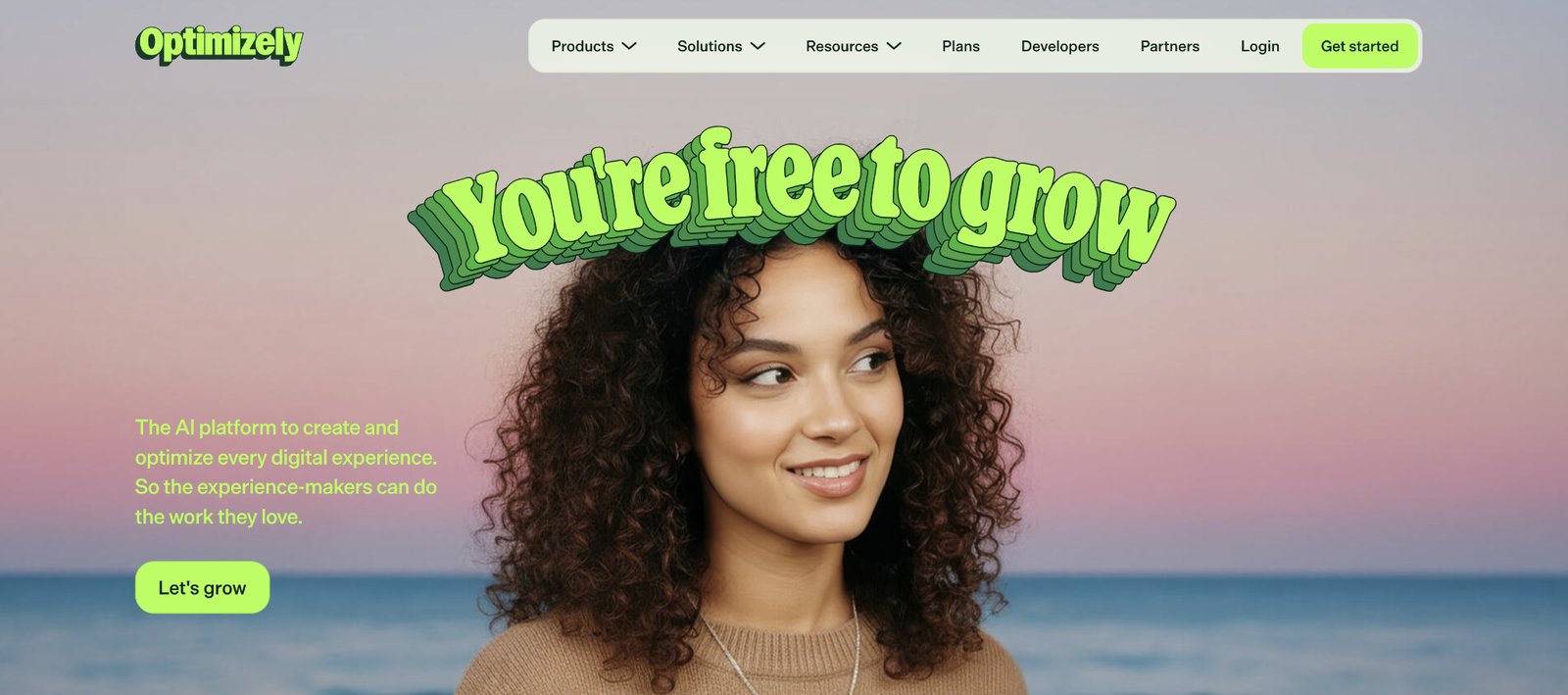
For teams that want Sitecore's breadth from a different vendor, it is the most direct move, and a top pick for enterprises that need the full DXP feature set. That breadth, though, comes at Sitecore-class cost and complexity: Optimizely is an enterprise purchase priced by quote, and standing it up takes a serious implementation.
Optimizely pros:
- A true DXP replacement: Nothing from Sitecore's core scope is lost in the move; personalization, testing, and commerce all come across.
- Experimentation built in: The testing and optimization engine is a category leader on its own, folding in capability conversion teams would otherwise buy separately.
Optimizely cons:
- Little cost relief: Because Optimizely matches Sitecore's scope, a move rarely lowers total cost of ownership. Teams switch for capability or contract terms, while the bill stays about the same.
- Broad suite, much of it optional: Optimizely bundles commerce and personalization that many teams never switch on. Part of the platform, and its cost, sits unused unless you need the full stack.
Pricing: Optimizely does not publish prices. It sells its DXP via custom quotes based on the products and scale you need, arranged through sales.
Best for: Enterprises that want a full DXP with strong experimentation, as a direct Sitecore replacement.
2. Adobe Experience Manager
Adobe Experience Manager (AEM) is the enterprise DXP for organizations already invested in Adobe, pairing a CMS with deep integration into Adobe's analytics, personalization, and creative tools. AEM sits at the top of the market alongside Sitecore.
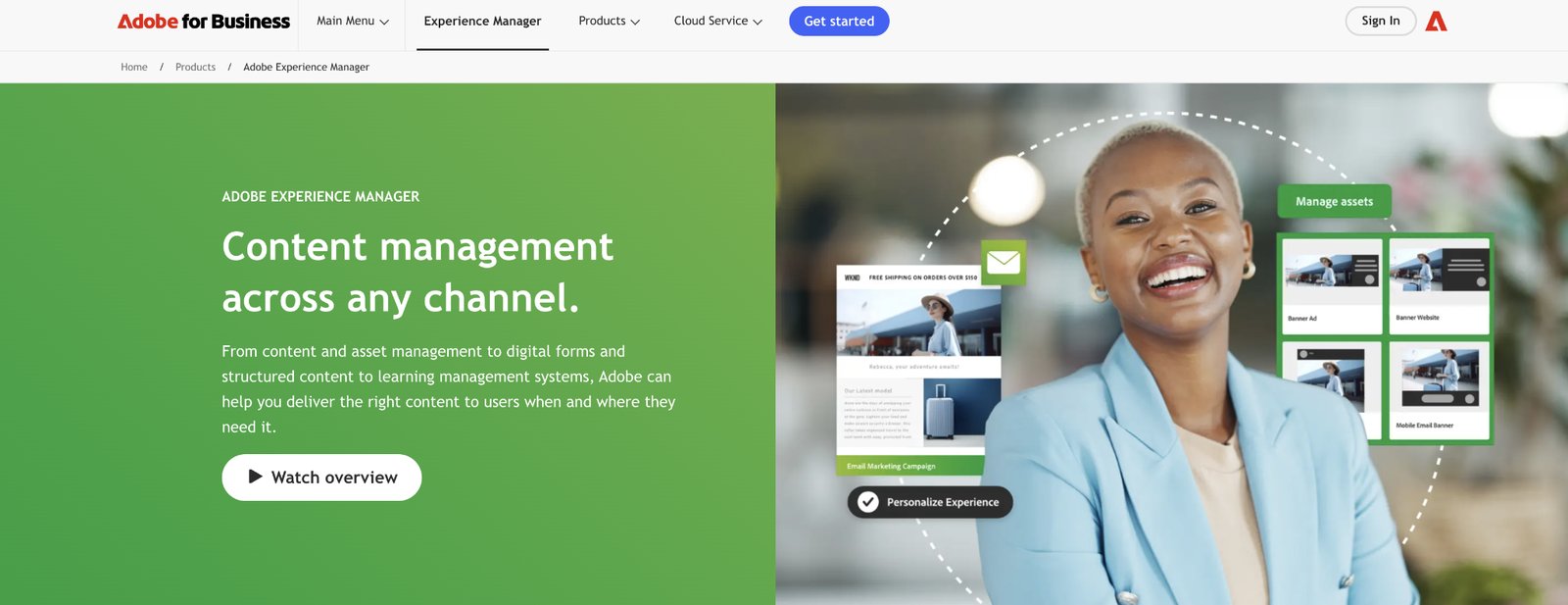
AEM makes sense for large enterprises already running Adobe Experience Cloud and wanting their CMS in the same stack. The tie-in to Adobe Analytics, Target, and Creative Cloud is the draw, and it handles complex, multi-brand, multi-region sites.
Among these platforms, AEM is the most resource-intensive to implement and the most expensive. Implementations are long and specialized, and the cost matches or exceeds Sitecore's.
Adobe Experience Manager pros:
- Deep Adobe integration: Because the CMS plugs straight into the rest of Adobe's marketing and creative stack, an Adobe shop skips the integration work of stitching separate vendors together.
- Built for scale and complexity: Multi-brand, multi-region sites are its home turf, with the governance controls large enterprises need, and leaner platforms cannot match.
Adobe Experience Manager cons:
- Only worth it inside the Adobe stack: AEM's value lives inside the rest of Adobe's Experience Cloud. A team not already invested there pays a top-of-market price for integrations it may not use.
- A narrow, pricey talent pool: Running AEM requires developers with Adobe's own certifications, a smaller and more expensive group than general web engineers, which slows both hiring and delivery.
Pricing: Adobe does not publish AEM pricing. It sells the platform as a custom enterprise quote through its sales team.
Best for: Large enterprises already on Adobe Experience Cloud that want their CMS in the same stack.
3. Acquia
Acquia is an open-source digital experience platform built on Drupal, which makes it an alternative for teams that want enterprise DXP capabilities without proprietary licensing on the content layer. You get Drupal's flexibility with Acquia's hosting, security, and support wrapped around it.
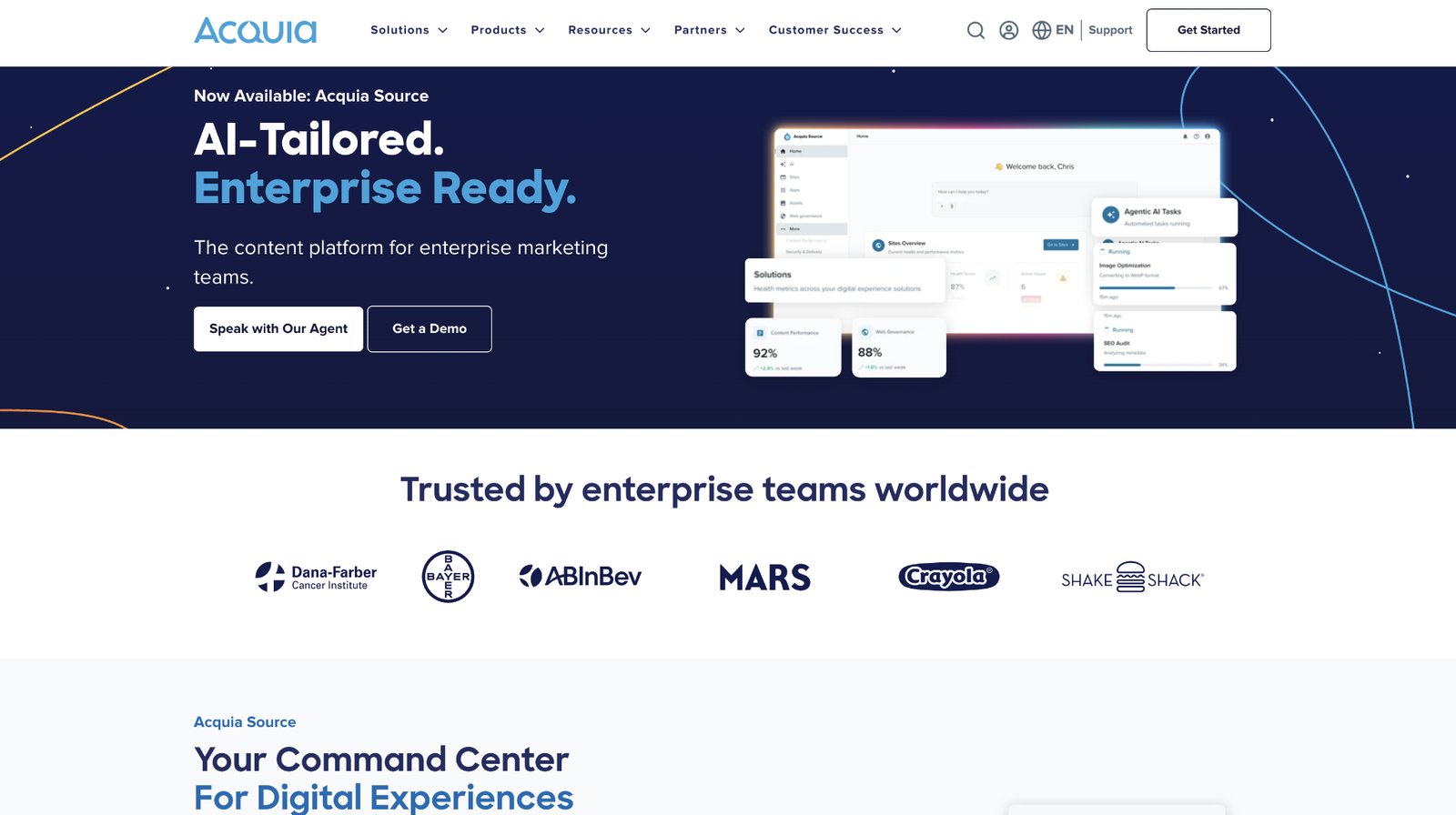
Acquia suits organizations that value open source and have (or can hire) Drupal talent. The open core avoids proprietary licensing on the CMS itself, and Acquia adds the enterprise cloud, personalization, and support that larger sites need.
That openness, though, comes with Drupal's developer overhead. Building and maintaining an Acquia site takes engineering, so marketing teams without developers move slower than they would on a visual platform.
Acquia pros:
- An open-source core: Drupal at the base means no proprietary CMS license. The content layer stays yours, and you can host it elsewhere if you ever leave.
- Enterprise Drupal, supported: Managed cloud, security, and personalization wrap around the open core, giving large organizations enterprise backing without surrendering Drupal.
Acquia cons:
- Drupal upkeep never stops: Beyond the initial build, Drupal sites carry ongoing module updates and major-version migrations. A fully managed SaaS platform would absorb that maintenance for you.
- Open-source savings can erode: Acquia prices the platform by quote, so the money saved on Drupal's open license can shrink once you add hosting, support, and services.
Pricing: Acquia does not publish prices. It sells its DXP as a custom enterprise quote layered on top of open-source Drupal.
Best for: Enterprises that want an open-source DXP on Drupal, with commercial hosting and support.
4. Contentful
Contentful is a headless, API-first CMS platform that manages structured content and lets your developers deliver it to any front end, from a website to a mobile app. For a team going composable, it is one of the most established content backends.
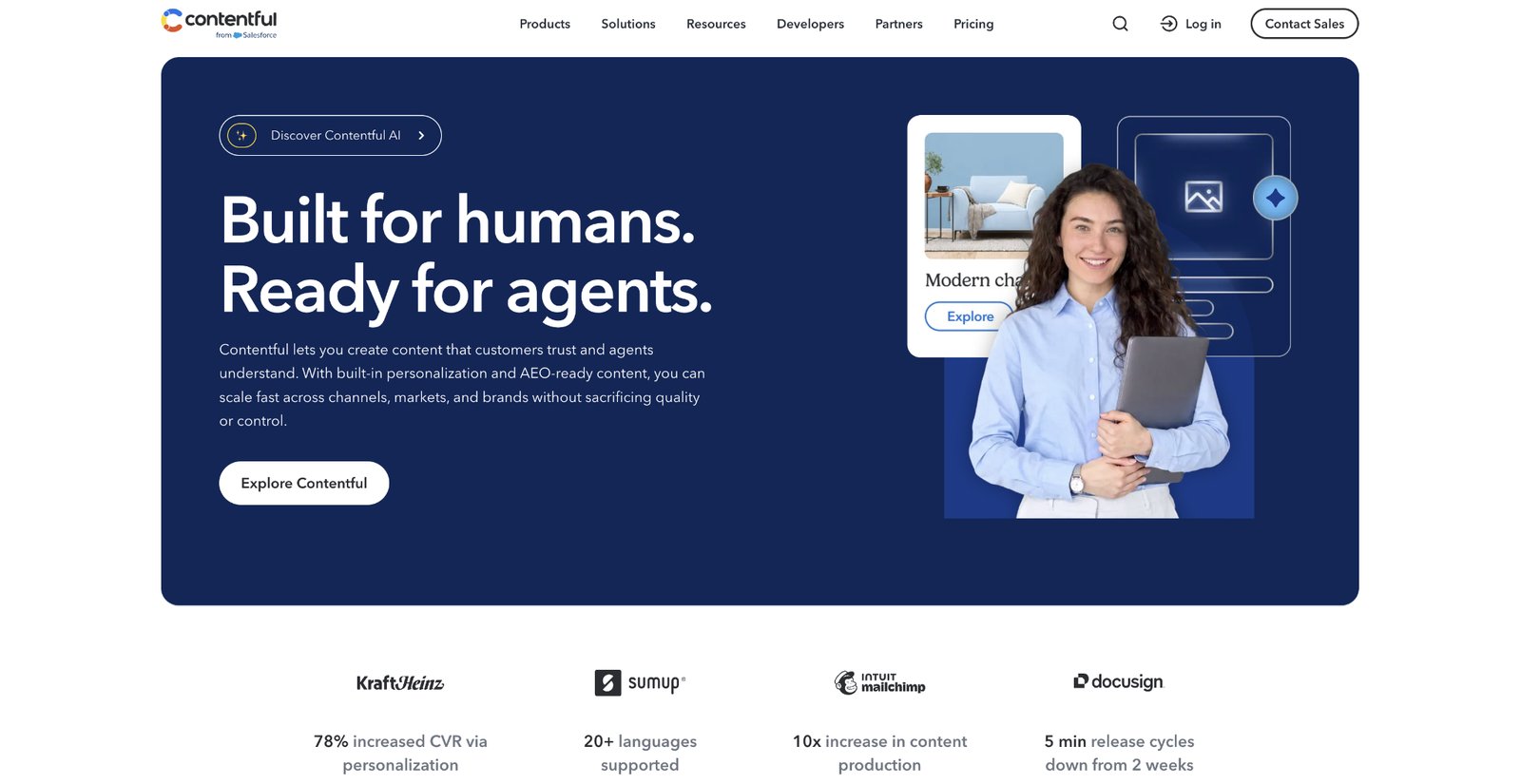
Contentful is the choice for organizations that want one content platform feeding many channels, with engineering building the front ends. Editors work in a structured content model, developers pull it through the API, and the same content serves a site, an app, and so on.
Be aware, however, that the API-first design has its own gap: there is no built-in front end. Without a visual page builder, marketing teams cannot ship a page without developers (the reverse of Sitecore's page-centric model).
Contentful pros:
- One backend, many front ends: Structured content flows through the API to a website, an app, a kiosk, etc.; model it once, reuse it everywhere.
- Public, scalable pricing: A free tier and a listed $300-a-month plan mean you can start and forecast costs upfront, with no sales call required (unlike full DXPs).
Contentful cons:
- The front end becomes your build: Contentful ships the content; you build the pages. Your engineering team owns the website, its performance, and its upkeep.
- Enterprise features require the top-tier plan: Advanced roles, SSO, and higher limits sit on the custom Premium plan, so large programs still end up in a sales conversation.
Pricing: Contentful has a limited free tier for small projects and testing. Its Lite plan is $300 per month for a single project, and a custom-priced Premium plan covers larger teams.
Best for: Teams that want an API-first content backend feeding multiple front ends, with developers to build them.
5. Contentstack
Contentstack is a composable, headless DXP with an integration and automation layer at its core. Built for enterprises that would rather assemble a stack than buy a monolith, Contentstack positions itself as the modern, composable answer to a platform like Sitecore.
Contentstack targets large teams committed to a composable, API-first architecture, with the engineering to run it. Its content management, automation, and integration marketplace suit an organization building a custom experience layer.
The downside is that Contentstack carries the cost of every headless move, and then some: it requires developers, and the composable approach shifts integration work onto your team. This makes it better for a deliberate enterprise build rather than a quick launch.
Contentstack pros:
- Composable and integration-first: Built to connect best-of-breed tools, Contentstack lets an enterprise assemble the stack it wants instead of accepting one vendor's whole suite.
- Enterprise headless at scale: High content volumes and many channels are handled with the governance and automation that large operations depend on.
Contentstack cons:
- You own the integrations: With a composable stack, each connected tool is a separate contract and a separate point of failure. Your team owns the integration and the uptime; no single vendor guarantees it.
- Hard to budget upfront: Contentstack lists no prices, so you cannot estimate or compare the cost without committing time to a sales call, the same friction as Sitecore.
Pricing: Contentstack does not publish prices. Plans are custom quotes based on your scale and the products you use.
Best for: Enterprises committed to a composable, API-first architecture with engineering to run it.
6. Storyblok
Storyblok is a headless CMS with a visual editor that bridges the gap left by pure headless platforms. Developers get an API-first backend, and marketers get a visual way to edit and preview pages. For teams that want composable architecture without losing editor independence, Storyblok is a strong middle path.
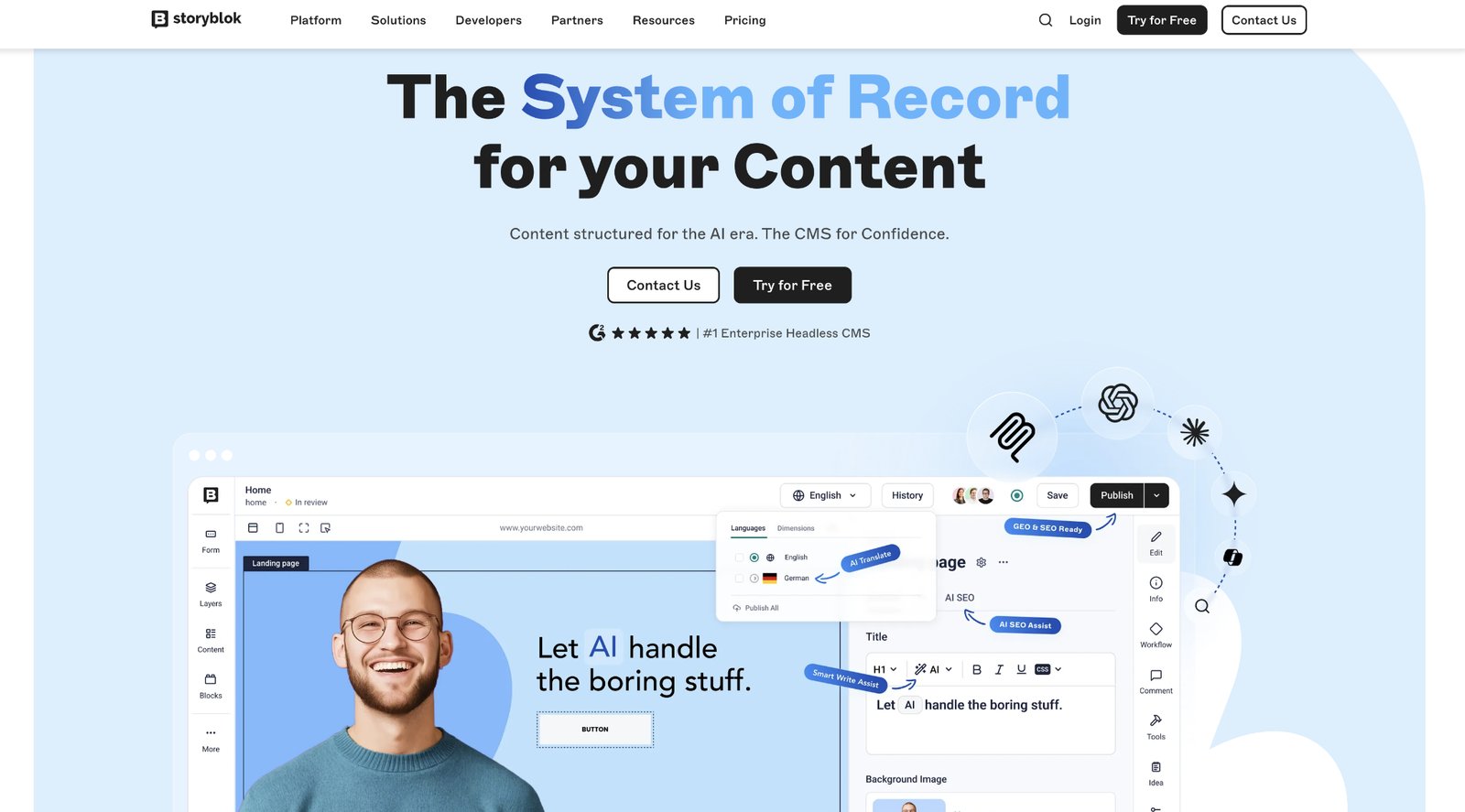
Storyblok fits teams that want headless flexibility without bottlenecking marketers by creating engineering dependencies for every change. Its visual editor lets non-developers build and preview pages on top of a structured backend, and its pricing is public.
Storyblok is younger and leaner than the enterprise DXPs, and that shows at the top end. For the deepest personalization, commerce, and governance a Sitecore replacement sometimes needs, the full DXPs still go further.
Storyblok pros:
- Visual editing on headless: Marketers edit and preview pages visually while developers keep an API-first backend. The result is a composable architecture that helps minimize bottlenecks.
- Affordable, public pricing: Storyblok's paid plans are listed and sit well below enterprise-DXP prices, so teams can size the cost and plan a budget without a sales call.
Storyblok cons:
- Smaller ecosystem: As a newer platform, Storyblok has fewer prebuilt integrations, partner agencies, and enterprise references than Sitecore or Adobe. A very large program can hit gaps the incumbents have already filled.
- Priced by usage: Plans scale by seats, traffic, and API calls. A large program should model the cost as it grows, since the headline tier is only a starting point.
Pricing: Storyblok has a free Starter plan for testing and personal projects. Its Growth plan is €99 per month ($115) and Growth Plus is €349 per month ($405), both billed monthly. Annual billing includes one month free, and enterprise-oriented Premium and Elite plans are custom-priced.
Best for: Teams that want headless architecture with a visual editor and public pricing.
How to choose the right Sitecore alternative
Selecting the right replacement involves balancing your technical team's capacity with your business requirements. Rather than focusing solely on features, consider how each platform changes your team's workflow and long-term operating costs.
Ask these three questions to narrow down your top choices:
- How close a replacement do you need? For Sitecore's full DXP scope, Optimizely, Adobe Experience Manager, or Acquia match it most closely. For a leaner, composable content backend, consider Contentful, Contentstack, or Storyblok. For a marketing and content site where a full DXP is overkill, check out the Webflow section below.
- Who will build and run it? The full DXPs and headless platforms all assume engineering bandwidth. If your marketers need to ship pages without waiting on developers, a visual platform changes the math more than any DXP feature.
- What is the real total cost? Licensing is only the start; add implementation and developer time, and weigh each alternative that way. A quote-based DXP can land near Sitecore's total, while a platform with public pricing and a shorter implementation can reduce it sharply.
Start with the problem you are trying to solve. For speed, consider visual and headless options. For complex, multi-channel orchestration, the full DXP suites remain the standard.
Where Webflow fits as a Sitecore alternative
Every option above replaces Sitecore with more of the same model: another enterprise platform, priced by quote and run by engineers. For many Sitecore users, that model is the problem, not the solution. Plenty of teams run Sitecore for what is really a marketing and content website, and pay enterprise cost and delivery times for it.
Webflow is the alternative for those teams. It is a visual platform where marketers design, build, and publish pages themselves, on a structured CMS with managed hosting, without waiting on developers or standing up an implementation.
The bill lands far below a licensed DXP, and the savings go beyond the license. You skip the multi-year rollout and the specialist team a DXP keeps on payroll.
Webflow is a website platform, not a full DXP. If you genuinely need Sitecore's depth of personalization, commerce, and multi-system orchestration, one of the platforms above is a better fit.
If Sitecore has become an expensive, slow way to run a marketing site, Webflow delivers that site faster and for less. If that’s your situation, start with the site and keep the full DXP machinery only where you actually use it.
Unlock growth with SEO
Join Webflow and leading growth agency Graphite as they discuss actionable insights for scaling and achieving growth with SEO
Frequently asked questions
What is the best Sitecore alternative?
There is no single best choice; it depends on what Sitecore does for you. If you need a full DXP, Optimizely, Adobe Experience Manager, and Acquia are the closest in scope. If you need a headless content backend, look at Contentful, Contentstack, or Storyblok. And if your Sitecore implementation is really just running a marketing site, Webflow can do it faster and for less. Let the work you need to do dictate the platform.
Why do teams move away from Sitecore?
Cost, complexity, and delivery speed usually drive brands to move off Sitecore. The license is only the start: a long implementation and a team of specialized developers drive the real bill, and the marketing team routinely queues behind engineering to publish. Teams leave for a platform with a lower total cost, a faster path to publish, or a composable architecture that fits how they build.
Is Webflow a Sitecore alternative?
For the right use case, yes. If you run Sitecore mainly for a marketing and content website, Webflow delivers that site faster and at a lower total cost, with marketers building pages themselves. Webflow is not a full DXP, so for deep personalization, commerce, and multi-system orchestration, a platform like Optimizely or Adobe Experience Manager is a closer match.
How much does a Sitecore alternative cost?
Cost varies widely. The full DXPs and Contentstack are priced by enterprise quote, like Sitecore. Contentful and Storyblok publish pricing, though their free tiers are limited to testing and small projects, and both rise to custom plans above the listed tiers. Contentful's paid plan is $300 a month, and Storyblok's run €99 to €349 a month ($115 to $405). Webflow's site plans start at $15 a month. Remember that implementation and developer time, not the license, usually decide the real total.
What is a composable or headless CMS?
A headless CMS manages content and delivers it through an API, leaving the front end to your developers (rather than bundling content and presentation like a traditional DXP). Composable extends that idea to the whole stack: you assemble best-of-breed tools instead of one suite. Contentful, Contentstack, and Storyblok take this approach, which trades built-in convenience for flexibility and engineering effort.
Can Webflow replace an enterprise CMS?
For a marketing and content site, often yes: Webflow provides a structured CMS, visual building, and managed hosting without the implementation an enterprise DXP needs. For a large, complex digital experience with deep personalization, commerce, and many integrated systems, a full DXP is still better. The decision comes down to whether you are running a website or a broader experience platform.

Choose the right CMS for a scaling enterprise
Discover how the right CMS can allow teams to efficiently scale rich, complex content – all without writing code.