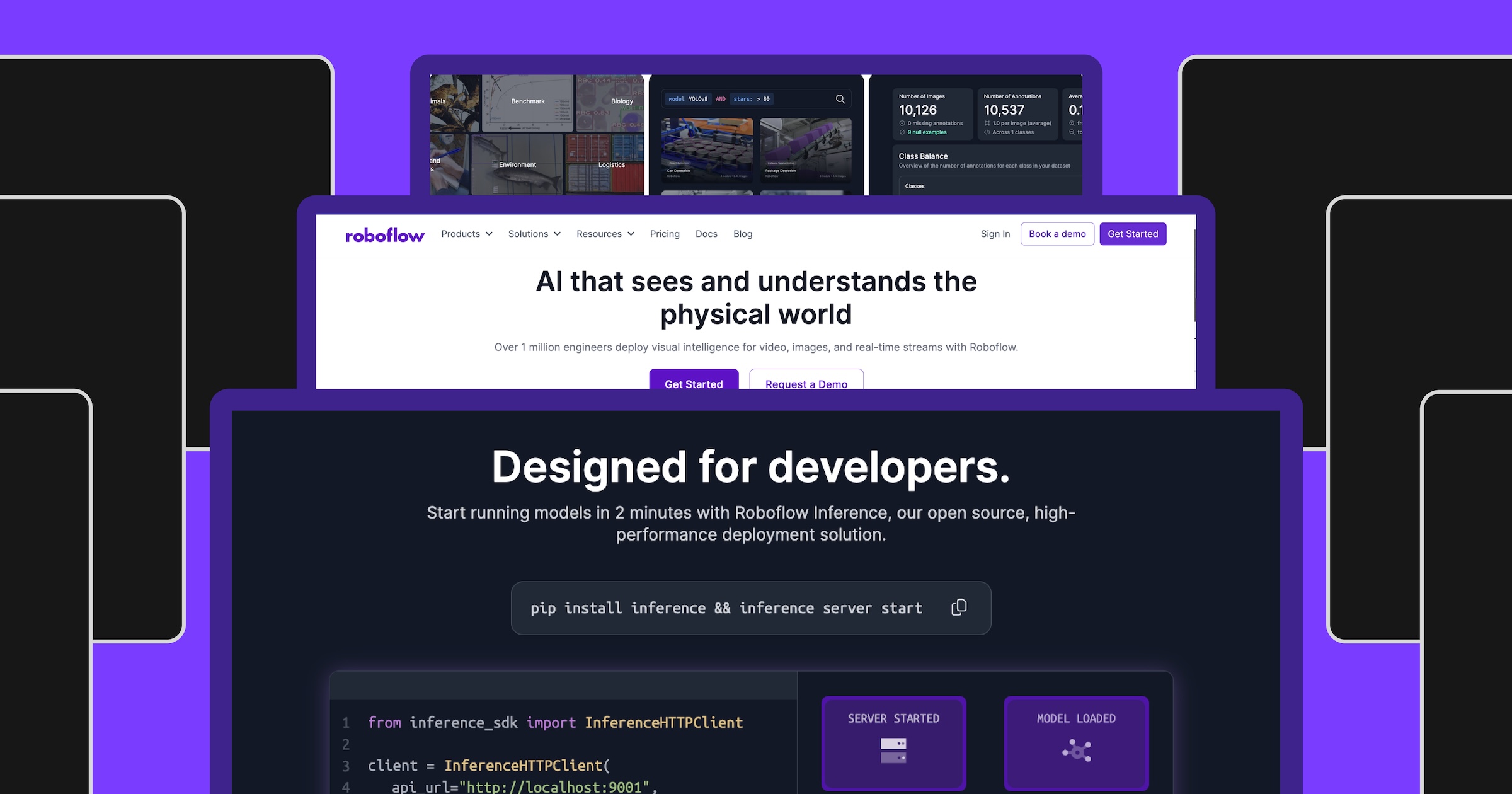




Roboflow is a computer vision platform trusted by over a million developers, including engineers at half of the Fortune 100. Every time a new AI model drops, their marketing team gets to work.
Within hours, a new cluster of pages is live on Roboflow’s website: one explaining how to train the model, one covering deployment, one comparing it to the field. Each page is tailored to a specific search intent, pulled together from a content operation the team built on Webflow. It’s the kind of agility AI-native companies need: the ability to publish and iterate at the pace search and AI discovery are evolving.
Today, the website is one of their top five channels for new user acquisition, run by a marketing team with one sole web designer/developer. That's the product of a few deliberate decisions Roboflow made early and has held to ever since: the website is too important to be anybody's bottleneck.
The front door to over 90% of revenue
Roboflow builds the infrastructure that lets developers train, deploy, and manage computer vision models — tools that give software the ability to see and interpret video, images, and live streams. Work that used to require a specialized team and months of setup can now be done in an afternoon.
For a product-led company like Roboflow, the website isn't a marketing asset sitting alongside the product; it’s the front door to more than 90% of revenue. "All roads lead to the website for us. That is the key conversion point," says Trevor Lynn, Roboflow's Head of Marketing. “Whether someone is an individual developer or a C-suite executive at a Fortune 500 company, they come in through the website,” he continues.
That means the site has to do several things at once: funnel developers into a free trial, capture enterprise leads through a sales demo form, and generate enough organic reach to keep both pipelines full. Each of those jobs runs through the same domain, and each one depends on the marketing team being able to move without waiting on anyone else.
“All roads lead to the website for us. That is the key conversion point. Whether someone is an individual developer or a C-suite executive at a Fortune 500 company, they come in through the website.”
A content system that runs on model releases
The computer vision space moves fast: new architectures, new foundation models, and new benchmarks are constantly rolling out, sometimes within weeks of each other. For Roboflow, every model release (e.g. Meta’s Segment Anything 3, Google’s Gemini 3.1 Pro, Anthropic’s Claude Opus 4.7) is a content trigger. "Every time a new model comes out, we spin up maybe ten or fifteen pages," Lynn says, "and then we win all these very important terms that connect into our product."
The team publishes training guides, deployment walkthroughs, comparison pages, use-case lists, with each one pulling in tailored content so the pages read as distinct rather than templated. The aggregate of hundreds of those pages, built up over years, is what makes it a channel rather than a tactic. High-intent search traffic — developers actively looking for guidance on specific models — lands on Roboflow's site rather than a competitor's.
Built for how search has changed
Timing is part of the strategy. When a new model drops, search volume spikes immediately, and Roboflow's pages are ready before most of the internet has caught up. "Those pages become the top-trafficked pages on the website for one to two weeks while the hype cycle is happening," Lynn says.
That’s answer engine optimization (AEO) in practice. By publishing model-specific content at the exact moment search engines and AI tools are indexing for it, Roboflow earns placement in both — traditional search results and the AI-powered answers that are increasingly where developers start their research. The same specificity that earns a top search ranking is increasingly what surfaces when someone asks an LLM how to deploy a vision model. It's a content system built for how search works today.
How one web marketer kept pace with a hundred-person company
In 2021, when Roboflow was still a small team, Lynn made a call that has compounded in value ever since. Engineers would focus on product. The marketing team would own the website, fully, without routing requests through a development queue. "We want our engineers to build products," he says, "and we want our marketing team to be able to be unblocked and not need an engineer to change text on a website or switch an H1."
Webflow is what made that separation hold. Not because it was the only option, but because it gave the marketing team the flexibility to operate at the pace the company was moving — and kept pace as growth accelerated. Roboflow is now a team of over 100 people, and the website has kept pace with every stage of that growth. "We've always had just one person dedicated to web design and development," Lynn says. “It hasn't been a problem to change or update the website.”
The speed he describes isn't measured in days or even hours. "There are Slack threads of work being condensed to minutes," he says. "Hey, can we change this on the pricing page? Done. Oops, sorry, I meant the number 10 instead of 10,000. Yeah, no problem, that's fixed."
This responsiveness comes from a single web marketer running a content system that produces hundreds of pages a year. That combination of real-time execution and systematic scale has shifted how the rest of the organization perceives marketing as a function, Lynn explains. When other teams get what they need in minutes, it builds a kind of internal credibility that's hard to manufacture any other way.
“There are Slack threads of work being condensed to minutes.”
A landing page that closes where a deck can't
The programmatic system handles the top of the funnel. Further down, the website shows up differently.
When Roboflow's enterprise sales team is working a large prospect — large can mean anywhere from a $150,000 to $2 million annual contract — they don't send a deck. They send a link. Custom pages built with Webflow, tailored to the specific company, showing what Roboflow has already done for teams inside that organization and what the results look like. "We can do videos, we can do images, we can customize the content... people just getting a link to a webpage, it resonates more than another PDF presentation that's static," says Lynn.
The fact that those pages are fast to build matters as much as the format. The team can reuse components and swap content without starting from scratch, which means building a page for a new prospect isn't a project. Every top deal in the pipeline gets a page tailored to that company, and the same approach applies when expanding existing accounts.
When all roads lead to the website, the infrastructure has to hold
Roboflow builds tools that remove bottlenecks for developers: infrastructure that lets people work at the speed of their ideas rather than the speed of their pipeline. Their own website runs on the same logic. The decision to give the marketing team full ownership, to keep engineering focused on product, to build a content system that compounds rather than one that requires constant tending — these are infrastructure decisions as much as marketing ones.
As Roboflow has had to evolve and rewrite itself rapidly since 2021, Webflow has been the kind of infrastructure that holds. That’s why Roboflow is one of a growing number of AI-native teams that have made Webflow their agentic web marketing platform: because it lets their marketing team transform the website into a growth engine that moves as fast as their product does.

.jpg)