



AI is changing how fast marketing teams can move, and your website is where that speed either compounds or breaks down.
Marketing teams are adopting AI to move faster, shipping campaigns and experiences at an unprecedented pace. But speed without a system creates its own problems: inconsistent brand execution and changes no one can trace back to results.
Your website sits at the center of this shift. It might have been a place where campaigns sent traffic in the past, but it’s now the execution layer where teams respond to changing demand, create personalized experiences for different audiences, and learn which improvements actually contribute to business growth (now all at AI speed).
The challenge is making those activities work as one system rather than a series of separate projects and tools. Moving fast is only an advantage if it comes with governance and agentic workflows that keep execution smooth as volume grows.
In this guide, we’ll explore how agentic web marketing platforms are an emerging category designed around that need.
What’s an agentic web marketing platform?
An agentic web marketing platform is a category of web-first technology where AI agents help marketers improve websites based on their website design system and CMS data. Unlike a conventional AI assistant, which responds to a prompt and produces an output, an AI agent can independently take several steps toward a defined goal.
For example, you can give an agentic web marketing platform, like Webflow, your full design system, brand guidelines, and positioning, and it can build hundreds of customized landing pages that match this data. Once approved, it can push these pages toward publishing. The marketing team still sets the strategy and guardrails, but they no longer have to move every task between separate tools and analyze every metric by hand.
Campaign expectations are rising. You need to launch and respond to audience behavior quickly, but many routine website changes still get stuck in development queues. An agentic web marketing platform gives you more governed control over execution without removing developers from work that genuinely requires their expertise.
How is an agentic web marketing platform different from agentic marketing automation?
An agentic marketing platform uses company and customer data to make controlled changes on a live site. That’s what sets it apart from the broader category of agentic marketing automation.
Many of those tools work with the same underlying data but act on it differently. For example, a customer data platform (CDP) brings customer information together so you can build audiences and improve targeting. Broader agentic tools use that data to plan campaigns or adjust paid media. An agentic web marketing platform, however, uses those data points to change what visitors actually see and experience on your site.
Here’s a chart that breaks down the differences in more detail.
The difference between broader agentic marketing automation and an agentic web marketing platform reflects a step forward in agentic business use. An AI agent may create a landing page or recommend new copy, but to improve a website, it also needs access to the content system, publishing controls, performance data, and integrated branding guidelines. Without that context, the agent can suggest or generate something to fill a gap, but it can’t reliably carry the improvement through to a measured result.
That’s what we’re defining at Webflow: a web-first platform and governed growth system that gives AI marketing agents the context needed to support the full lifecycle, including pages you’ve already shipped.
What are the core capabilities of an agentic web marketing platform?
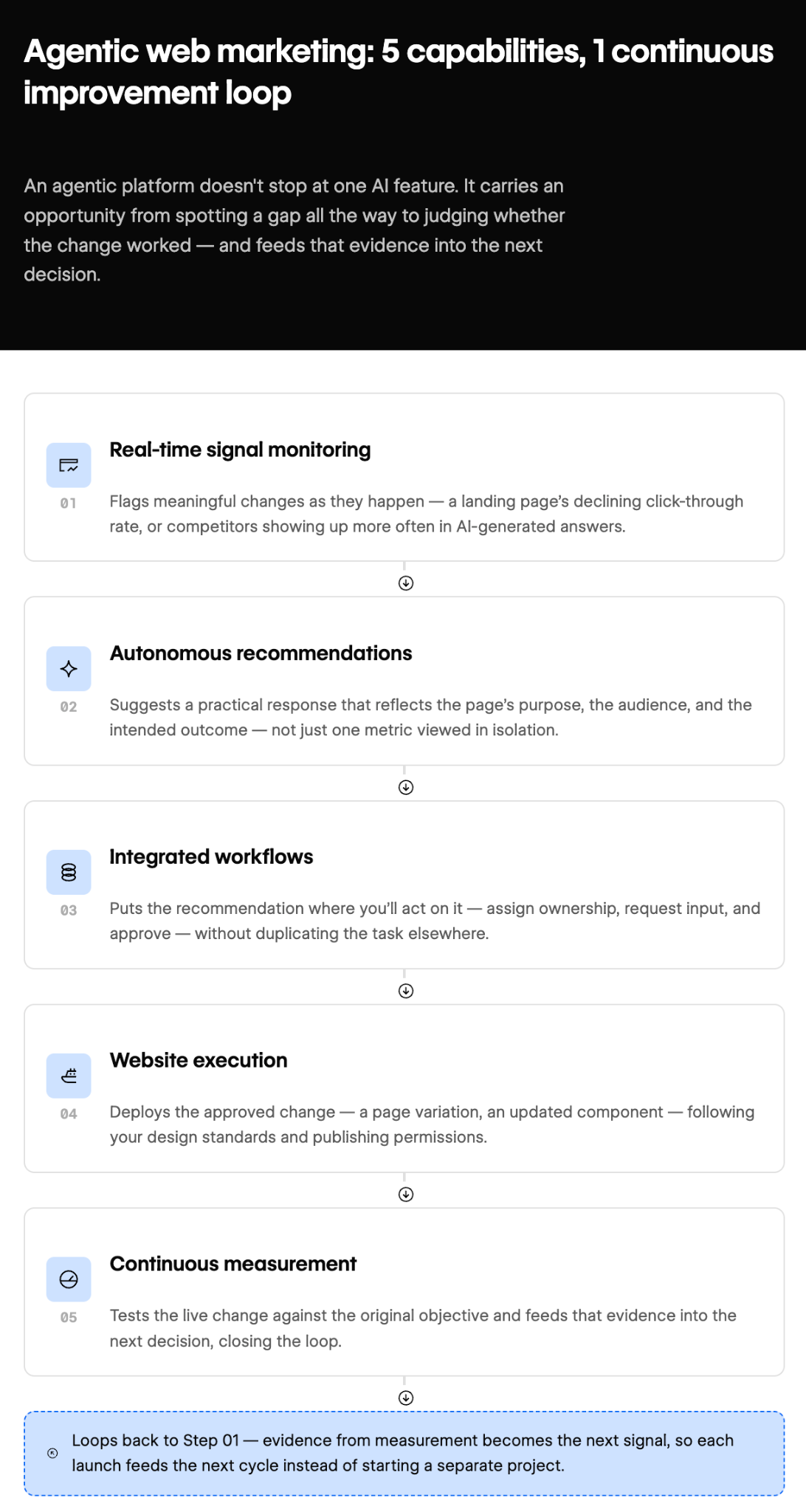
An agentic web marketing platform isn’t defined by a single AI feature. Rather, it should be able to carry an opportunity through an entire improvement cycle, from spotting a gap to judging whether the resulting change made a difference.
Most marketing teams already have tools that perform individual parts of this process. For example, one may surface issues while another generates content to solve them. The web development team then publishes updates and uses an analytics program to measure the outcomes. Each tool is useful on its own, but you still have to transfer information between them (sometimes manually) and preserve the original context along the way.
An agentic web marketing platform connects those steps within a system you oversee. Some of its core capabilities include:
- Real-time signal monitoring. The platform should monitor for meaningful changes that may require action. For example, it might identify that an important landing page has a declining click-through rate, or show that competitors appear more often in AI-generated answers about your niche.
- Autonomous recommendations. After finding something to improve, the platform should suggest a practical and feasible response. That recommendation needs to reflect the page’s purpose and your audience while understanding your ideal outcome. An AI agent that sees only one metric may offer plausible advice without understanding the broader problem, and accidentally make a declining metric worse in the process.
- Integrated workflows. A recommendation needs to appear where you’ll act on it. You should be able to assign ownership, request input, and complete approvals without duplicating the task elsewhere. This reduces avoidable handoffs and admin work while keeping the right people informed.
- Website execution. The platform should help you deploy approved changes, like creating a page variation or adjusting a reusable component, while following your design standards and publishing permissions.
- Continuous measurement. Once the change goes live, the platform should test and compare it against the original objective, then automatically feed that evidence into the next decision. This creates an improvement loop where you and the AI agent both learn from each update, rather than treating every launch as a separate project.

The future of marketing is now
Thought leaders from Silversmith, Accel and Webflow discuss the current and future impact of artificial intelligence on the marketing landscape
What does the agentic web marketing stack look like?
An agentic web marketing stack is a collection of systems and autonomous AI agents that help you understand how your brand is performing online, improve your website, and link those changes to business results.
Each layer solves a different problem, but the entire stack’s value stems from context shared between the layers. An efficient stack creates a continuous path from discovery to execution. When the layers are disconnected, an insight from one agent is more likely to lose meaning as it moves between tools and teams.
Depending on the platform, an agentic web marketing stack may include custom agents configured for a specific task, but a typical stack is made of the following components.
AI visibility and AEO layer
This layer helps you understand how your brand appears in AI-generated answers. You can see whether answer engines like OpenAI’s ChatGPT and Google Gemini mention your company, which pages they cite, and whether the information they present is accurate.
The answer engine optimization (AEO) layer also shows which competitors appear for the same questions, giving you context to distinguish between a broad visibility issue and a specific content gap.
For example, an AI engine might cite a competitor’s page because their content answers a buyer’s question more directly or provides stronger supporting evidence like an external citation. These findings tell you what to improve. Your goal shouldn’t be to appear in every AI answer, but rather to strengthen your presence in answers that influence someone’s awareness and consideration.
Website execution and CMS layer
The website execution and content management system (CMS) layer includes the tools to make improvements to your website, as well as permissions and approval processes for added oversight.
Structured content makes information easier for answer engines to find and understand, and for you to replicate across your site.
For example, shared and reusable components keep the design language and branding consistent between pages, while visual development tools let marketing and design teams implement those changes at scale.
Personalization and experimentation layer
This layer lets you edit your website based on what you know about a visitor’s needs or intent.
For instance, you can adapt a message for someone arriving from a specific social media campaign or show different proof points and testimonials to visitors from different industries.
Content personalization should be selective rather than constant, because changing every part of the user experience makes results harder for AI engines to understand. It also creates more maintenance work and complicates scaling your site further.
Experimentation methods like A/B testing let you compare multiple versions of your site and identify whether a variation improves your ideal outcome. The results guide future decisions instead of assumptions and trends.
Campaign orchestration and workflow layer
The final layer uses marketing workflow automation to connect the people and steps involved in planning and launching a campaign, including:
- Assigning task ownership and responsibilities to specific departments and team members.
- Moving content and performance metrics through review and audit processes.
- Tracking dependencies or hurdles that could delay publishing.
Campaign slowdowns typically occur between tasks. For example, a landing page may be complete from the designers’ end, but still requires legal approval, so the finished product waits in the queue for weeks instead of going live and increasing the conversion rate.
So, this layer provides much-needed cross-team visibility to keep progress moving forward.
Once the campaign is live, the agentic web marketing platform relates the website results and performance metrics back to the campaign. You can see whether people engaged with the page and completed an intended action or converted. Then, you can use that evidence to influence the next campaign.
How does an agentic web marketing platform turn a website into revenue infrastructure?
A website becomes revenue infrastructure when it plays an active, measurable role in winning business. It helps buyers find your brand, understand its value, and take meaningful action, moving them further into the marketing funnel.
An agentic web marketing platform connects what brought someone to your site with the actions they take once they arrive. The platform can help you learn which experiences drive conversions and apply those lessons to future site updates.
Here are a few ways that agentic web marketing platforms can make an impact on business:
- Turn campaigns into conversion paths. Agents can help you create or update landing pages once a campaign plan is approved. The page can reflect the campaign’s audience and promise rather than sending every visitor to the same generic experience. A closer match between what attracts the buyer and what they immediately find can reduce drop-off and increase the chances of conversion.
- Optimize performance while demand is available. If a high-traffic page is attracting visitors but few are taking the intended action, the agentic web marketing platform can surface the problem and recommend a change. Then, you can test another value proposition or stronger proof point before the campaign ends, when an improvement can still affect its return.
- Make experiences more relevant. Real-time personalization can adapt specific content to a visitor’s needs, making them feel like the experience was tailored to their preferences and encouraging them to take action. For example, someone arriving from an enterprise campaign might see relevant case studies or multimedia content instead of general B2C messaging. When you test that variation against the original, you can tell whether the extra relevance produces more qualified conversions.
- Scale revenue without weakening your brand voice. Agents should work within approved components, content rules, and publishing permissions. This lets more people contribute to your website without creating inconsistent pages that confuse buyers or become expensive to maintain.
These learning opportunities are what separates agentic web marketing from generic campaign automation. Campaign automation helps content move across channels, but an agentic platform makes the website a hub where campaign content and related activity becomes a live experience that produces measurable, revenue-driving results.
What are the benefits of agentic web marketing?
Agentic web marketing platforms help you make better use of your website. They keep analytics and results connected while carrying context from one step to the next, creating a shorter feedback loop that can improve decision-making processes.
Here are a few ways that adopting an agentic web marketing platform can support better business practices:
- Make faster, better-informed decisions. An agentic web marketing platform can watch for meaningful changes, like a sudden drop in conversions or weaker visibility in AI answers. It flags the issue and supporting context to your team, rather than requiring a team member to dedicate their time to it instead.
- Personalize at scale without multiplying manual work. Agentic systems can compare audience segments and identify where behavior and your site’s customer journey don’t align, then suggest different approaches before applying those changes using approved content guidelines and components. This allows you to create and test more targeted experiences without brainstorming new ideas for every persona.
- Optimize AI and web-based discovery. The platform can show where your brand appears in AI search results, which sources they cite, and what information competitors provide that your site doesn’t. It can then link those findings to content gaps. For example, you can strengthen an incomplete explanation in a blog post or rearrange a page’s heading structure to make information easier to find and understand.
- Increase engagement and improve ROI. Agentic web marketing connects website updates to defined outcomes like qualified conversions. Testing reveals where a change helped and whether the gain justified the campaign spend. When you can see which changes improve revenue, you can put more time and budget into systems that perform.
Agentic web marketing platforms aren’t designed to replace marketers or simply hand important decisions to AI. They reduce repetitive tasks that consume valuable human resources and time, so you can invest in higher-impact opportunities that directly affect your bottom line.
How Webflow is defining agentic web marketing
At Webflow, we believe a web platform should help you do more than create and publish pages. Web experiences are still important, but new developments require understanding how people and AI systems find your brand and improving your site’s role in revenue infrastructure.
An agentic web marketing platform gives you a reliable way to manage your website as one intelligent marketing system. Since your content structure, design system, publishing controls, and performance data can all live in Webflow, AI agents gain valuable context about how the site works and the rules for changing it.
Webflow AEO puts this model into practice. It helps you measure how your brand appears in AI answers and understand how AI-driven discovery contributes to activity on your website. AEO agents then surface prioritized improvements that you can review, edit, and publish without leaving Webflow.
That’s how we define agentic web marketing: people and AI agents working together within the same governed platform to turn web intelligence into measurable improvements without removing your judgment or control.
Discover the future of agentic web marketing with Webflow
Fragmented workflows can no longer keep up with changing discovery and buyer expectations. When you understand how people and AI systems discover your brand, you can use agentic platforms to deliver stronger web experiences without weakening oversight and visibility.
With Webflow, you can bring intelligence and execution layers together. AI agents work with the context already built into your website, so their recommendations are easier to turn into changes you make today. Then, test those changes against your other ideas and connect the results to visitor behavior or conversions without rebuilding the workflow across separate tools.
Learn more about our approach to agentic web marketing and see how you can move from AI visibility insights to autonomous website improvements with Webflow.

Rewriting the web
A conversation with leaders from PwC, Vectra, Graphite, and Designit on AI and the future of the web