



As code continues to become commoditized, craft—and the teams who amplify it—will be what sets the best brands apart. Today we announced new ways to bring modern marketing teams together to meet the moment and shared our vision for what comes next.
Opening Webflow Conf 2026, CEO Linda Tong took the stage to share how she’s thinking about this pivotal moment for the web and the teams that bring it to life.
With the ability to write code now available to anyone with an internet connection, the definition of “builder” has expanded from designers, developers, and agencies to include marketers, and now agents. This new, modern marketing team required us to fundamentally rethink our platform and who it works for—so Webflow serves marketers and agents the way it has always served designers, developers, and agencies.
Today we announced big updates to do exactly that, with new ways for teams to build alongside their agents and new products to support marketers beyond the build.
We also unveiled our vision for the future: Source by Webflow, a new platform for modern marketing teams and their AI agents to harness the web, drive business growth, and do their best work.
Here’s everything we announced in the opening keynote
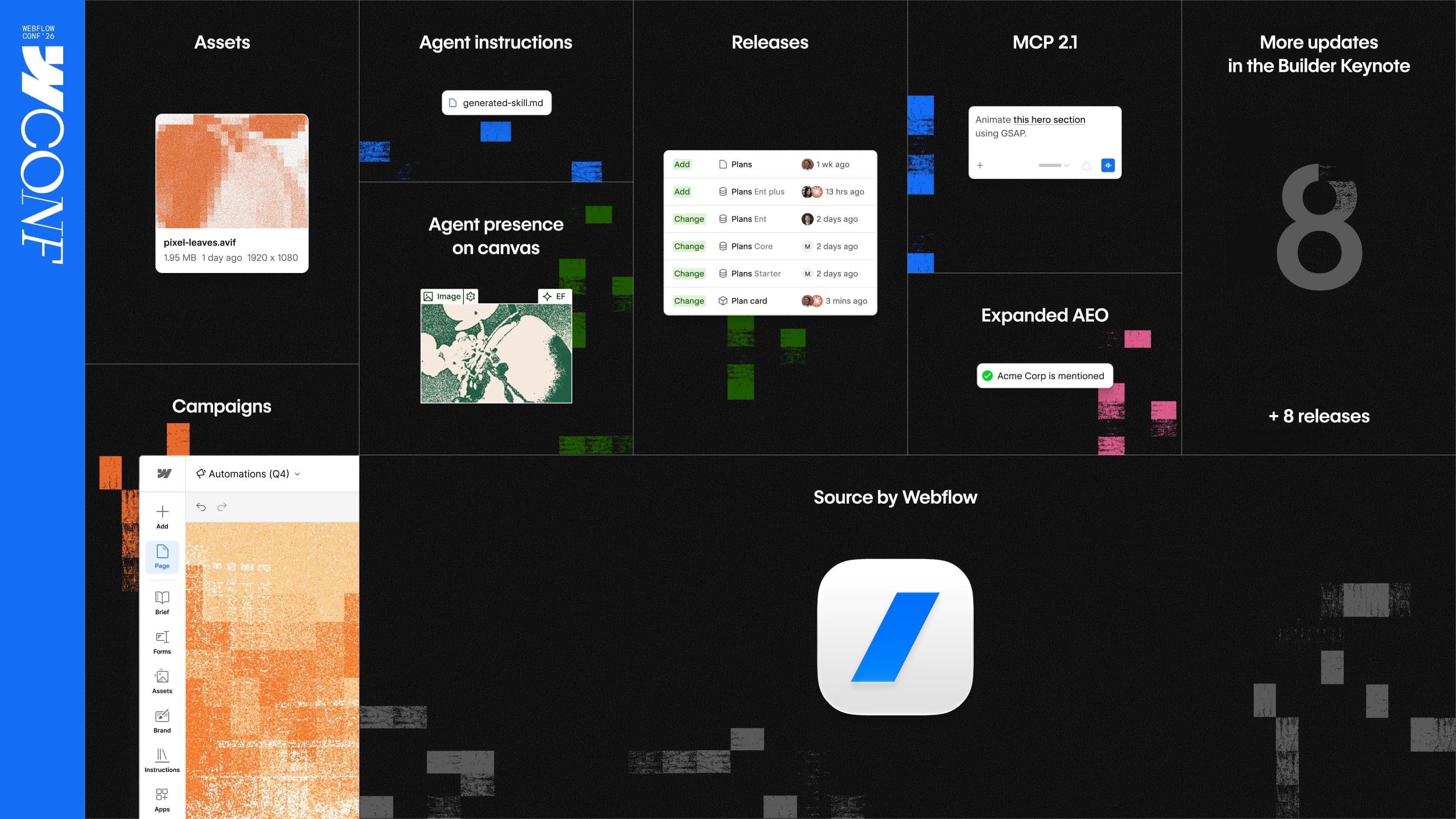
- Source connects your codebase and martech stack, bringing agentic and visual development into one shared environment.
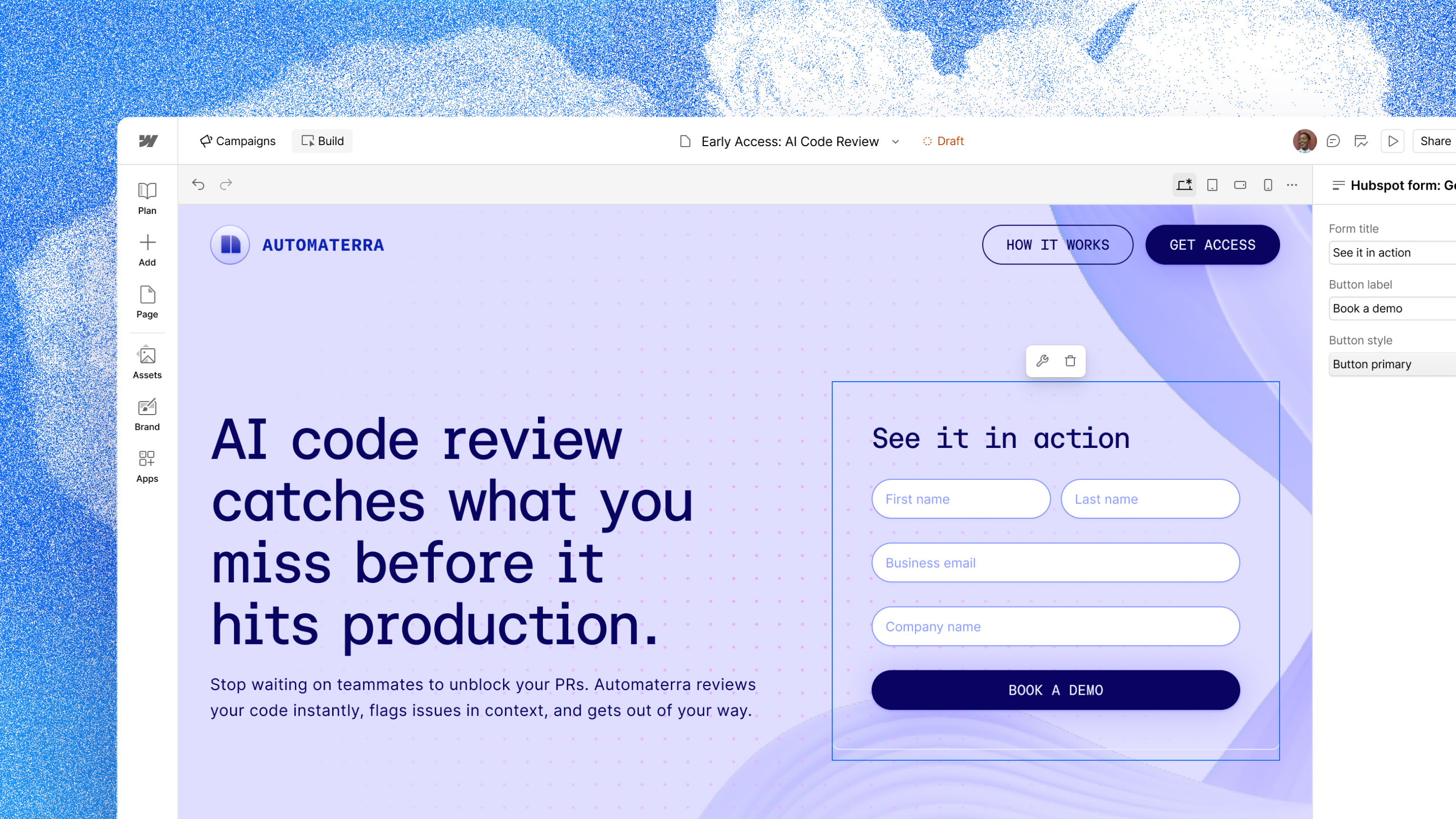
- Campaigns is a new product to take performance marketers from brief to live landing pages, personalized variants, and matched ads in hours, not days.
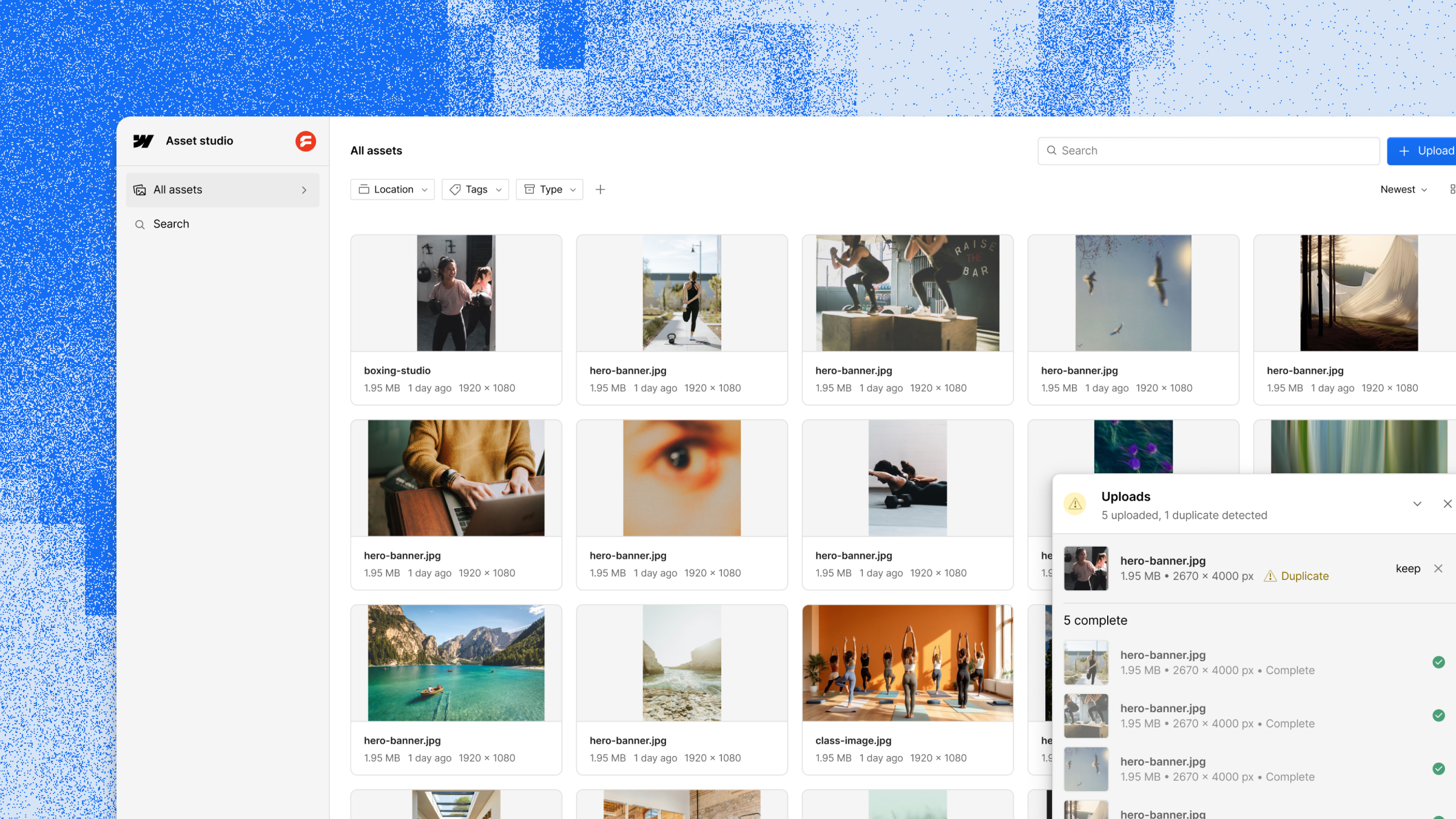
- Assets is a new agentic way to produce and adapt on-brand creative, built on technology from Vidoso, a company we acquired earlier this year.
- MCP updates give agents expanded access to Webflow, including Interactions with GSAP, deeper CMS querying, and help managing deploys to Webflow Cloud.
- Releases is a new way to ship your biggest projects. Teams can branch an entire site, including pages, CMS content, components, assets, and locales, so big launches are staged together before they ship.
- Content agents in Webflow AEO find the topics where competitors are getting cited instead of you, then draft original content in your CMS.
- Agent Instructions can now be generated automatically inside Webflow, using the context that already lives on your site.
- Agent Presence shows agents working live on your site's canvas, so collaborating with them feels like collaborating with anyone else on the team.
But wait, there’s more! These updates are just what we covered during the opening keynote. Later today, we’ll be holding our first ever Builder keynote. Be sure to tune in here.
Introducing Source
As the number of teammates building continues to expand, teams need new ways to work synchronously with agents to ship campaigns, optimize for AI discovery, test variants for CRO, and localize across markets; continuously, not just at launch. But existing solutions haven't caught up to that reality.
Source connects to your codebase and your martech stack, bringing agentic and visual development into a shared operating environment, with every marketer, designer, and developer getting a workspace tailored to their job and the outcomes they own.
Here’s what it unlocks:
- Agentic scale with visual control, on one surface. Source makes code the foundation for everything that ships on your site. With direct access to that code, Source’s agents can take on larger, more complex changes without the constraints of an abstraction layer.
- Views to tailor workspaces to your team. Source lets you customize unique workspaces for every member of your team powered by Views—a new primitive that lets teams shape their software to the exact jobs and outcomes they own. Views are dedicated surfaces for visual site building, campaigns, content, optimization, and can be custom-built for any workflow your team needs.
- A shared operating layer across your existing stack. Source is composable by default, bringing your codebase, CMS, hosting, and marketing tools (including sites you’ve already built in Webflow) into one environment where teams and agents work together.
Source is now available in a limited research preview. Read the full announcement here.
Tools for marketers
The core job of marketers—build brand and drive growth—hasn't changed, but how the work gets done looks nothing like it did two years ago, from the channels you're accountable for, to the speed required to deliver real impact.
Today we announced two new products to help marketers keep up with the speed of the market, as well as new updates to Webflow AEO to keep your brand discoverable in AI search.
Campaigns
For most teams, shipping a campaign is a multi-step process from detailed briefs for the assets each channel needs, to the landing page you need built. Often, campaigns ship weeks after their inception, well after the moment in market has passed.
Campaigns in Webflow is built for performance marketers to go from strategic spark to live campaign in hours, with the help of agents.
Here’s how it works:
- Start by sharing a URL to your live website, and an agent will pull your colors, fonts, and UI elements to build a brand system, whether or not your main site runs on Webflow.
- Next you submit your brief, and an agent will review and help refine your campaign strategy, including audience, message and channel recommendations.
- With your brief finalized, Campaigns will generate your primary landing page, plus variants for each audience, target account, or keyword.
- Campaigns will also generate ad creative for your campaigns, and lets you push your ads and pages into channels like Google Ads.
Once a campaign is live, Campaigns tracks conversions, connects to HubSpot or Salesforce so you can measure pipeline, and its agents recommend iterative updates to your landing pages to improve conversion along the way.
Campaigns is currently in beta, and will be available for purchase next month.
Assets
Like with code, AI has made it easy for anyone on your team to generate an asset in minutes. But most of those assets are never quite ownable. They miss the nuance and texture that make your brand yours, and every adaptation drifts a little further from the source of truth.
To solve that issue, agents need context: your design system, your brand variables, your existing asset library, and how those assets have performed. More context than any one person on your team has, and more than a standalone AI point solution can give you.
Assets is a new, agentic way to create brand-consistent creative that drives growth, right inside Webflow. Its agents find, understand, and adapt your approved assets to work across channels, whether you're adapting a static asset for use across your site or cutting down a full-length video, trimming filler words, and adding captions for social.
Save the new asset when you're done and it's ready to use, without exporting and reuploading between tools.
Assets will be entering beta this October.
Webflow AEO
Most brands are barely showing up where their buyers go to ask questions. We analyzed the websites of 2,000 companies and found the median company appeared in 16% of the AI answers they would want to be part of, and were cited in those answers only 6% of the time.
So earlier this year, we announced Webflow AEO, a closed loop system for winning at AI discoverability. Today, Webflow AEO customers get 70% more mentions and 120% more citations than non-Webflow brands.*
Webflow AEO pulls data from ChatGPT, Claude, Gemini, and Perplexity, so you can see where you're mentioned, where you're cited, and who's getting cited instead of you. And because your hosting and site analytics live in Webflow, we can show you what AI bots find interesting on your site, how many visitors the LLMs refer, and how well those visitors convert.
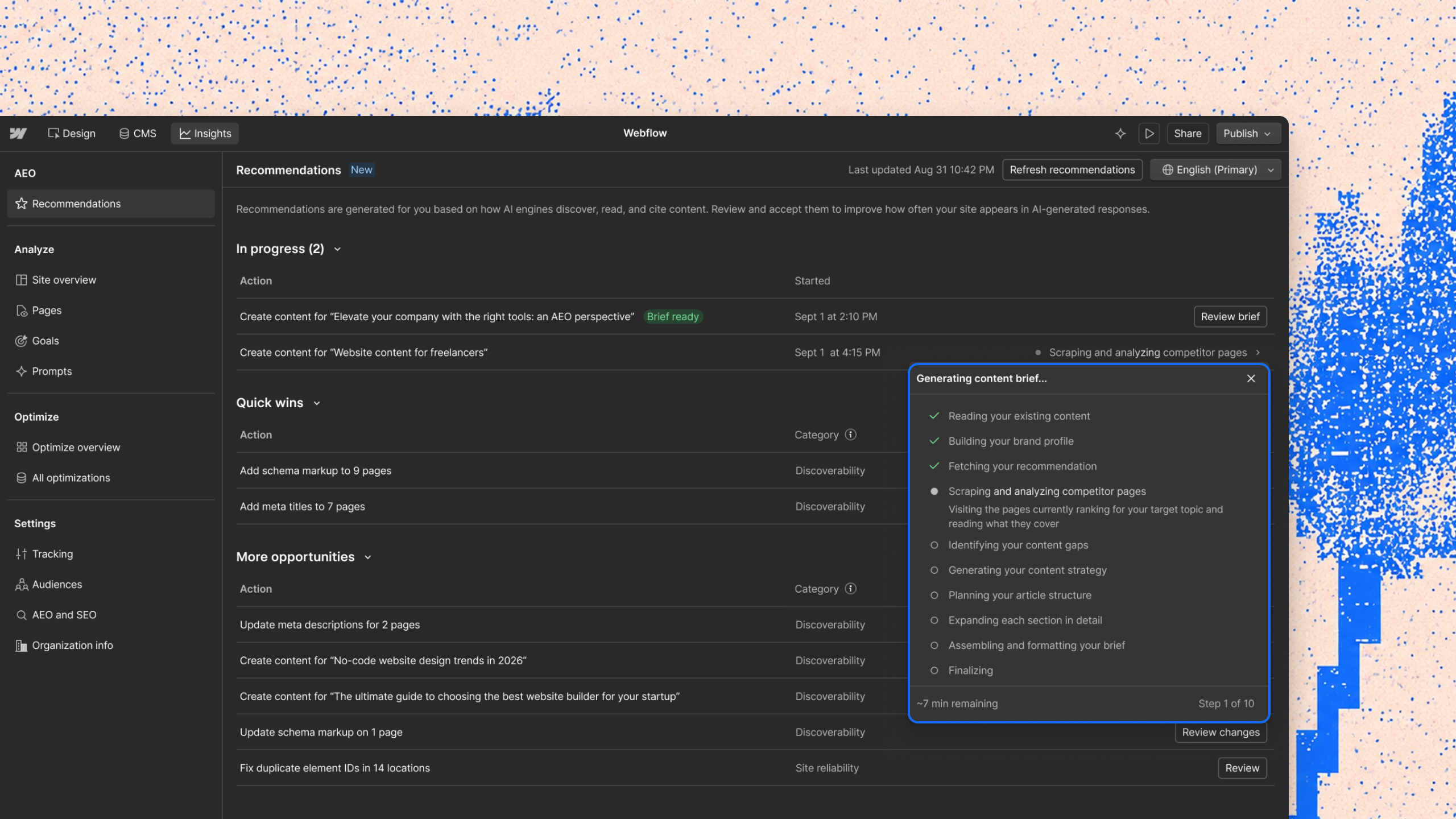
Using those insights, agents queue prioritized recommendations to improve your discoverability in LLMs, which your team can review, approve, edit, or reject.
New content creation agents can find the topics where your competitors get cited and you don't, then write the brief and draft original content right in your CMS.
Coming soon: In the coming months, we’ll be releasing agents to help refresh existing content across your site, and later this year, we’ll introduce new ways for external agents to get access to your site’s AEO data through the Webflow MCP.
All Enterprise customers have access to AEO agents by default, and you can get insights into your AEO analytics by upgrading to the latest version of Webflow Analyze for Enterprise today.
Building with agents
Agents have become working members of modern marketing teams, and they help us build fast. But that speed only counts if the work is done well, and safe to ship. An agent moving quickly through production raises the same questions you'd have about any new teammate: what did they change, who asked for it, and did anyone review it before it went live.
So as our teams expand to include agents, more of Webflow needs to be accessible to those agents, while providing more visibility into what those agents do once they're there.
MCP 2.1
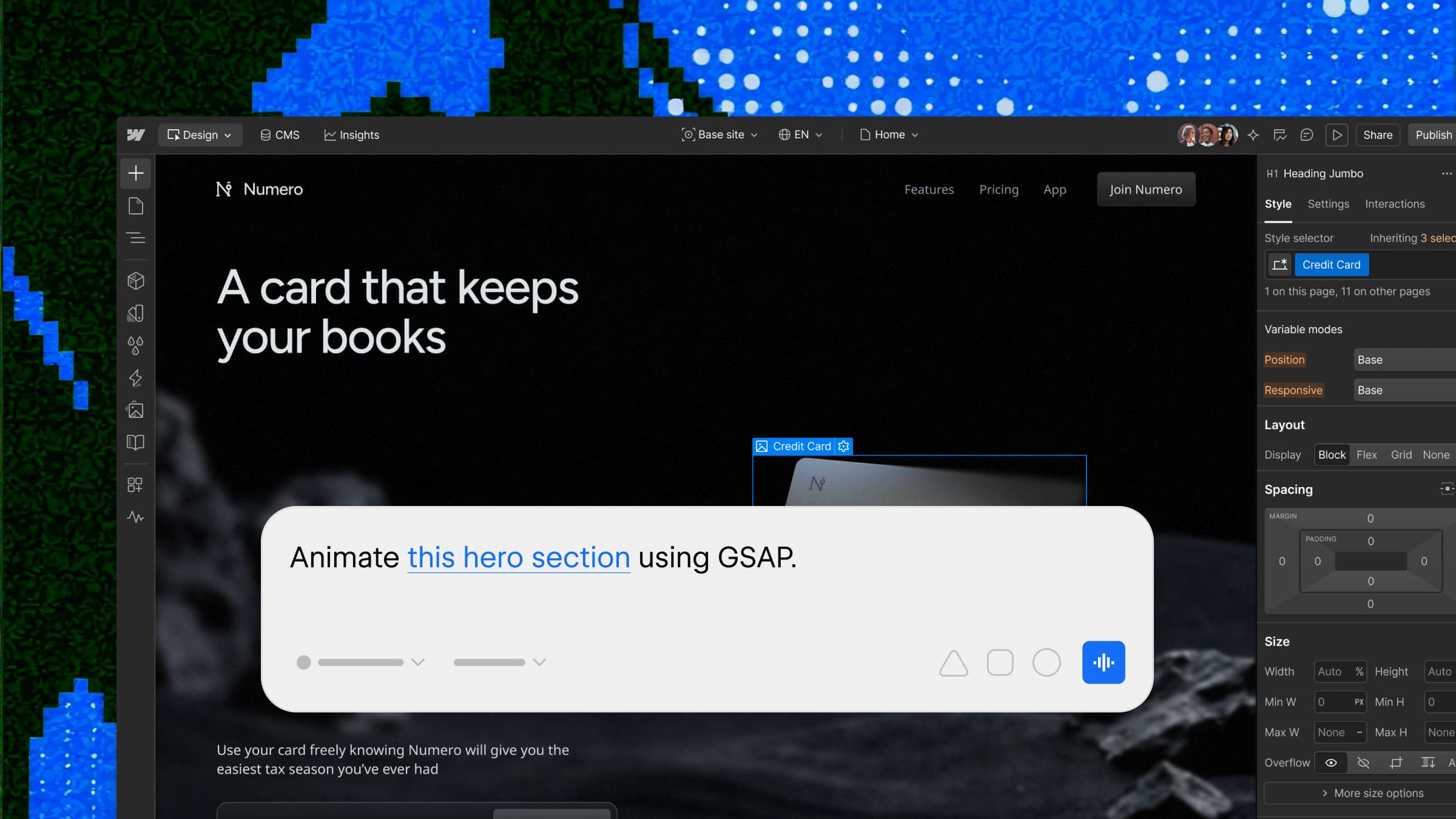
Webflow MCP 2.0 shipped earlier this summer and gave your agents in Claude, ChatGPT, and Slack new access to Webflow; including your design systems, components props and variants, and your site analytics via Webflow Analyze.
Today we announced MCP 2.1, which continues to expand how agents can build in Webflow:
- Interactions with GSAP. Prompt the interaction you want and your agent builds it, including complex, timeline-based animations. Because these are native GSAP-powered animations, you keep the visual controls you're used to for getting the timing right.
- Better CMS querying. Agents could previously sort and filter on only a few CMS fields, and only if you knew the exact field name. Now they can sort and filter on custom fields, search across reference fields, and page through results, which means finding the right content in a single request. Resulting in faster content audits, and less token burn on multi-step CMS work.
- Webflow Cloud. Deploy errors used to send developers back and forth between the CLI and the dashboard. Error logs now surface to agents, so Claude Code, Codex, or Cursor can work the issue and redeploy on your behalf.
MCP 2.1 will be available to everyone later this month, with more releases planned between now and the end of the year, including expanded access to AEO Analytics and Webflow Optimize.
Releases
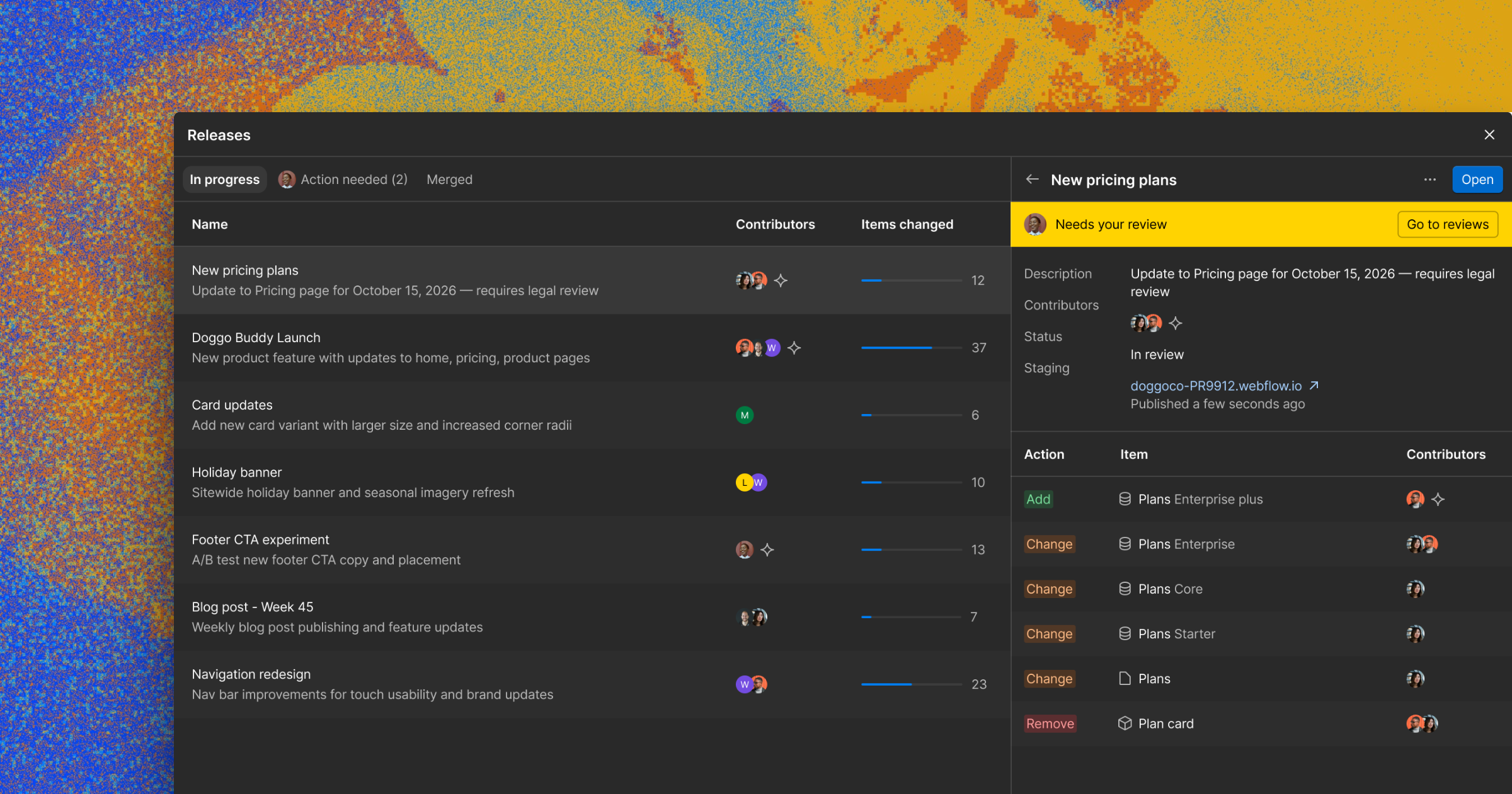
Releases is a new way for large teams shipping complex site updates to branch and stage their work before it goes to production. It branches your entire site, including pages, CMS content, components, assets, and locales, so your team and your agents can build and stage safely before anything moves live.
Inside Releases, the Release Manager keeps track of all the work happening across your site: what's been updated, who's working on it, and where it stands. And as individual releases ship, you can pull those updates into your open branches so your site is always in sync.
As always, agents can contribute to your team's work inside a release, and they're subject to the same roles and permissions as your teammates when it's time to merge and publish.
Releases will be available in beta later this year.
Agent Instructions generation
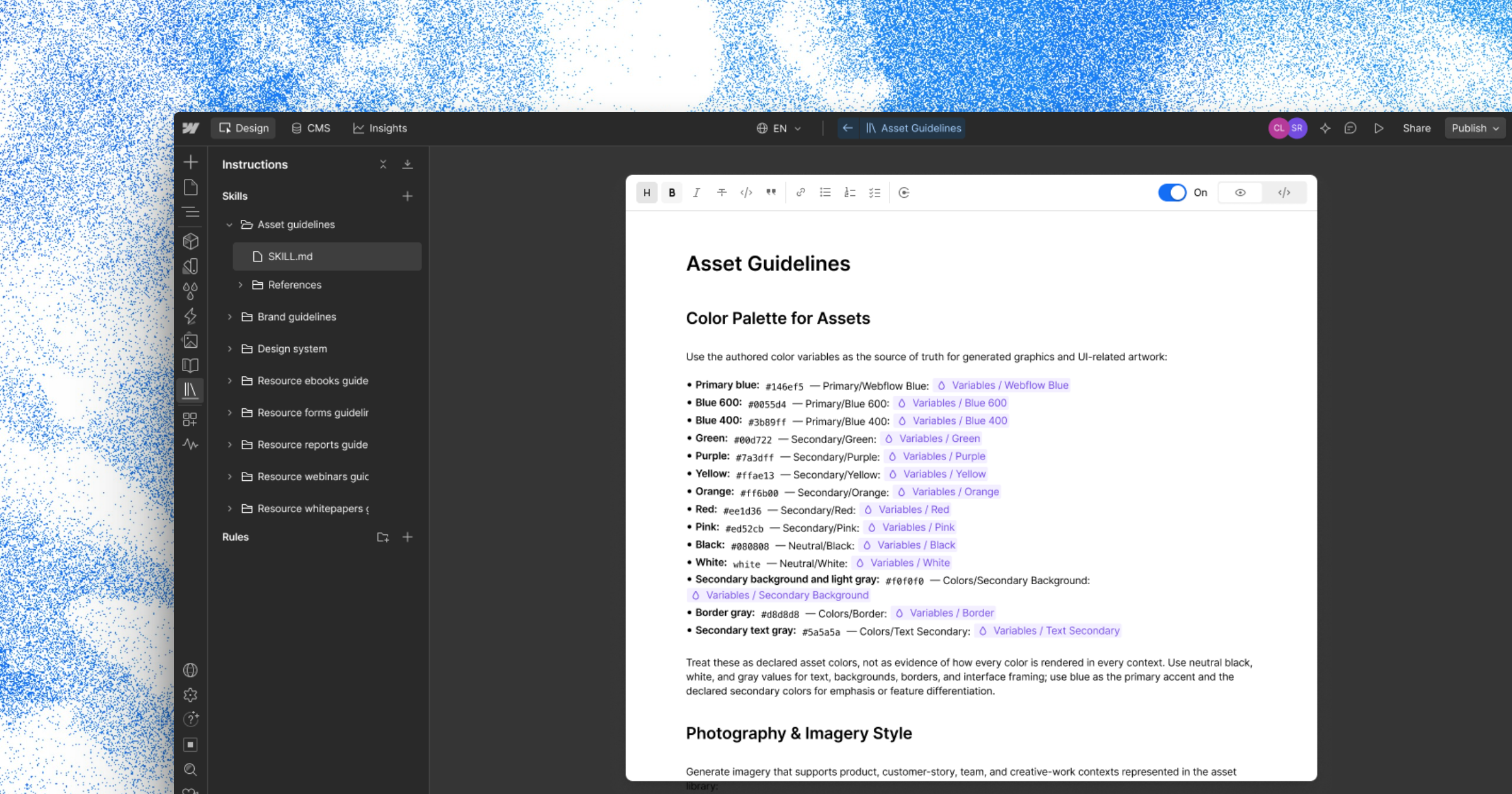
Agents can build almost anything quickly, but building something worth shipping takes context: how your design system gets applied, which legal language is non-negotiable, what your brand actually sounds like. Your team has all of it, scattered across a doc, a deck, and somebody's head.
Agent Instructions launched earlier this summer, and teams have been writing context files for design system documentation, SEO guidelines, form governance, and more.
But providing useful context is time consuming, so now Webflow can help you generate the instructions for your agents. Templates cover brand guidelines, design system, asset guidelines, and CMS content, pulling from what Webflow already knows about your site. The generated markdown files can be edited, updated, or regenerated as your site evolves.
Agent Instructions are already available in your workspace, and Instructions generation will start rolling out to everyone today.
Agent Presence
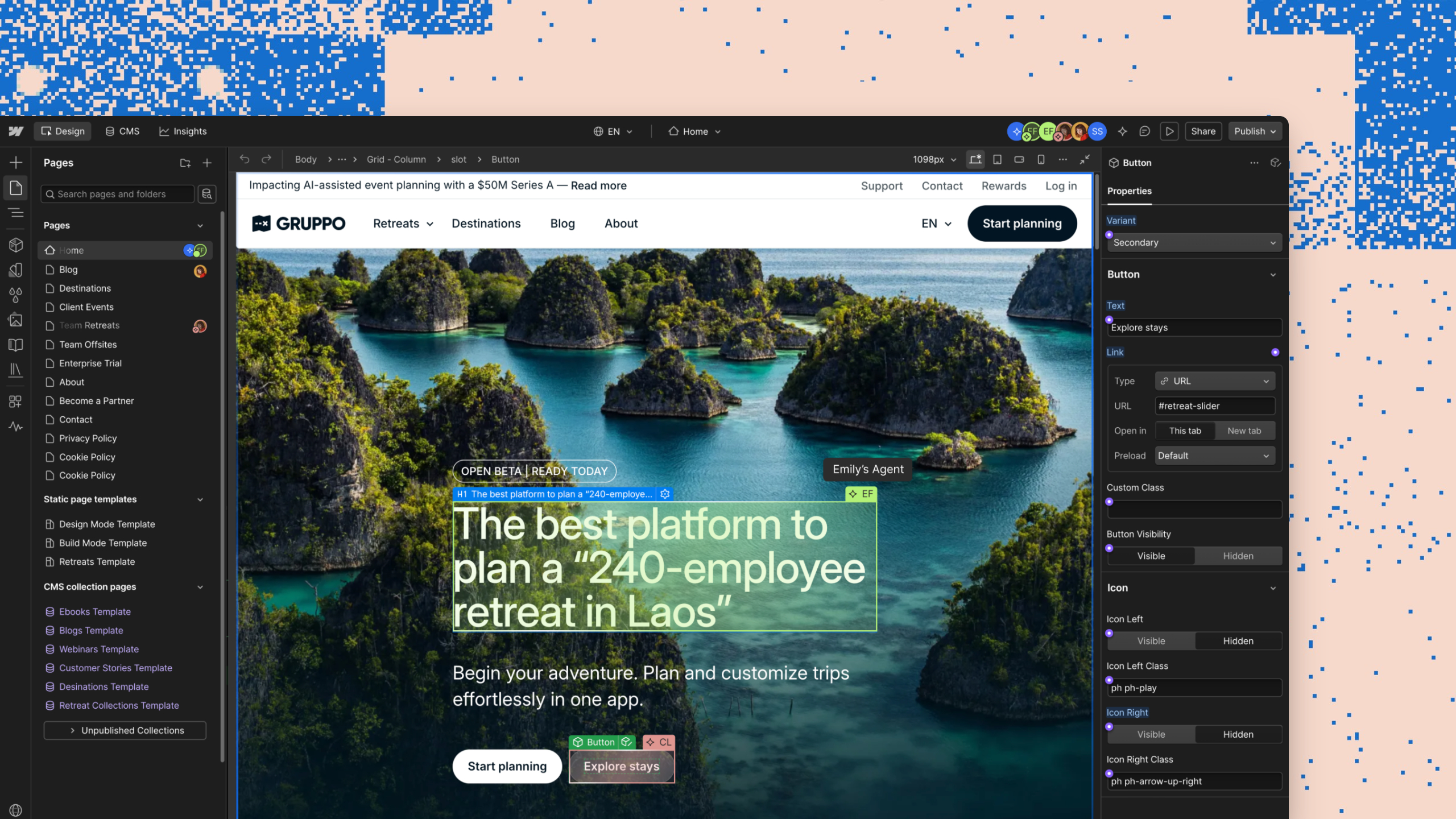
Keeping track of an agent's work can feel impossible. Earlier this summer we updated the site activity log to improve visibility and tracking for every AI change across your site.
But the more your team builds with agents, the more chances there are to collide mid-edit or publish before an agent has finished. Agent Presence lets you track agent work in real time, showing where an agent is working live on the canvas, the same way you'd see a teammate.
Agent Presence will be available for all customers later this month.
Webflow Conf 2026 is just getting started
This morning’s keynote was only the opening act. Join us on the live stream to catch the rest of the Webflow Conf 2026. Here are a few highlights to tune in for over the next few days:
- Source by Webflow: a closer look, 9/2 @ 12:30pm ET. Join the Webflow team behind Source to go deeper on our biggest product announcement of the week and what it changes about how teams build.
- Builder Keynote, 9/2 @ 1:15pm ET. We had more to announce than we could fit in the opening keynote. Join Webflow’s own builders to see what else the team has been shipping for the designers, developers, and content creators in Webflow every day.
- A conversation on how enterprises can succeed with AI, 9/2 @ 2:45pm ET. Tune in to join Webflow’s CPO Ben Haefele and Anthropic's Head of Applied AI Alon Krifcher on what separates the enterprises getting real value from AI from the ones that stall out.
- A conversation with today's top marketing leaders, 9/3 @ 2:15pm ET. Webflow CMO Dave Steer talks with Heather Freeland of LinkedIn, Dan Slagen of Zapier, Whitney Magnuson of Zoom, and Oana Manolache of Sequel about the calls and tradeoffs facing marketing leadership right now.
- Fireside Chat with Ethan Mollick, 9/3 @ 3:00pm ET. Wharton professor and author of the New York Times bestseller Co-Intelligence, Ethan cuts through the hype on what AI is actually changing about work. His next book, Co-Existence, is out in October.
- A Conversation with Seth Meyers, 9/3 @ 4:00pm ET. Two decades from SNL to Late Night, and still finding new audiences. Seth joins us on which changes are worth chasing and which ones aren't.
Can’t make it? All sessions will be available on demand early next week.
*Directional finding from internal Webflow data covering 158 customers that accepted AEO recommendations, compared with 187 that received the same recommendations and did not, measured from May 19 to July 13, 2026. The difference in organic traffic growth rate does not specifically isolate AEO recommendations from other drivers of traffic, including seasonality, changes in search and answer engine indexing, marketing activity, and site changes.
.jpg)