.png)





In 1987, Apple shipped something strange and gave it away free with every Macintosh. It was called HyperCard, built by Bill Atkinson, the same engineer who gave the world MacPaint.
HyperCard let people who would never call themselves programmers make software. A teacher built the quiz tool her classroom needed. Two brothers in Spokane stacked some cards together into a game called Myst. (Yes, that Myst. It began life as a HyperCard stack.)
The premise was radical then and it is still radical now: software is not something you buy and adapt yourself to. It is something you shape to fit your life and your work.
We recently shared our belief that creators need direct contact with the artifact. HyperCard points to the next question: once the artifact is reachable, how much of the interface around it should remain fixed?
Apple discontinued HyperCard in 2004, but the idea never quite went away. It arrived before the economics could support it. Handmade software stayed expensive, tailoring stayed a skill, and so the industry standardized.
Off the rack
The pioneers of personal computing imagined software as a living medium, something its owner could reshape. We got the personal computers. The software stayed impersonal.
We know how designing for the average works out because fashion ran the experiment for us. In the late 1930s, federal researchers Ruth O'Brien and William Shelton measured nearly 15,000 women in an effort to improve standard clothing sizes. Their data exposed the problem: height and girth varied independently, so one measurement could not reliably predict the rest of the body. Ready-to-wear could standardize a range, but it could not eliminate variation. Every fitting room since has been the proof. When clothes truly need to fit, the answer has never been a better average. It has always been the tailor.
Software never got its tailor.
Think about what a modern app actually is: ready-to-wear software. One interface, one workflow, one set of assumptions, stamped out for a million customers whose jobs, teams, and Tuesdays look nothing alike. Settings pages are our industry's alteration counter, and let us be honest about how much they can actually take in.
None of this happened because designers dreamed of sameness. Tailored software did not scale, and standardization put capable software in front of millions. Some of the best software ever made treats that constraint as a virtue: a clear point of view, fewer choices, coherence fiercely protected. That is design. Endless configurability usually means a product has not decided enough.
There is also a reason the HyperCard dream stayed a dream: most people do not want to stop doing their work to design the tool for doing it. A configurable system can swap one burden for another. Agents change that math. They can carry the burden, adapting the tool to the task without asking anyone to formalize every variation.
The future is neither one fixed interface nor infinite configuration. The core stays decided. The interface adapts around the work. Off the rack lasted so long we started treating an economic constraint as a product philosophy.
Rack and ruin
Which brings us to the discourse. You have seen the headlines about AI coming for the software industry; the market has seen them too. Someone on a Wall Street trading desk coined the term "SaaSpocalypse" during the early-2026 selloff, and the name stuck because the fear is real. If anyone can ask an agent for software, what happens to the companies selling it by the seat?
We should be upfront that we read those takes with more than academic interest, since we sell software subscriptions for a living. But the fear gets the outcome wrong. What is ending is not software. It is the assumption that one fixed interface has to carry the product's entire point of view for every customer. That model was never purely a design philosophy. It was an economic constraint dressed as one.
Fashion had its own reckoning with the industrial model. Zara compressed six-month seasons into weeks and let demand steer production. But fast fashion did not change the rack. The production got faster, not more fitted. Software ran the same play and called it agile: yearly releases became weekly, yet every customer still got the same experience. Fast gets you more averages per year. It does not get you fit.
The right metaphor for this moment is not an apocalypse. It is a graduation. Software can finally leave this industrial constraint behind, and unlike fashion, we do not have to stop at fast. Code can be recut for every wearer. We get to finish the arc clothing started: from off the rack back to made to measure.
Alterations
Our designers are building controls that show every state of a checkout flow at once, rigs for stress-testing enterprise workflows across different configurations, and motion studies for settling animation treatments. Our marketing team is creating custom views for revenue operations and go-to-market motions, along with workflows that turn creative briefs into production deliverables. These are not products we sell. They are pieces of software that exist because somebody needed one on a Tuesday.
The pattern extends beyond Webflow. During a recent design refresh, Linear used coding agents to build temporary color controls, fed the chosen values back into its design system, and threw the tool away. A machinist would recognize the move: a jig, a small instrument made for one operation. Most of these tools get discarded the same week they are made, which is exactly what makes them interesting.
What is emerging is different ways to see, reason about, and change the same underlying work. Roles remain useful because they reflect how a company divides responsibility, how the business operates, and what people are accountable for. A marketer may need a view organized around campaign performance; a designer may need to compare states; a developer may need to inspect structure.
But roles are not the only structure that matters. A cross-functional team may need an interface organized around a launch, a workflow, or a decision. New ways of working should earn their way into the system when they improve how work gets done, rather than simply encoding the current org chart. The unit of fit is organizational, not merely personal: sometimes a role, sometimes a team, and sometimes the work itself. Not everyone needs to become a tool builder. Someone close enough to the work can shape an instrument others use while preserving the standards and authority over what ships.
Tailor made
Here is what we believe comes next.
The interface can be shaped around the work. The source has to endure. An interface may last for one decision or become durable enough to share across a role or team. If every instrument creates its own data and rules, you get a drawer full of private forks. A shared source keeps each one inside the product rather than creating copies that drift apart. The view can change. The source, objects, permissions, history, and standards do not. That continuity is what makes trust and recovery possible.
Judgment moves beyond the interface into the system. A product does not need to express all of its judgment through one fixed screen. Its judgment can live in the primitives people combine, the standards every result must meet, and the boundaries that keep experimentation safe. The design system stops being documentation and becomes live infrastructure: standards present while people and agents work, instead of living in a slide deck or a reviewer's memory. The order matters: articulate what good looks like before automating the decision.
Fit can follow a role, a team, or the work itself. Roles encode responsibility and authority. Teams coordinate around shared outcomes. The work often cuts across both. Made to measure software should reflect how a company operates without freezing it in place, giving better ways of working somewhere to take hold.
The bottleneck moves from making to judging. Cheap variation is not craft; it is more chances for craft to operate. A quick experiment lets a team hold alternatives side by side, notice the misfit, and decide. Judgment moves upstream. The hard question for design leaders becomes what must stay coherent everywhere and what is allowed to adapt. Some decisions can become rules. Others will always need a person. The tailored era needs more judgment, not less, and judgment is what designers have been training all along.
Made to measure does not mean made from scratch. It means starting from a strong pattern and altering it where fit matters. The product carries the point of view; the team shapes the edges around the work. Most teams do not want bespoke software. They want their inch.
The fitting room
Nearly forty years ago, HyperCard handed ordinary people the material of software and invited them to shape it. Bill Atkinson spent his career betting that computers should bend toward people, and the promise he shipped in 1987 did not die with the product. It waited for the cost of tailoring to fall.
This is the next consequence of getting to the source: the source can remain stable while the interface evolves around the work. A role can have the controls its responsibilities demand. A team can shape an instrument around a shared decision. A better way of working can emerge without creating another version of the truth.
At Webflow Conf this September, we will show what we have built for this future. Come see what happens when the source stays real and the software finally starts to fit the work.
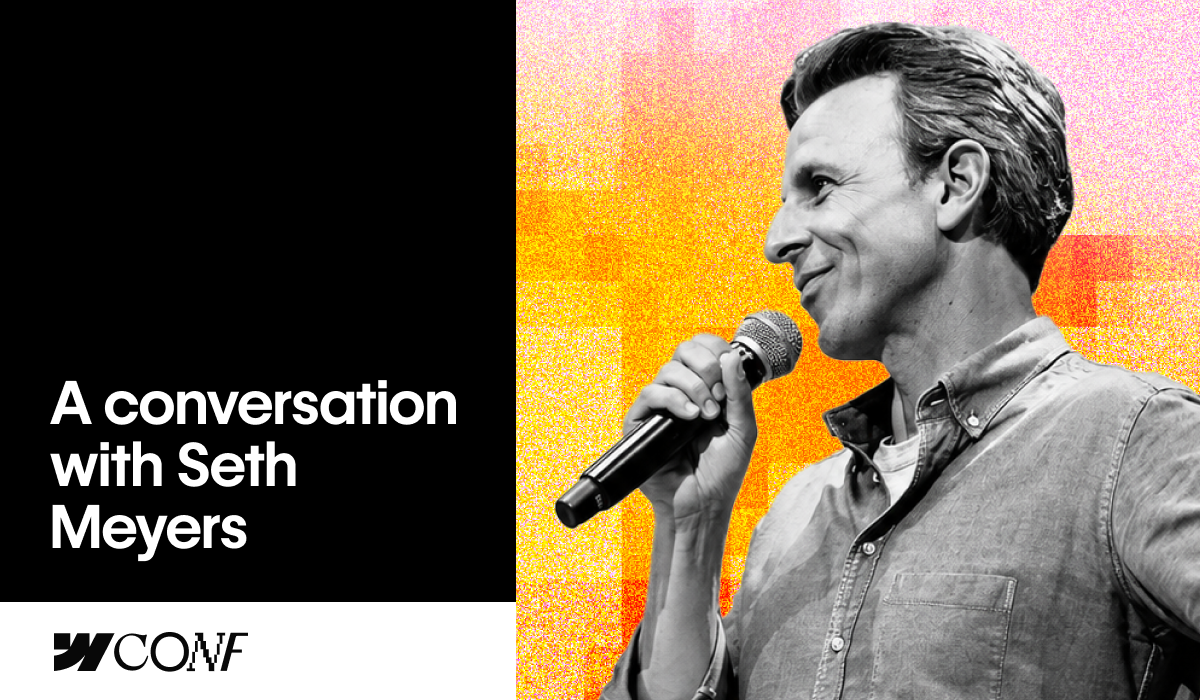
Software is changing. So is the conversation. Join us at Webflow Conf with Seth Meyers.