





To maximize conversions, you need to know how to turn a one-page digital experience into an engagement engine.
Landing pages are often complex assets designed to attract attention, persuade an audience, and convert them, all in one place. While the rest of a website may steadily build trust with its audience over many visits, a landing page goes straight for the sale by removing as much friction as possible. To make it effective, you’ll have to refine both the landing page's individual elements and its overall experience.
Landing page optimization involves leveraging data, UX best practices, performance improvements, and A/B testing to discover what drives ROI. In this guide, we’ll explain what conversion-generating landing pages include and how to build them reliably for your clients.
Why landing page optimization matters
While a website is a dynamic experience that’s usually meant to be explored, a landing page is a focused, linear journey. Well-designed landing pages can:
- Boost conversion rates. A successful landing page can become a conversion engine that reliably turns traffic into customers.
- Maximize ROI. Landing pages don’t require as much development time or effort as full websites, and they can often be reused in multiple marketing campaigns.
- Lower customer acquisition costs. By driving potential customers from multiple sources to a single optimized landing page, you can lower the average costs per acquisition and conversion for clients.
- Improve visitor journeys. A thorough landing page can guide visitors along an entire user journey, from discovering and learning about the product to making a purchase.
- Provide actionable insights. Because a landing page is so focused, its analytics often show exactly which elements worked well and which didn’t. This helps you optimize the page further and improve future designs.
Above-the-fold elements that drive conversions
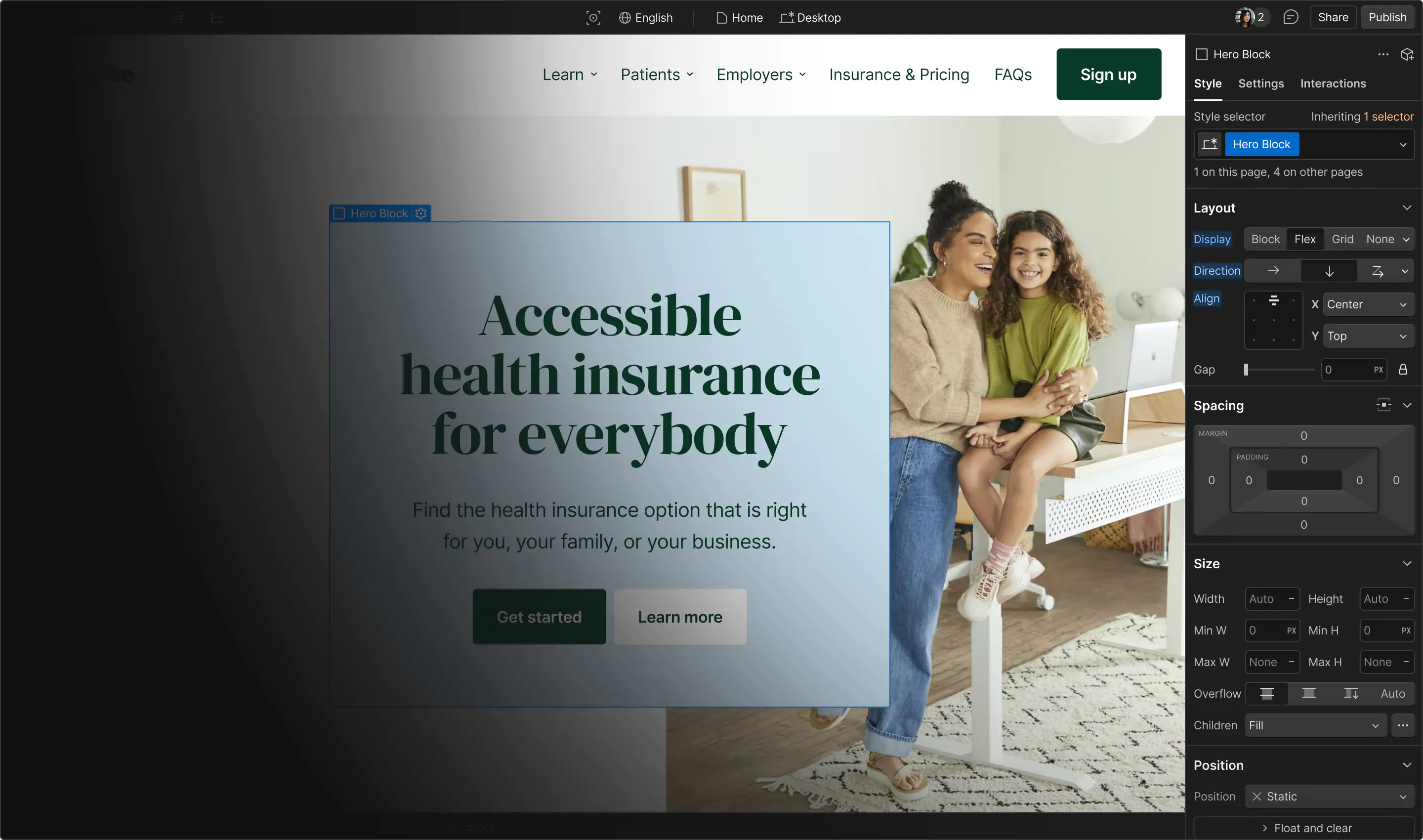
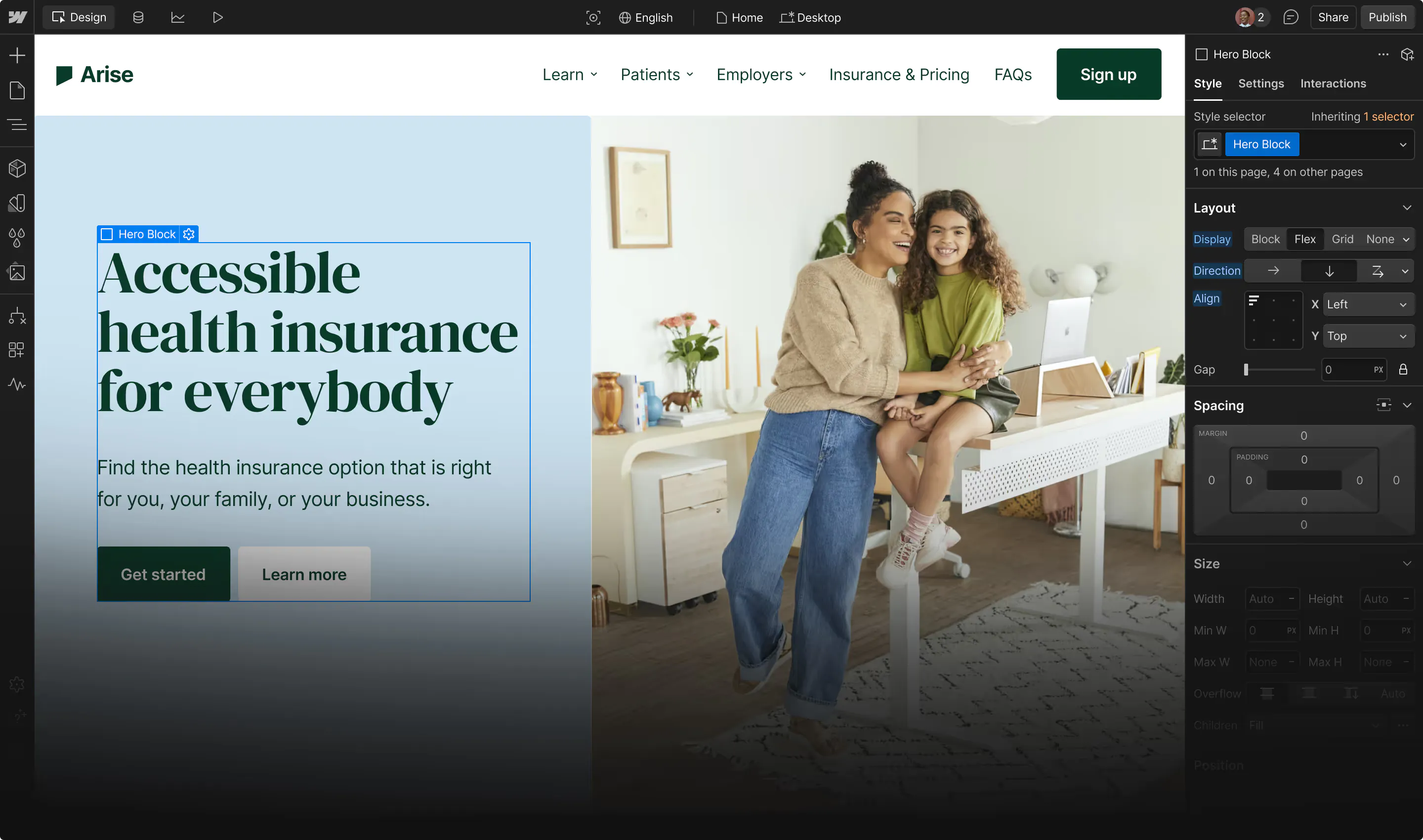
A landing page’s above-the-fold section includes all the elements that appear before visitors scroll down. This section is the page’s first impression, and its design determines whether people read further or click away.
Let’s look at some key above-the-fold elements and how to optimize them.
Headline and tagline
Most landing pages begin with a bold headline and tagline, which together communicate the page’s purpose and its benefits to readers. Make sure these elements set a clear expectation for what’s ahead, and that they speak to the target audience’s needs in as few words as possible.
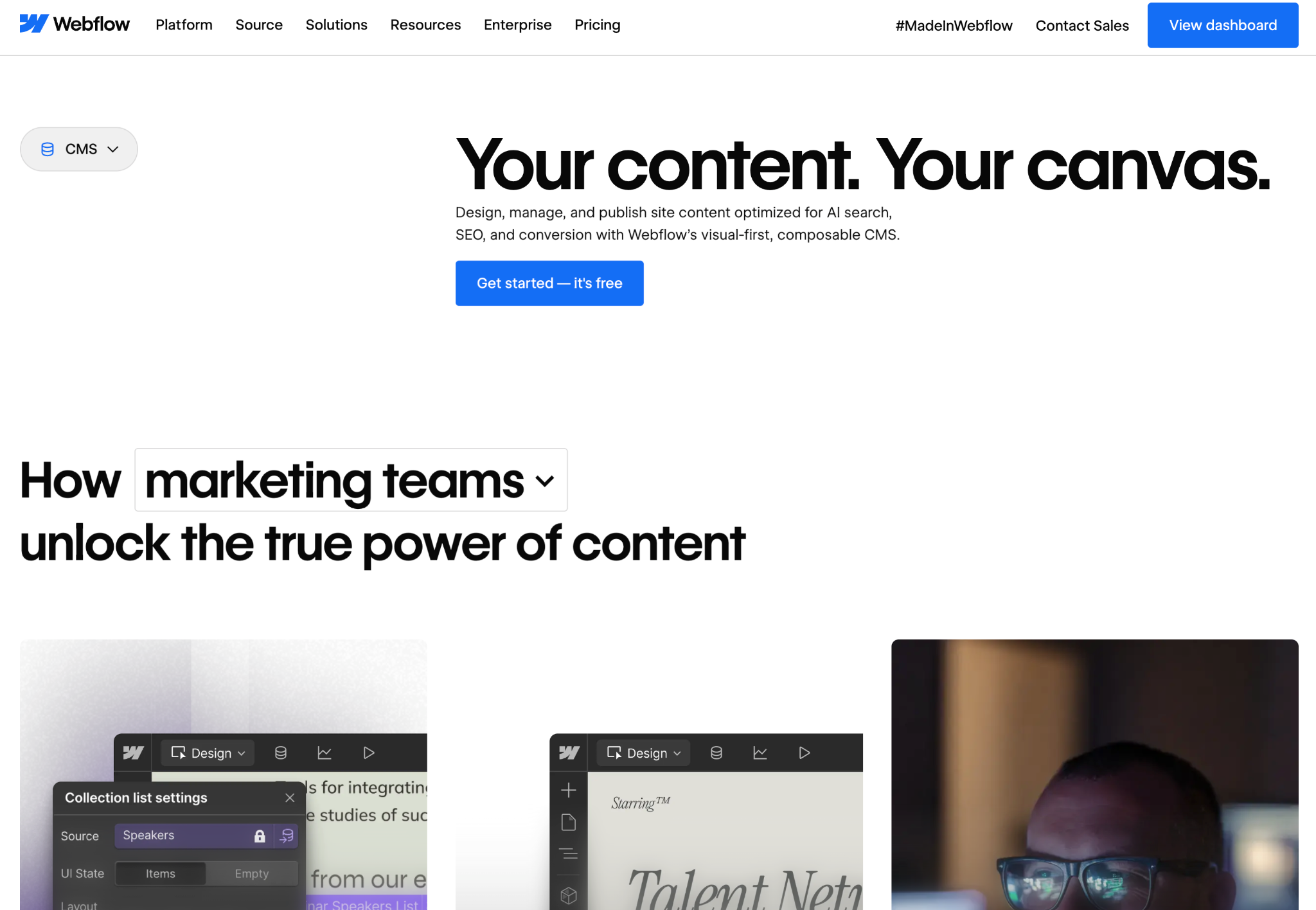
For example, our Webflow CMS landing page starts with the headline: “Your content. Your canvas.” This short, simple statement speaks directly to the reader, while the following tagline expands on what they can do with Webflow’s composable CMS.
Supporting copy
Once you have visitors’ attention, build on that momentum by laying out the product or service’s value proposition. Know what the audience wants, then concisely explain how they stand to benefit.
Don’t go into too much detail at this point; there’s plenty of room further down the page to elaborate on features and use cases. Instead, focus on the core problem the product or service solves, and use a few short phrases or sentences to preview the page’s broader narrative.
Clear call to action (CTA)
Place a highly actionable CTA in the above-the-fold section, in case the reader is ready to click through immediately. Short phrases like ‘Get started’ and ‘Try for free’ offer next steps that are clear at a glance.
If the product is complex or the buy-in is steep, you might start with a less commitment-focused CTA like ‘Learn more’ or ‘Get a demo.’ You can also use this first CTA to segment different types of visitors; for instance, sending businesses and individual consumers to distinct learning resources or pricing pages.
Social proof
It’s important for a landing page to offer immediate social proof, especially when visitors may be new to your brand. Display a few awards or recognizable logos if possible, to demonstrate your brand’s credibility and professionalism. You might also include key phrases from positive reviews, but save in-depth quotes and case studies for below-the-fold sections.
Visual hierarchy and mobile responsiveness
The above-the-fold section should have a clear visual hierarchy, so visitors understand what to look at first. Make sure this is true on the mobile version of the page as well, where reduced screen space can quickly create clutter and confusion. You’ll also want to consider the page’s readability and its accessibility for different types of visitors.

Build with Webflow
Webflow Enterprise gives your teams the power to build, ship, and manage sites collaboratively at scale.
How to optimize a landing page: 5 steps
Great landing page design is both an art and a science, and you’ll need a clear process you can follow to turn these designs around quickly. Here’s how to use best practices and careful testing to optimize landing pages for conversions.
1. Research the target audience
First, explore all the data you have on your client’s target audience, whether from provided resources or current website and landing page metrics. Pay attention to how people discover the brand, what they care about, what they interact with, and what distinguishes visitors who convert. It’s also worth doing a competitor analysis to learn from similar brands’ successes and failures.
In addition, look at traffic data to learn where visitors come from, so you know what channels to prioritize. For example, if a lot of people arrive from Google or AI searches, you know search engine optimization (SEO) and answer engine optimization (AEO) will be impactful.
2. Define conversion goals and KPIs
Clarify what the landing page’s conversion goal is, and consider how difficult it will be to achieve. A low-commitment ask, such as signing up for a free demo, often requires less content and optimization than a high-commitment ask like an expensive purchase.
This is also the time to decide which metrics you’ll use to measure progress toward the page’s goal. Analytics like bounce rates and view times tell you if the landing page drives interest. Marketing KPIs like signups and click-throughs measure whether the page encourages action and improves ROI.
3. Run A/B tests and personalization experiments
The more you experiment with a landing page, the more opportunities you have to discover what works and emphasize those elements. You can use a tool like Webflow Optimize to run automated A/B tests and discover which headlines or CTAs engage visitors. You might also try personalized features aimed at specific audience segments or buyer’s journey stages.
4. Use heat maps to understand visitor behaviors
Heat maps help you determine which parts of your landing page design capture people’s attention. This kind of tool offers visuals that show how people explore the page, including where they look and when they hover or scroll.
You can also use session recordings and behavioral analytics to learn more about how people interact with the landing page. Once you know what visitors tend to focus on, whether that’s a certain color or a button design, you can use those elements to drive attention to the right places.
5. Continuously refine and optimize the landing page
A single landing page may drive conversions over months or years, and it can often be used effectively in multiple marketing campaigns. That doesn't mean the page should remain static, though, as new experiments and ideas can further improve its conversion rate and ROI.
Use landing page optimization tools to capture data over time. Then, perform further experiments and testing as needed to adapt the page to evolving audience expectations.
Build and optimize landing pages efficiently with Webflow
Landing pages are great ways to funnel visitors toward focused CTAs and improve conversions. Because an entire user journey can happen on this one page, each element of its design and content must have a clear purpose and strong optimization. If you want to create quality landing pages consistently, you’ll need the right tools for gathering data, performing experiments, and building scalable workflows.
Webflow is an agentic web marketing platform that brings the entire landing page design process into one place. The composable CMS lets you create and reuse effective layouts, while performance optimization tools ensure that the page performs well under heavy traffic loads. Plus, testing tools and real-time analytics help you optimize each on-page element for best effect.
Create great landing pages at scale with Webflow.
How AI optimization drives conversions for marketers
In our ebook, learn how marketers are creating frictionless online experiences with AI.