

Take control of your website-building journey, from brainstorming to publishing, with this checklist.
Publishing a website can be as simple as choosing a template and clicking a few buttons. But to design and launch something that effectively draws in your target audience, you need a thorough process that ticks every box — from hosting the site on a reputable platform to adding engaging content with eye-catching typography.
Read on to learn how to publish a website and go live with confidence.
7 steps to prepare and publish your website
Follow these seven steps to effectively prepare, publish, and launch a website that performs just how you want it to.
1. Start with your audience and content
Before anything else, be clear about who your site is for and what it needs to say. Here are a few things to plan ahead of time so you can successfully connect with site visitors.
Define your audience
Create a profile of the people you want to reach and identify what they typically try to do after they land on your pages. Audience clarity matters here because it shapes the user experience (UX) and the actions you’ll ask them to take on your site.
Say you’re building a new website for your sports apparel company that makes customizable jerseys and uniforms. You want to use your new site to grow your client base, which is mostly small youth teams, by expanding into other kinds of teams.
Since the audience you’re interested in capturing isn’t the team itself (it’s the coaches or administrative support who orders uniforms) details about customization, pricing, and shipping times should be front and center. The main call to action (CTA) underneath those details could direct these potential buyers to a customization page where they can design and order their jerseys, or prompt them to book a call to learn more about ordering in bulk.
Define your website’s purpose
Decide what success means for your website so every page works toward the same goals. Establish this early on so it’ll be easier to make high-level design choices: what to prioritize first, what to cut, and which CTAs deserve the most attention.
For example, you might choose a primary goal like converting leads or answering FAQs to reduce support requests. Then, you’d see how each page moves visitors toward that outcome. If there are spots where it gets confusing or they could get distracted, you’d rework your content plan.
Map out your content
Understanding what content needs to exist on your site (and how it all relates) lets you efficiently plan the visitor’s journey. When you organize content with logic and intention, visitors spend less time figuring out what to do and more time learning about your offering.
Content mapping takes your notes and groups them into related topics so you can provide your site visitors with the right content at every stage of their user journey. Flow charts and diagrams are helpful at this stage because they visually differentiate topics and subtopics.
Write the content and gather media
Once you have a content map with complementary messaging, add copy to your design outline to see how they come together. It’ll help you figure out where to add emphasis with larger text size or bolding, where to shorten copy, and which sections need visuals for clarity.
For media, use high-quality, licensed images (or your own), and compress large files like videos so pages load quickly. Slow-loading content can cause people to bounce and search for similar information elsewhere. Add alt text for your uploads to make media more accessible, and keep your sourcing and permissions clear for legal purposes.
Optimize your content for users and search/answer engines
Content optimization makes your website easier to read and understand. Search engine optimization (SEO) pushes your site toward users through search engine rankings, and answer engine optimization (AEO) does the same for language learning models (LLMs). These search and answer engines crawl your site looking for certain signals to understand what’s on your pages, like meta descriptions and relevant keywords that match what people are searching.
While there are many strategies and tactics to optimize your content, these simple basics help you appeal to real visitors along with search engines and LLMs (that may eventually put your content in front of their own users):
- Use descriptive headings and short paragraphs that match search intent.
- Add internal links to help readers go deeper within your site.
- Use keywords naturally instead of forcefully stuffing them in for the sake of SEO/AEO.
Together, this information tells search engines and LLMs how reliable and relevant your content is to visitors, which changes how prominently your site is mentioned by LLMs and shown off on the search engine results page (SERP).
2. Design and build your website
Once you have the basics figured out, you can start turning skeletons into an enjoyable experience for visitors. Here’s the best way to proceed.
Come up with a layout
A layout impacts what draws visitors’ attention first and how they follow your content map through your CTA. Use visual storytelling to establish a clear path that takes visitors from curiosity to conversion.
- Start by breaking each page into sections and gradually fill in the gaps to structure your website.
- Outline core details about each page: the primary message, the sections it’ll need, and the major CTA.
- Keep navigation intuitive and use page names your audience would naturally search for and can instantly understand, like “Products” or “About.”
Create your website’s identity
Your brand identity is a combination of your brand’s messaging and how it looks online. If your visual branding shifts from page to page, your business will feel inconsistent and cause visitors to hesitate. Pick a direction and commit to it across every page — it makes your brand more recognizable, and it’ll be easier for you to make consistent design decisions.
If you don’t already have a visual brand identity, you’ll need to define the following:
- Tone of voice: How you speak to your audience (e.g., casual and friendly, wise and instructive).
- Color palette: A fixed set of colors for backgrounds, text, and accents.
- Typography: One or two fonts with a clear hierarchy for headings and body text.
Build a strong UX
The UX is what a visitor feels as they browse and move through your site. Ideally, it should be intuitive and load quickly, with obvious next steps. If visitors get confused, they’ll bounce — even if your site is aesthetically pleasing.
Before you start designing, think like a first-time visitor. They won’t have context about your brand and will scan for answers to basic questions. Make it easy for them to orient themselves, understand who you are and what you offer, and take action without any problems.
Develop a consistent user interface
The user interface (UI) is the interactive layer people interact with, like buttons, forms, and navigation bars. For example, you might add a hamburger menu that reveals different subpages users can visit.
Many UI features are consistent across sites (e.g., a drop-down menu behaves the same way when you click on it from a marketing agency’s site or a student portfolio). This consistency makes the UI feel dependable. When a button that looks the same everywhere on your site has the same specific response when clicked, your site’s reliability builds trust with visitors. To make UI and UX feel cohesive (and easier to update in the future), create a set of reusable components and repeat them across pages.
3. Choose your website platform and CMS
A website platform with a content management system (CMS) is how you’ll design, update, and publish your site. It makes everyday maintenance, like adding new pages and updating SEO-related elements, easier.
Here are some CMS options to explore.
Webflow
Webflow is a visual website-building platform with custom design features, a composable CMS, and managed hosting. It has thousands of templates to choose from, but you can also create bespoke sites without hiring a developer.
Your web pages will be automatically responsive with Webflow, so they’ll automatically adapt to multiple screen sizes without having to make any manual changes. And you can structure content in collections (like blogs, case studies, and directories) to update the information inside without rebuilding layouts from scratch every time.
Webflow is an excellent option for anyone who wants to build a visually appealing yet functional website, from personal portfolios to enterprise sites.
Wix
Wix is a website builder with templates and drag-and-drop editing tools ready for beginners and hands-off developers. If you want a simple site that you can publish quickly, Wix also offers an AI Website Builder that puts everything together based on your prompts and pre-made themes. It also has built-in website hosting and security updates so you can publish without touching code.

Get started for free
Create custom, scalable websites — without writing code. Start building in Webflow.
WordPress
WordPress is an open-source CMS, which means you can use it for free. WordPress.com includes website hosting, but with WordPress.org, you can choose your own hosting provider and extend your site’s functionality with themes and plugins. WordPress is a popular platform for content-heavy sites, but adding more features through its plugin library means it’ll be more work to keep it up and running.
4. Secure a domain name
A domain name is your website’s public address, and it makes up most of the URL visitors use to access your site. Choosing a memorable domain name makes future touchpoints easier, as people can recall and share it more easily while you build a recognizable brand.
Pick a name that’s ideally short, easy to spell, and simple to say out loud. Anything confusing increases the risk of typos, which cause people to end up somewhere else. For example, “designstudio.com” is a better domain name than “design-studio-california-2026.”
Once you’ve chosen a unique domain name, register it through an ICANN-accredited registrar like GoDaddy or Hostinger (or a reputable reseller they work with).
5. Find the right web hosting service
A web host stores your site’s files on a server and makes them accessible on the internet. When someone types your domain name in their browser, the host delivers your web pages to their device. Without hosting, there’s no ‘live’ website to load. Platforms like Webflow offer built-in hosting, while others connect with a provider of your choice.
Here are a few factors to consider when looking for a web hosting service.
Speed
Speed isn’t limited to how fast your site loads — it’s also how quickly visitors can interact with it. Hosting affects the server response time, caching, and global content delivery of every visit. When pages feel fast, people are more likely to stay and take action. Look for hosting that supports modern performance metrics, like content delivery networks (CDNs), so your Core Web Vitals are easier to maintain.
Scalability
Scalability is how your hosting provider handles changing demand, like a traffic spike after a product release. Depending on the demand, your host will increase or decrease resources like bandwidth and storage as needed to host your site. A capable hosting service will keep your site from slowing down or crashing, no matter how demand shifts.
Reliability
A reliable site is one that’s available and behaving as expected as much as possible. It should be visitable 24/7 and consistently load error-free. Your host affects your site’s reliability through its uptime, redundancy, and how the provider’s resources handle strenuous situations.
6. Do a quality assurance audit
A quality assurance (QA) audit is one way to make sure your site matches your intent once it’s live. After publishing, visitors will click links, read headings, and judge your credibility within moments of browsing your site. A QA audit with a pre-launch checklist helps you catch issues before potential customers do.
Here are the most important things to check.
Proofread the content
Read each page like a first-time visitor. Do you understand the site’s offering at a glance? Does the structure flow logically into your CTA?
Check that headlines effectively lead into what follows, CTAs are prominent, and you back up bold claims with evidence. If you can, read the page out loud to catch awkward phrasing and missing context. Scroll through the site on mobile, too — you’ll see whether your site is responsive or content gets cut off.
As you edit, prioritize active voice and shorter paragraphs, which are easier to read on mobile.
Check spelling and grammar
Spelling errors can undercut your site’s polish. Start checking your spelling in high-impact areas — navigation menus, CTAs, and headings — and work your way to supporting elements like body and alt text.
Then, scan for proper nouns like brand names or product names. Spell checking tools aren’t always familiar with wordplay-style branding and mistakenly ‘correct’ it. If your site uses industry terminology, add jargon to your dictionary so it won’t get flagged.
Spelling and grammar-related tools can help catch typos and poor phrasing, but thoroughly scan your site and make the final call yourself.
Fix SEO/AEO-related text
In addition to a general hygiene check for spelling and grammar, review microcopy across the entire user experience, keeping SEO/AEO best practices in mind. Prioritize:
- Button labels
- Form placeholders
- Error messages
- Success messages
- Cookie banners
- Footer details
To keep your site discoverable, check metadata that appears in browser and search engine/answer engine results, like page titles and descriptions. Preview your keywords and general readability on desktop and mobile. You won’t want to miss minor details like an incorrect phone number or a confusing state error that stops a form submission.
Optimize images
Images are some of the biggest files on a page, and optimizing them is one of the fastest ways to improve your site’s load time. Here’s how to do it:
- Resize images to the largest display size you actually need.
- Compress images before uploading them.
- Save images in modern formats like PNG or JPG.
- Add descriptive alt text for screen readers and better accessibility.
- Make sure individual breakpoints have appropriately sized files for responsive images.
Follow proper semantic structure
Semantic structure means using headings and HTML elements to describe the content. Screen readers navigate with headings and landmarks, so a clear hierarchy helps everyone find what they need. Use one clearly labeled H1 per page and nest headings in descending order: H2 → H3 → H4.
Anchor text and bullet points should also make sense out of context so search engine features (like Google’s rich snippets or AI Overviews) can summarize and prioritize your site. Being featured in a rich snippet or AI Overview can boost your site’s ranking (and reputation). If your content is reputable and accurate — and presented in a clear, easy-to-digest hierarchy — Google’s LLMs can pull a few sentences off your website to answer a common search query at the top of page one.
Test links and integrations
Test every link and integration before going live to make sure they redirect to the correct destinations. Broken links and integrations are counterproductive when you’re trying to convert visitors, and they can create crawl issues once Google starts indexing your site.
Click through navigation menus, CTAs, and footer links, and submit every form to confirm what happens next is what you want. Verify that your interactive tools all function as they should, and check for 404 errors that visitors may run into.
7. Publish your website
After identifying your target audience, creating content, and honing the user experience, your site is almost ready to go live. Most hosting platforms offer ways to see a staged, but not live, version of your site as it’ll appear to visitors. Review the draft on desktop and mobile to spot errors like broken buttons or broken/blurry images. If everything looks clean and works correctly, it’s time to share your work with the world.
There are two ways to finalize and publish your site in Webflow.
Publish from Webflow’s visual design platform
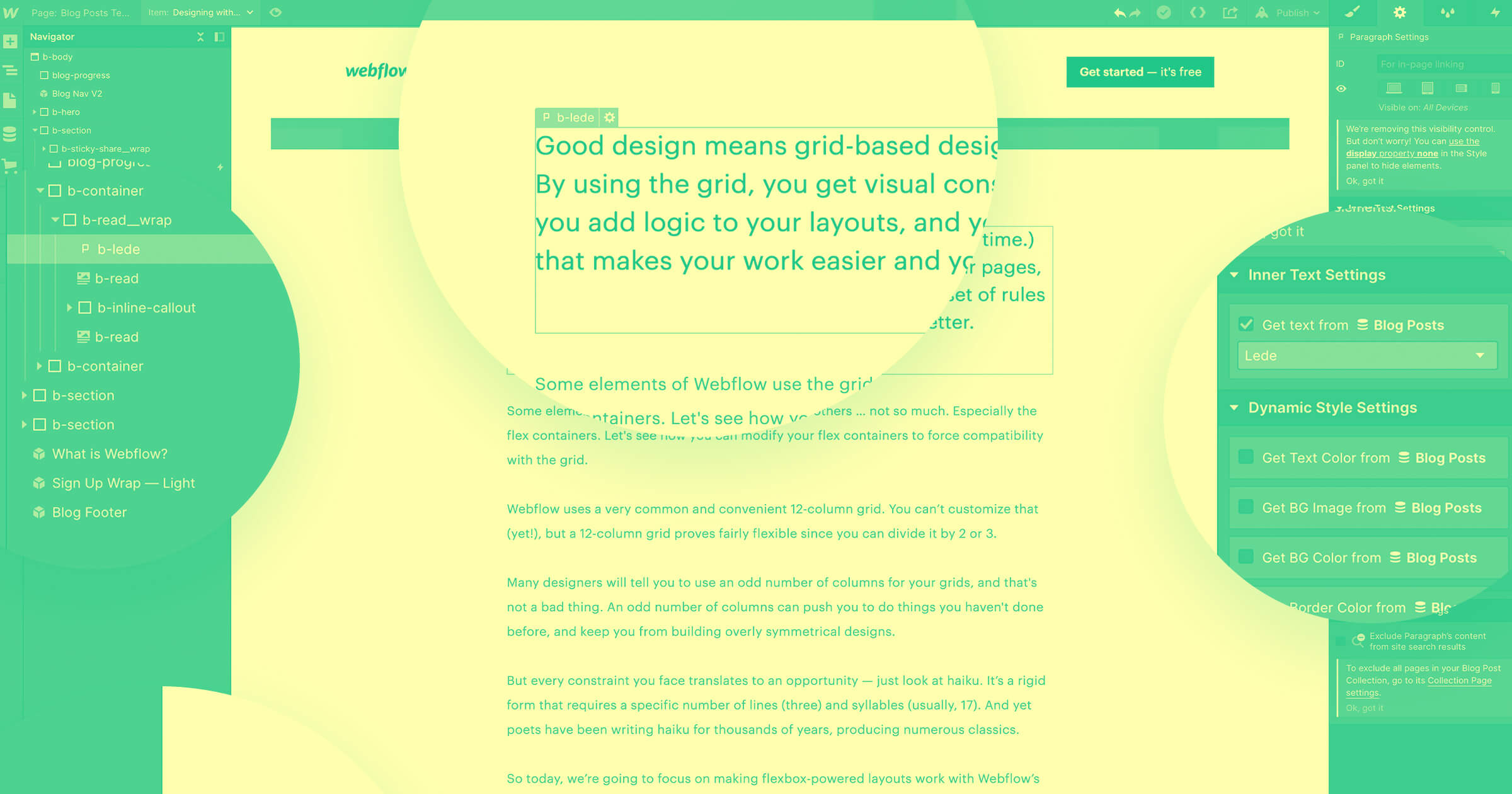
When you’re ready to go live, publishing from the design platform is the fastest way to ship updates. Click “Publish” and choose where you want to view changes — your Webflow staging domain (a safe testing environment for final checks) or your custom domain, which pushes your site live.
Publish from Webflow’s product settings
If you prefer an approach that lets you fine-tune the more technical elements yourself, you can publish from “Site settings.” This page is also where you can connect and manage domains. “Site settings” helps if you’re setting up a feature for the first time — for example, verifying your domain name system (DNS) and confirming that your custom domain points to the right location. Once you’re ready, click “Publish.”
Create your site and go live with Webflow
Building and publishing a website is a process that involves a lot of planning your visitors may never see. But that effort makes for the best web experience possible — one that captures their attention and converts. Once you’ve paved their journey through your site and handled the technical details, you’ll be set for publication day and beyond.
With Webflow, design, CMS content, and publishing live in one hub to help you build a more intuitive workflow. Reliable hosting means your site loads efficiently, while responsive design automatically adapts your site to different screen sizes.
Over time, you can keep improving your site without having to hire a developer, but our collaborative features mean you have the option for others to edit and provide feedback in real time.
Start and scale your best site yet in Webflow.
Full site build
Design and develop a CMS-driven website that meets the needs of your client and their audience.