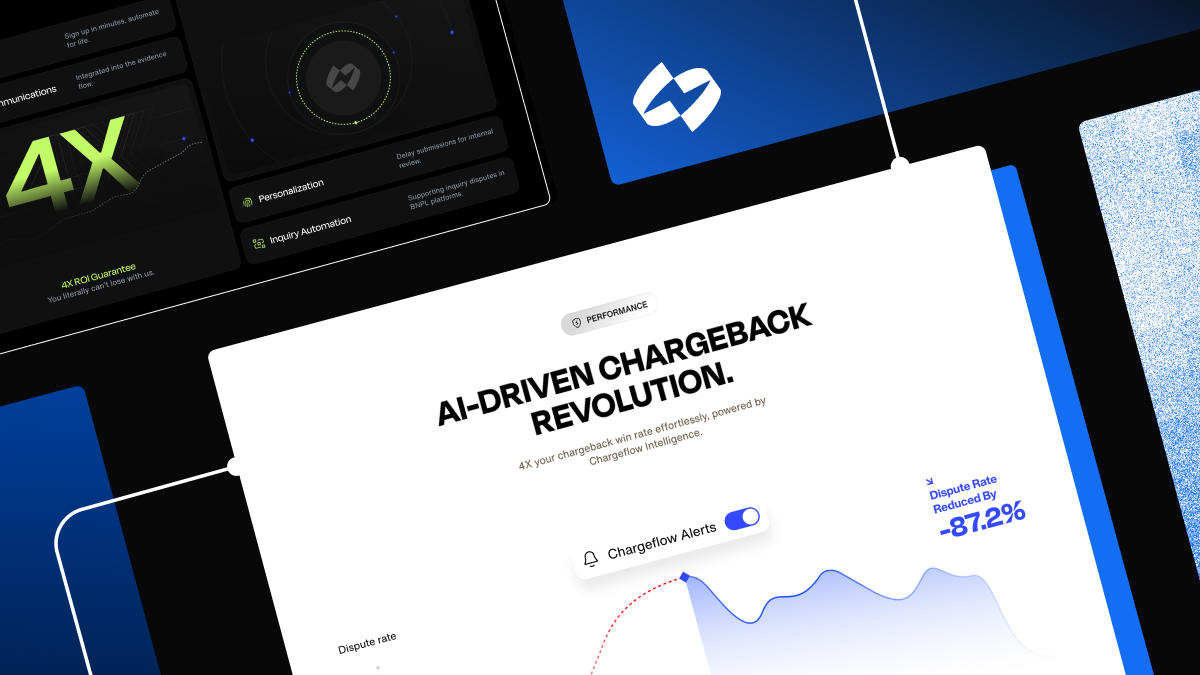




Merchants lose over $100 billion to chargebacks every year. Most of them treat it as a line item to absorb and simply, the cost of doing business. Chargeflow was founded by people who saw it differently.
Ariel and Avia Chen were running a beauty subscription brand when chargebacks started draining their margins. They built an internal tool to fight back, and it worked well enough that their founder friends wanted access, then their friends' friends. They sold the brand and went all-in on the problem. Now, five years later, over 20,000 merchants — including Miro, Huel, Fanatics, and Sweetgreen — trust Chargeflow to automate their chargeback recovery, and revenue has tripled year over year.
That builder instinct runs through how they operate today: an AI-native team, a content machine publishing 10 to 15 pieces a week, a brand built to look nothing like the competition, and a website designed from day one to show up where their customers are increasingly looking.
The team runs like the product
Chargeflow is trying to create a category around a problem most merchants haven't fully quantified yet. That requires publishing fast, showing up everywhere, and building authority before the window closes. So Dan Moshkovich, VP of Marketing at Chargeflow, built a team wired for it — marketers creating quality content, with Claude in the loop to optimize, proof, and fact-check, custom in-house agents for repeated tasks, n8n pulling data across the stack.
"AI is not just a buzzword," Moshkovich says. "It's a critical component of the product itself and of how the team operates." It maps directly to what Chargeflow sells. The product automates chargeback dispute management end-to-end using agentic workflows that learn from millions of resolved cases.
Mastercard projects chargeback volume will reach 324 million transactions annually by 2028, with friendly fraud accounting for nearly 80% of cases. The window to own this category is open now, and Chargeflow has been investing toward it on every front: the team, the content operation, the website.
"AI is not just a buzzword. It's a critical component of the product itself and of how the team operates."
A content machine built to educate and be discovered
The publishing operation runs out of Chargeflow's site across two tracks that are more complementary than separate: ecosystem education and SEO.
"Once we built the sections of the website like Chargebacks 101 and the Knowledge Base, that let us tackle SEO and the educational side at the same time," Moshkovich says.
Chargebacks 101 covers the macro: how the dispute landscape is shifting, what regulatory changes mean for merchants, why the problem compounds in ways most businesses don't track. The Knowledge Base goes tactical: how to prevent chargebacks on high-value orders, what issuer banks look for in dispute evidence, why certain submissions fail. Both sections are custom-built in Webflow, structured around topic tags, TLDRs, and a clear information hierarchy. The goal is bigger than just ranking in search. It's to be the source AI engines cite when a merchant asks a question about chargebacks.
The workflow runs through Claude. Chargeflow's head of content starts with a topic brief, feeds it into a multi-step Claude sequence that pulls external research and builds an initial draft, then reviews and rewrites for accuracy — product specifics, industry nuance, the details a model will confidently get wrong without a subject matter expert in the loop. AI handles the volume, and a skilled marketer handles the craft.
Built for AI search from the start
What makes this more than a content velocity story is timing. The structured architecture — tagged articles, TLDRs, clean section hierarchy — was designed into the rebrand from the beginning.
Tomer Meshulam, Head of Design at Chargeflow, has described the site's purpose as creating an experience where the brand is fully legible: dynamic, direct, and rich with signals about what Chargeflow is and who it's for. That design sensibility and the AEO strategy turned out to be the same project. A site built to communicate clearly and specifically to humans also communicates clearly and specifically to AI systems trained to surface the most authoritative answers.
"We invest heavily in making sure the content inside the site is optimized for AI engines," Moshkovich says. Review sites are a deliberate part of the strategy too because third-party citations signal authority to AI systems the same way backlinks signal it to traditional search. When merchants ask AI tools which chargeback solution to use, Chargeflow shows up consistently enough that they built a campaign around it — Good AI Recognizes Good AI — that invites prospects to test the result themselves.
Craft and performance aren't a tradeoff
Fintech, as Meshulam describes it, is an industry where design innovation has historically lagged: finance people, legacy interfaces, nothing that matches the ambition of the product behind it. When Meshulam joined Chargeflow, the brief was to change that — to build a brand that reflected what the product actually was. "Branding has been one of the ways that we differentiate ourselves from the competitors," Moshkovich says.
Last January, that brand partnered with award-winning agency, Refokus, and found its fullest expression in a site rebuilt from scratch on Webflow. The result is one of the most visually distinctive in fintech: motion design throughout every page, a navigation that shifts colors as you scroll, a brand page layered with stickers and interaction. "We wanted to create an experience," Meshulam says, "because I think it's one of the things that makes everything unique with Chargeflow."
Chargeflow's core customers are ecommerce merchants — people who spend their days on well-designed storefronts and understand branding intuitively because their own business depends on it. A beautiful website in that context is a trust signal. It tells a merchant that the company behind it cares about craft at every layer.
For the Chen duo, who built their first business selling to consumers online, this standard came naturally. Moshkovich goes as far as describing their attention to detail and craft as meticulous: “"I see them at two in the morning, in Figma, doing their magic, moving pixels. It's a testament to how important brand and design is to them,” he explains.
After the rebrand, engaged sessions grew by more than 112%. Visitors weren't just arriving in greater numbers; they were staying and going deeper into the site. Webflow is the infrastructure that makes this possible at the pace Chargeflow needs. The content team publishes without waiting on developer time. The ABM and events coordinator puts up landing pages ahead of conferences — a month out, independently, without a developer ticket. Templates handle the brand consistency. In-house Webflow developer Harel Panker handles the builds that actually need him. "Webflow is actually taking me 80-90% of the way when I need to convert crazy Figma designs into actual working pages,” he says.
“We wanted to create an experience because I think it's one of the things that makes everything unique with Chargeflow.”
What Chargeflow has its sights on next for the site
With a $35M Series A closed and an enterprise sales team now based in New York, Chargeflow is asking the website to carry more of the buying journey. Enterprise buyers take longer to convert and need more to engage with before they do.
The team is building vertical-specific gated reports — friendly fraud in luxury fashion, in ticketing, in SaaS — with landing pages designed to let prospects read the first few pages before reaching the gate. The content machine that educated the market on chargebacks is now being pointed at ABM. An AI-to-CMS publishing pipeline is also in development, one that will reduce the steps between a finished draft and a live page.
The website, structured from the beginning for AI search and built to a visual standard most fintech companies strive for, is the platform all of it runs on.
Chargeflow built a product that automates something most merchants had accepted as a fixed cost. They built a marketing org that runs the same way. And they built a website that holds all of it together: structured for AI search, designed to stop people mid-scroll, and built to keep up with a company that hasn't slowed down since two founders sold their business to go all-in on a problem they lived themselves. Webflow is the infrastructure underneath that. For a team that needs every layer of their operation to move with the same intention, it's what lets the website keep pace with everything else.
.jpg)
Own your brand visibility in AI search
Measure how your brand shows up in answer engines, get prioritized recommendations, and ship improvements at scale — all within Webflow.