




Agents can generate answers; governed data, encoded expertise, and architectural controls make those answers trustworthy.
As Webflow builds the agentic web marketing platform, our Data & Insights team applied the same AI-first mindset to internal decision-making. An agent can write valid SQL and still produce the wrong business answer. One question became central: what must be true for an agent to produce work people can trust?
Our team spans data platform engineering, analytics engineering, business intelligence, and data science. To build trustworthy self-service analytics, we first had to become effective users of AI and builders of agents ourselves. Using agents in our own workflows showed us where they created leverage, where they failed, and what context, standards, review points, and controls they needed to operate reliably. That experience also forced us to encode expertise that previously lived in individual workflows. We learned that making the team AI-native and enabling trusted self-service analytics across Webflow are not separate transformations. Both depend on the same operating system: governed data, executable business context, reusable skills and agents, architectural controls, and human judgment.
Generating a query is easy. The harder challenge is encoding Webflow’s business definitions, approved sources, permissions, and review expectations so an agent can operate reliably. An AI-native operating system must continue to evolve with business needs and ways of working. In this article, we are sharing what we built, how it changed our work, and the impact we are seeing.
Trusted self-service analytics starts with an AI-native team
Before we could enable trusted answers at scale, we needed to make AI part of how our own team worked. Access to an AI assistant was not enough. We embedded an “Agent First” mindset in team norms and career expectations, redesigned workflows, and protected time for learning and experimentation.
New ideas could be tested freely, while reusable skills and context were committed to centralized repositories and organized by maturity and trust level. AI champions and weekly forums helped the team share working examples, solve recurring problems, and turn individual learning into shared team capabilities. This shift created immediate efficiencies and gave us firsthand experience collaborating with agents.
The team adopted a recurring prompt: How could we do this with an agent?
The operating system
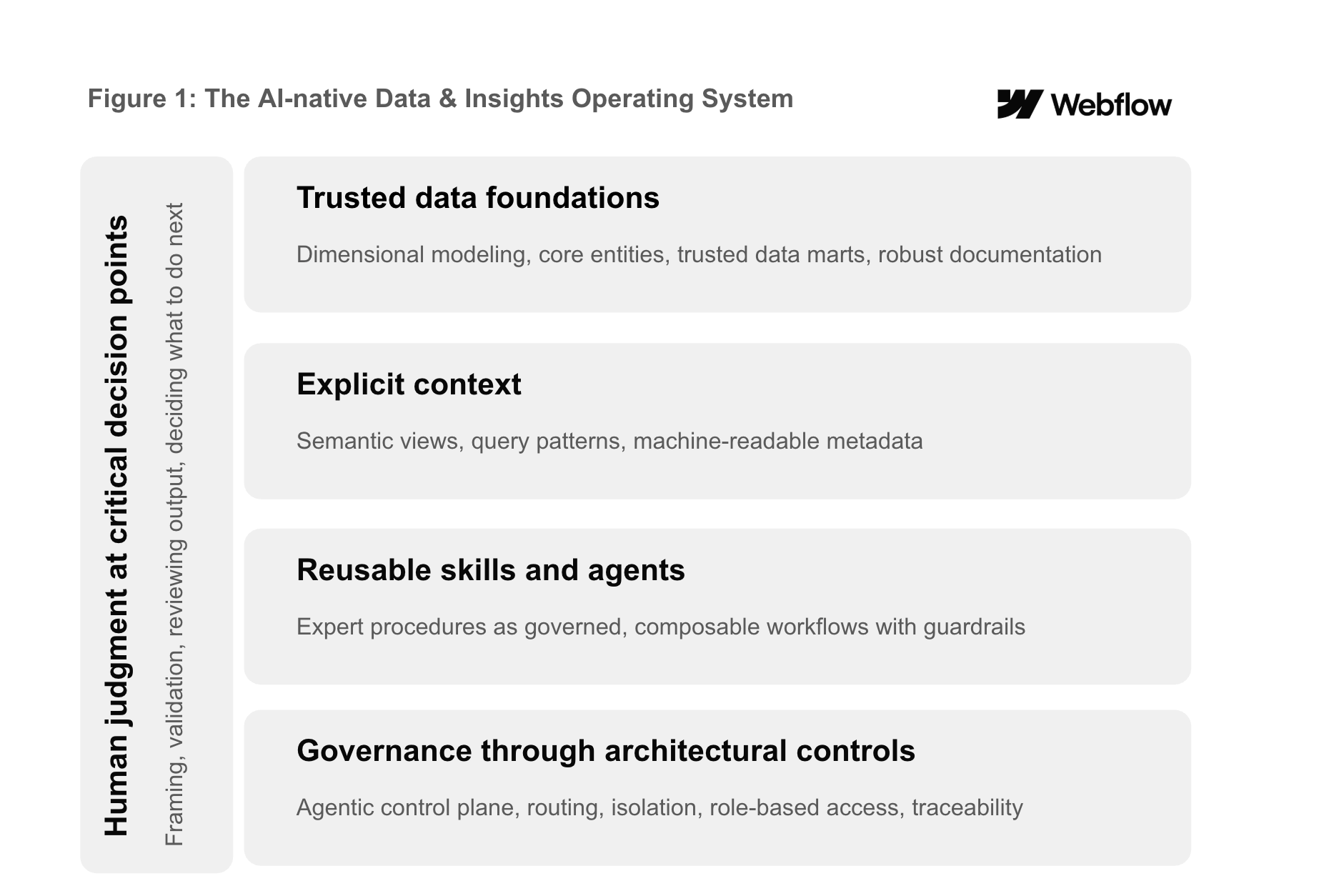
Scaling trusted self-service analytics required a broader operating system that agents could navigate reliably and people could trust.
Start with trusted data foundations
Over the past decade, Webflow accumulated hundreds of sources, tables, and models built for human experts, not agents. Choosing the right asset often depended on tribal knowledge about which tables were current, how identifiers mapped across systems, and which definitions applied. Agents made that ambiguity more consequential. Last year, we began a multi-quarter effort to rebuild our enterprise data warehouse using Kimball dimensional modeling. Modular star schemas now standardize facts, dimensions, identifiers, and taxonomies across our data. Governed data marts, a searchable data dictionary, and an automated catalog workflow provide a documented, common source of truth.
Building business focused data marts with standardized entities
Previously, duplicated entity logic, inconsistent identifier mapping, and drifting metric definitions created conflicting results across teams. The new core layer standardizes seven master entities. Every new fact model uses these standardized dimensions, while a common customer key reconciles self-serve workspaces and sales account identities for consistent customer-level analysis.
On top of that core, governed data marts serve as trusted query layers for various use cases, replacing fragmented reporting with decision-ready data purpose-built for how each team works. A Customer 360 mart combines customer and product data, with product adoption signals flowing into Salesforce to support field teams with upgrades, retention, and expansion motions. An ARR mart provides reconciled recurring revenue & net dollar retention reporting by customer, subscription, and product. Other governed marts cover product adoption, customer journeys, marketing funnels, pipeline and bookings, AI credits, seat utilization, and site usage.
Engineer reliability into the foundation
A trusted data foundation cannot depend on people or agents remembering which sources, definitions, and standards to use. We encode those controls directly into the foundation.
Modeling standards, semantic definitions, and reference documentation live together in a version-controlled repository, while tooling routes agents to trusted models first. The PR Review Agent checks every dbt change for architectural violations, naming drift, missing tests, PII exposure, and dependencies on uncertified assets. Downstream work must build on the trusted layer, with tests catching unintended effects before changes are merged. The goal is to make the correct path the easiest path for people and agents alike.
Make business context executable
A governed warehouse is necessary but insufficient. Agents also need to understand what Webflow means by “ARR,” “customer,” or “seat utilization,” and how those concepts map to data. We created governed context assets to make those definitions explicit and usable by agents.
Semantic views
Semantic views act as a contract between business language and governed data. They encode approved metrics, dimensions, relationships, and terminology as version-controlled code, allowing AI clients and downstream workflows to use the same calculations. Together with warehouse models and metadata, they form a machine-readable context layer, so business logic does not live only in dashboards or people’s memories. Agents can rely on these centrally maintained definitions instead of inferring meaning from table and column names.
Questions such as “What is NDR by segment?” can now be answered from a validated metric definition rather than one-off SQL. Our Semantic View Author Agent helps create Snowflake semantic views at scale, while humans retain ownership of the definitions.
Query patterns and business context
We encode recurring analyses as domain-specific patterns that define grain, filters, assumptions, and known failure modes, starting from reviewed logic rather than reconstructing the approach each time. A machine-readable repository organizes data science metadata, organizational context, and analytical work for agents, creating a path from individual insight to shared institutional knowledge.
Encode expert workflows as skills and agents
While semantic definitions resolve business meaning, skills govern execution. Our largest investment has been encoding Webflow’s analytical procedures and review standards into repeatable workflows defining permitted sources and tools, execution steps, validation requirements, human review, ambiguity handling, and evidence. Each discipline applies this approach to its own work.
Operating the data platform with reusable expertise
Data platform work spans production systems, repositories, and failure modes, often requiring distributed expertise. We created a plugin marketplace to build, version, install, and share that expertise, with automatic updates for consumers.
Skills cover major operations: data-quality triage diagnoses failures while preserving read-only production safeguards; analytics-store validation compares ingested data with the source of record; orchestration skills inspect pipelines and coordinate backfills and deployment jobs; and streaming skills support topic, connector, consumer-group, and schema operations. These workflows reduce reliance on tribal knowledge and interface switching.
Building governed data with composable workflows
Analytics engineering created a four-level skills library: orchestrators manage end-to-end workflows, coordinators provide domain expertise and checkpoints, functional skills complete lifecycle steps, and primitive skills perform reusable operations. This structure makes the library composable and auditable while giving every analytics engineer consistent answers to two questions: what should I build, and where should it live?
The team uses a connected workflow: the dbt Author Agent drafts SQL, YAML, tests, and documentation for human review; the PR Review Agent checks the change against engineering standards; and the Follow-Up Agent addresses deferred advisories. Cursor services orchestrate this workflow, while a Slack interface lets the team investigate data errors without switching contexts.
Turning governed data into trusted insights and decisions
The data science team created a lab for publishing skills across three maturity levels: experimental for drafts, stable for tested workflows, and shared for cross-functional use. Promotion requires review based on the intended audience.
Skills support analysis design, forecasting, and question-framing review, while coordinated agents support descriptive analysis, opportunity sizing, root-cause investigation, cohort analysis, and trend analysis. Shared guardrails include catalog-first definitions of fields, filters, and query recipes; freshness gates that stop stale or incomplete workflows unless explicitly approved; materiality thresholds that focus on meaningful changes; and epistemic checks that surface ambiguous definitions and assumptions. Every answer is labeled CONFIRMED or INFERRED to make its provenance explicit.
Enforce governance through architectural controls
Traditional analytics governance relied on a layered pipeline of certified data and controlled dashboards. Agents can bypass both and query data directly, so guardrails cannot live only in prompts or policy documents. An agent’s attention is distributed across skills, pretrained knowledge, documents, conversation context, and competing warehouse tables. Governance must therefore sit outside the context window.
We built an agentic control plane that constrains the path before an agent can select an ungoverned source. An Enterprise Skills Registry versions and deploys governed skills across supported AI clients, allowing governance to follow users across interfaces.
A deterministic path to governed answers
Returning to the NDR example, every governed interaction follows four hops that remove decisions the agent might otherwise get wrong (see Figure 2).
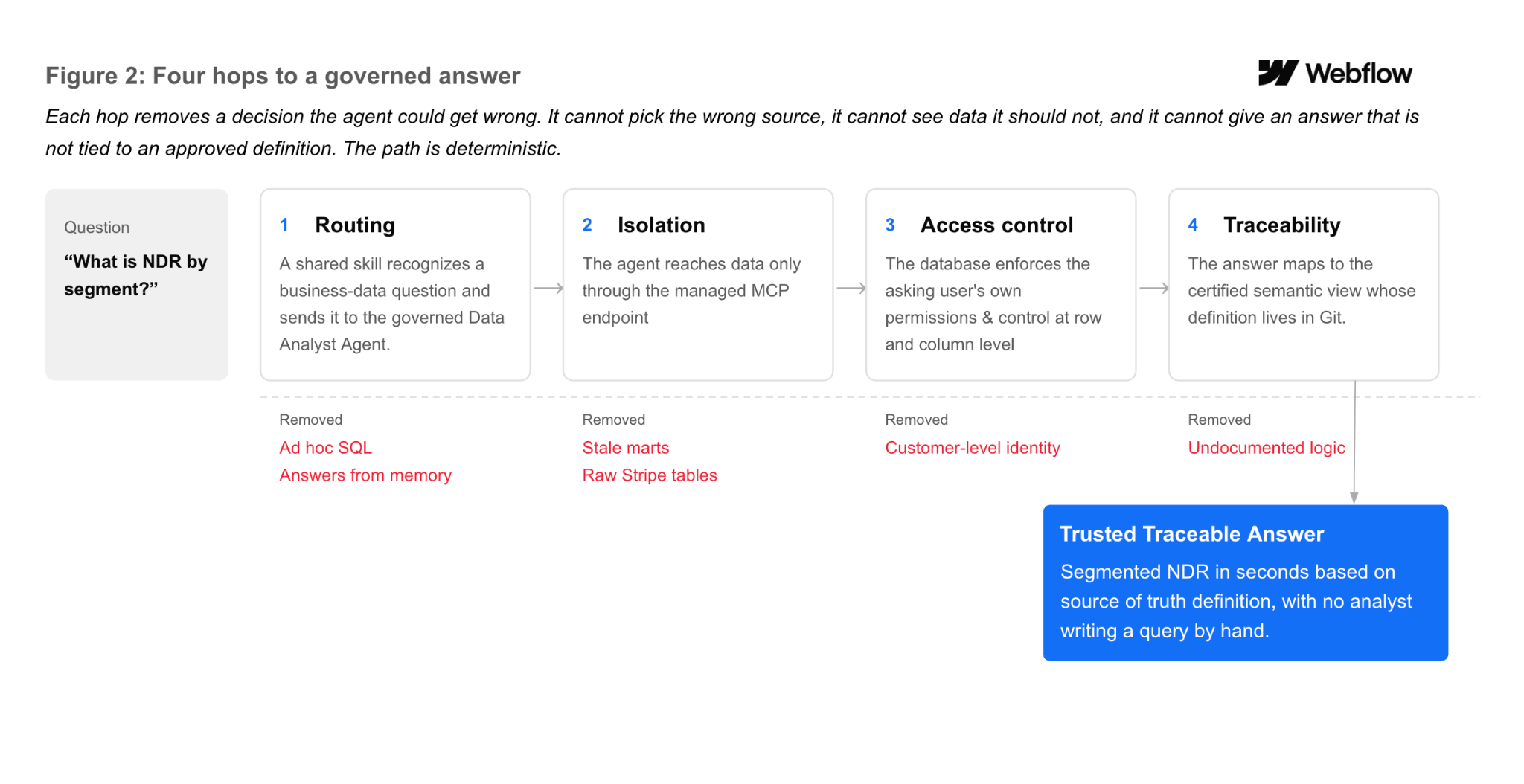
These controls constrain available sources, metric definitions, and permissions, reducing the high-risk decisions left to the frontend agent. They do not eliminate failure because the agent must still interpret user intent, but they narrow the available paths and make deviations easier to detect.
Validating the control plane
Architectural controls matter only if the agents and skills behind them are tested before release and continuously evaluated afterward. We built two systems to support this.
Before release, our reliability evaluation framework tests agents and skills at scale and gates which versions reach production. After release, the Governor reviews each run, verifies whether the response came from a governed source, and returns a “certify” or “warn” verdict. This gives users a visible trust signal for every answer.
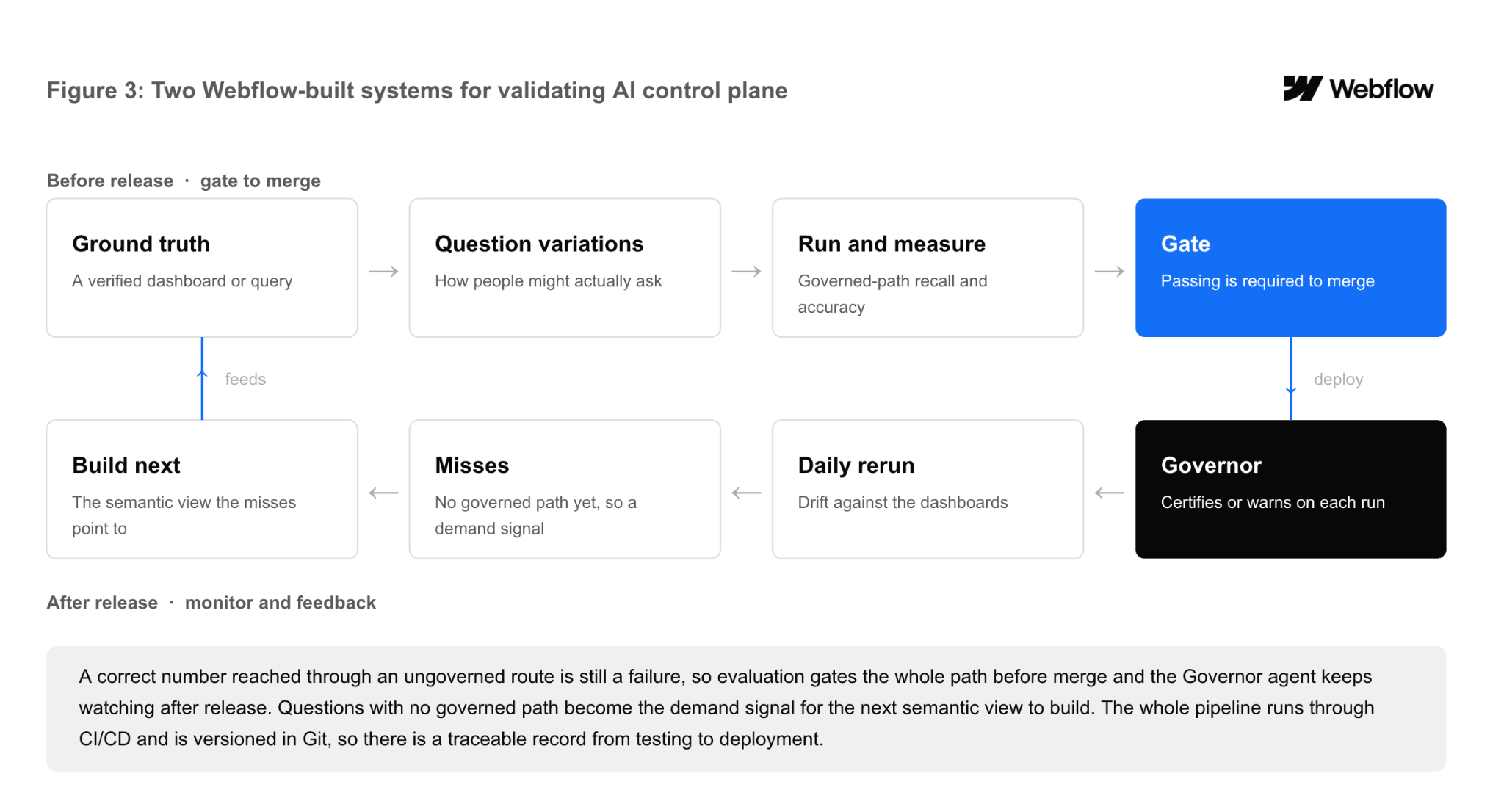
As Figure 3 shows, findings from production monitoring feed the next round of testing and determine what we build next, creating a continuous feedback loop.
Impact across the data lifecycle
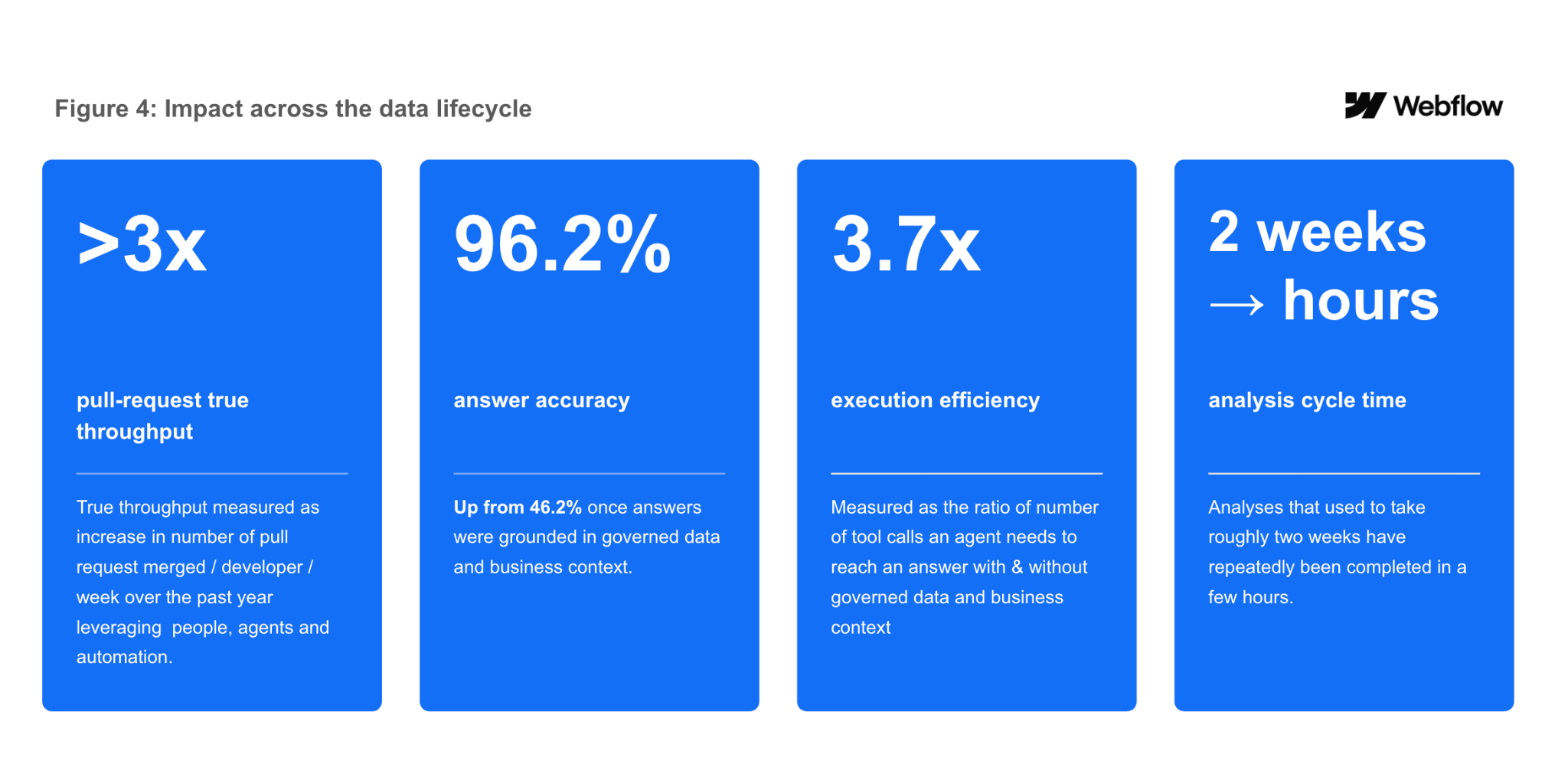
The impact spans team operations, delivery speed, and access to trusted answers across Webflow (see Figure 4). Together, these shifts save time, accelerate asset delivery and insight-to-decision cycles, and improve decision quality while extending trusted self-service analytics without weakening governance.
Faster engineering delivery and more efficient data operations
Across data platform and analytics engineering, total pull-request true throughput increased by more than 3x over the past year, reflecting the combined output of people, agents, and automation. Agents now support authoring, review, incident investigation, and follow-up while preserving human approval where judgment is required.
Agents have resolved production data-quality incidents end to end, identifying downstream dependencies and opening pull requests with diagnoses and fixes. Work that once required manual investigation can now be completed in minutes.
Greater analysis velocity and strategic leverage
We have repeatedly completed analyses in a few hours that would previously have taken roughly two weeks, while cycle times for metric investigations and root-cause analyses have also fallen.
Data scientists now have more capacity for strategic work and spend more time reviewing agent output, applying business judgment, and translating analysis into action. The role is shifting from producing a correct number to recommending what the business should do. This has changed how we design agents: we focus on workflows that involve people where their judgment is most valuable rather than automating an entire analysis in one pass.
A governed path to trusted self-service analytics
These foundations are beginning to enable broader access to governed insights across Webflow. Our Data Analyst Agent supports governed metrics across product, finance, and sales.
Early users can ask questions through a familiar AI interface while the control plane routes each question to certified semantic views, applies access controls, and ties the answer to an approved definition. As we expand access and metric coverage, we can deliver faster answers without sacrificing consistency, security, or traceability.
In our internal evaluation set, grounding agents in governed context and architectural controls increased answer accuracy from 46.2% to 96.2% and improved execution efficiency by 3.7x, as measured by the number of tool calls required to reach an answer. Anthropic reported an increase from 21% to more than 95% once analytical workflows were encoded as reusable skills; Snowflake reported an increase from 25% to 86% with improved business context; and dbt Labs reported an increase from roughly 90% for raw text-to-SQL to 98–100% with a governed semantic layer. Although these benchmarks use different methodologies, they show a consistent pattern: trusted business context, not the model alone, drives reliable answers.
What we have learned
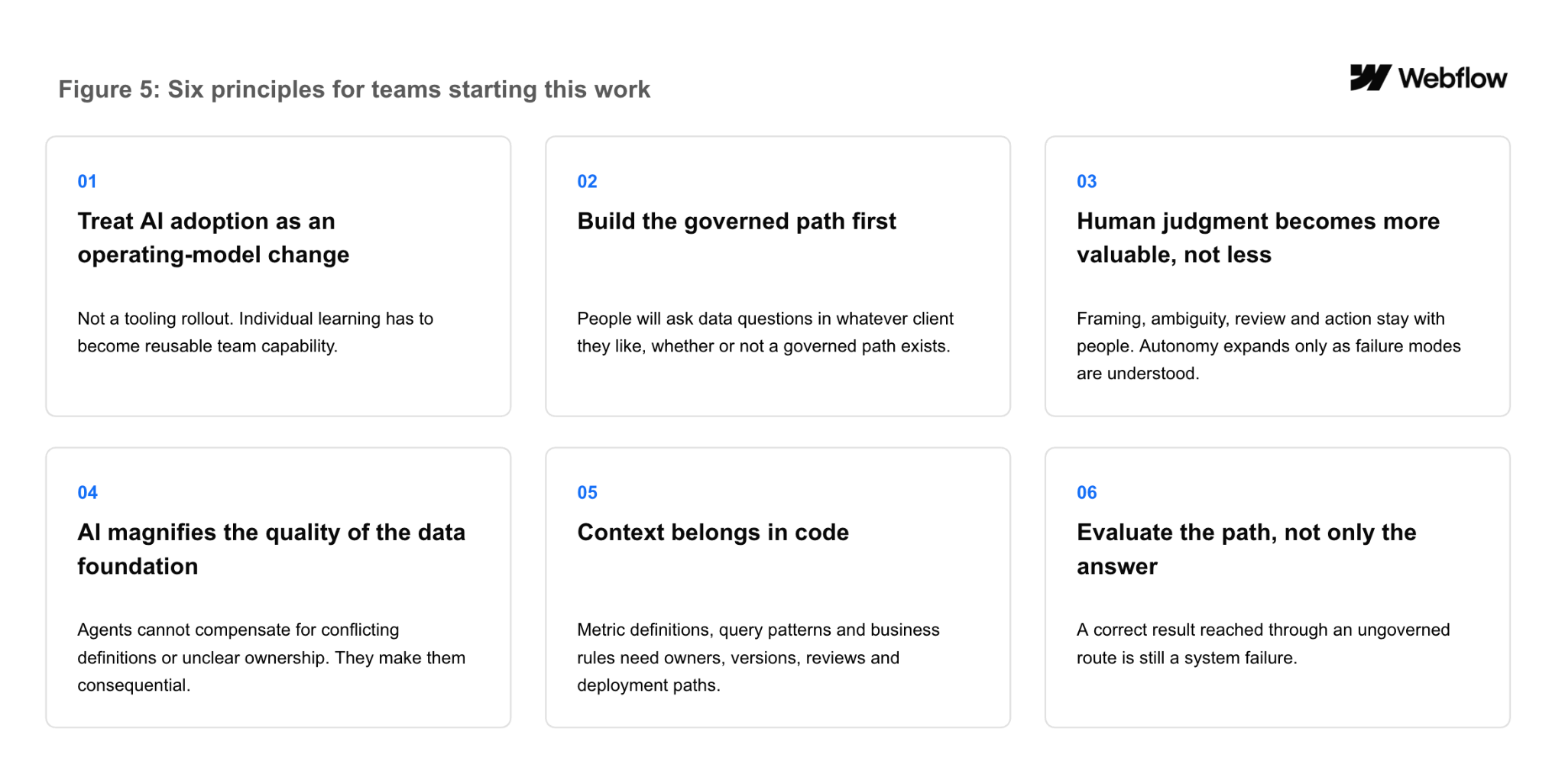
Figure 5 summarizes six principles from our experience building and scaling an AI-native Data & Insights operating system.
The larger shift
We are just getting started. As we broaden these capabilities, the next challenge is detecting plausible but incorrect answers before they influence decisions. That means exposing freshness, provenance, assumptions, and confidence; strengthening evaluation; and retaining human review where errors carry high costs. Another frontier is building fully closed-loop autonomous analytical systems that move from question intake through dynamic modeling and execution, grounded in code-derived business meaning, with human approval at critical points.
Ultimately, an AI-native Data & Insights team is defined not by how many agents it builds, but by whether AI operates within a trusted system of governed data, explicit context, reusable workflows, architectural controls, measurable quality, and human judgment. We started by asking how agents could help us work differently. We are now building toward a larger outcome: trusted self-service analytics for more people, a shorter path from question to decision, and better decisions without compromising governance. That is the promise of an AI-native Data & Insights operating system.