



For fifteen years, getting found online was mostly one team's job — and that's why almost no one is ready for what comes next.
Search Engine Optimization (SEO) used to live with a specialist individual or team who thoughtfully chased keywords, tuned meta tags, and watched their rankings. The goal was to drive traffic to the company’s website to deliver revenue. The rest of the company typically heard about it only when something went wrong.
The buyer journey is changing thanks to LLMs because they are genuinely useful. 51% of marketers surveyed by G2 said they would start their short lists with answer engines more often than Google, and 69% changed the software they bought because of LLMs (source). As a result, Answer Engine Optimization (AEO) is now a board level issue, and AEO also comes up in essentially all of the hundreds of CMO conversations I have each quarter.
When a prospect asks ChatGPT, Gemini, or Claude about your category, the answer and how you show up is shaped by inputs from across the company: SEO/AEO, engineering, contend, brand, comms, data teams, and more.
Good AEO is a team sport, and our research found that most companies aren’t ready for the field.
Want to understand how your site stacks up for AI-led discovery?
Get your free AEO maturity assessment today
Almost no one is as visible as they would like to be
Answer engines directly impact marketers’ ability to drive revenue by impacting traffic, similar to the impact Google search has had for years.
We asked answer engines questions a typical prospect in their space would ask throughout the funnel, the median company - right in the middle of all 2,000 - showed up in just 16% of responses. Even more impactful on marketing’s ability to drive traffic (and therefore revenue), the median company was cited with a link only 6% of the time. When we analyzed those same answers for competitors, the median company appeared 15% of the time when any company was mentioned. There is a lot of room to improve.
Answer engines also impact marketers’ ability to build their brand by reshaping marketers’ storylines. Google search never did this.
Today, LLMs have a propensity to get information about a company wrong, present it blandly, and leave out the company’s carefully crafted storyline. When a company is mentioned, answer engines got the facts wrong roughly one-third of the time (accuracy of 63 out of 100 where answers were assessed against site content and larger errors counted for more), and almost never conveyed what actually makes the company different (message pull-through of only 24 out of 100), and describe the company in a neutral, factual tone (the median sentiment of 57 out of 100).
To generate these benchmarks, we analyzed the live websites of more than 2,000 US companies, spread across industries and company sizes, the way answer engines would most likely read them. The picture is humbling for almost everyone.
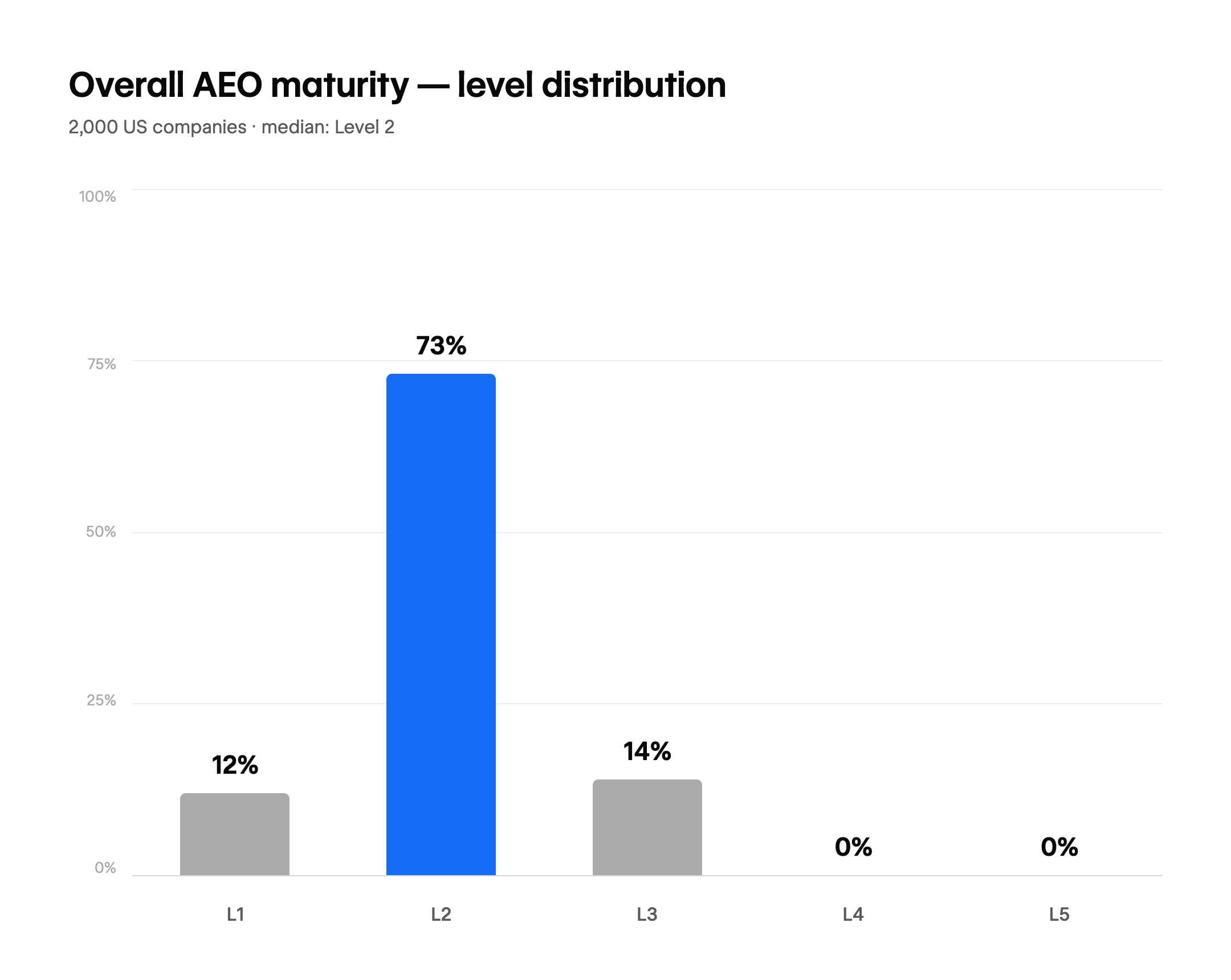
The Webflow AEO Maturity Index: a lot of room to grow
How should companies marshall their teams to improve these results in order to do marketing’s job of brand building and revenue driving?
Good AEO is close to what good SEO always should have been, where genuinely valuable content that helps prospects through the funnel is rewarded. The differences between AEO and SEO break down into four categories: the content you publish, the technical readiness of your site for AEO, the authority others grant you, and your ability to measure all of it.
Those four categories of work are what make AEO such a cross functional sport. Together, these four categories cleanly predict AEO mentions and citations, and the data shows almost no company is covering all of them yet. (source)
We developed a rubric called the Webflow AEO Maturity Model to help teams structure and measure their work expanding from SEO to AEO in these four categories across five levels of AEO maturity from 1 (still at decent SEO) to 5 (expanded to great AEO). The higher AEO maturity, the higher mention rate (2.3x going from level 1 AEO maturity to level 3) and the higher the citation rate (3.7x higher going from level 1 to level 3).
Visibility, website traffic, and brand fidelity are the outcome. AEO maturity is the work to do to achieve the outcome.
We scored all 2,000 companies on this maturity model. The aggregated results are launching today as the inaugural Webflow AEO Maturity Index.
How did brands do?
Overall maturity landed at 2 out of 5 (with 5 being the best). There is plenty of room for most to grow from good SEO to mature AEO! Here’s the breakdown:
- Overall: 2
- Content: 1
- Technical: 1
- Authority: 2
- Measurement: 3
The categories where the median brand scored best among the 2,000 sites (measurement at 3, authority at 2) is largely a result of cross functional work: analytics teams that instrument everything, brand teams that drive consistent expression everywhere, product marketing teams that define messaging, and PR teams that disseminate those messages broadly. Where companies tended to score the worst was in fundamentals under their own control, content and technical, albeit still across several teams.
The fundamentals are holding companies back
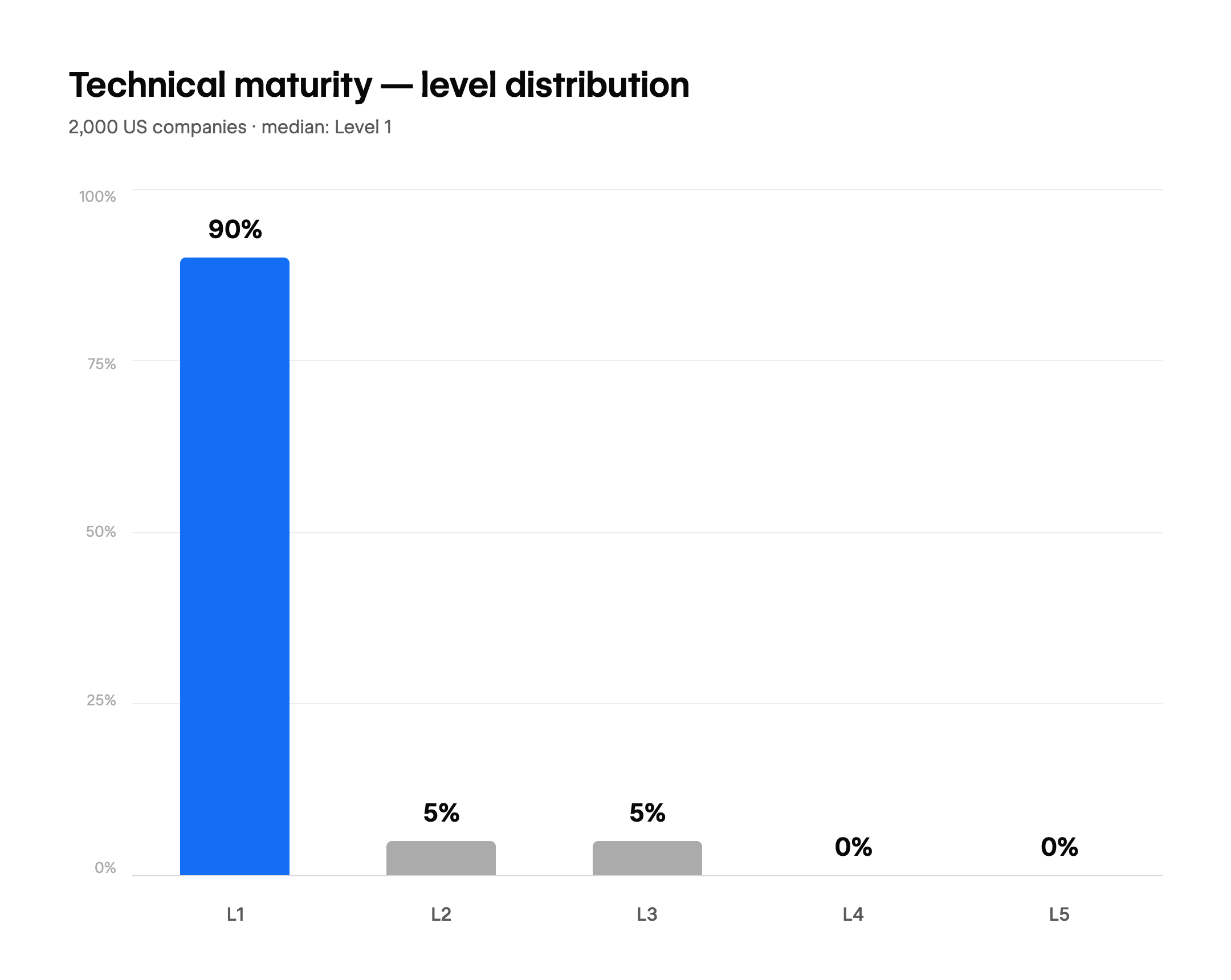
Technical fundamentals are holding brands back the most. Almost all companies scored a 1 out of 5. To our surprise, the reasons are the fundamentals. Broken internal links on a site (62% of companies), missing SEO metadata (60% of companies), and more. Why? One realistic explanation is that fixes have historically required an engineer and a marketer to be in a room together at the same time, and that almost never happens. Marketing needs to be empowered to do the work directly in a way that’s up to engineering standards rather than waiting for a meeting that almost never happens.

Content that answers prospect questions and is fresh is the second anchor. LLMs consume lots of content, and they strongly prefer fresh content. The median ChatGPT citation was updated six months ago, yet 54% of companies have updated less than one tenth of their content in the last six months. Additionally, most companies’ content isn’t geared towards answering prospect questions, which is what answer engines seek. Each company’s content-machine as voracious as ever. Meeting that demand requires enabling teams to produce on-voice content at scale with human review.

Authority has an outsized impact on mention rate and is where brand and PR are more important than before. LLMs seek consensus across many sources, yet 73% of companies are mentioned in less than a quarter of the places LLMs are citing for their category. Additionally, 55% of companies lack basic on-site authority, like author bylines, on the vast majority (85%+) of the relevant pages. At the same time, that on-site authority (backing claims in your content with data, sources, and credentials) was the single strongest correlation with AEO mention rate. Similarly, the next strongest correlation is recognition by third parties as an industry leader, a thought leader, and an authority in the spaces. Brand helps companies to speak consistently, and PR helps brands show up in many places. That combination drives consensus, helping brands appear trustworthy in the places LLMs are searching.

Measurement begins with the tools you’re already using like Google Analytics to understand how much of your human referred traffic is coming from LLMs and how well it’s converting.
Companies then typically pay for a new tool to measure how often they are mentioned and cited in answer engines to understand the impact of their work in the other three categories. It’s this closed loop approach of hypothesis -> act -> measure that wins, mirroring the approach marketers already take in paid media, conversion rate optimization, and more.
The four categories of AEO involve most of the company, and the scores show that it is early days in a new medium.
The data shows that the more of the company that supports AEO, the better. The four categories barely overlap. Being good at one has little impact on the others, as evidenced by there being virtually no correlation between the measured maturity of each of the four categories (<9% shared variance, <0.3 correlation). Each one is an independent contributor to AEO success. (source)
There is enormous room to grow and companies that play this cross-functional sport better will be outsized benefits. Those with teams, process, and technology that empowers a faster iteration through the closed loop will very likely be rewarded with strong brands and more revenue.
Brand matters, and the playing field is leveling
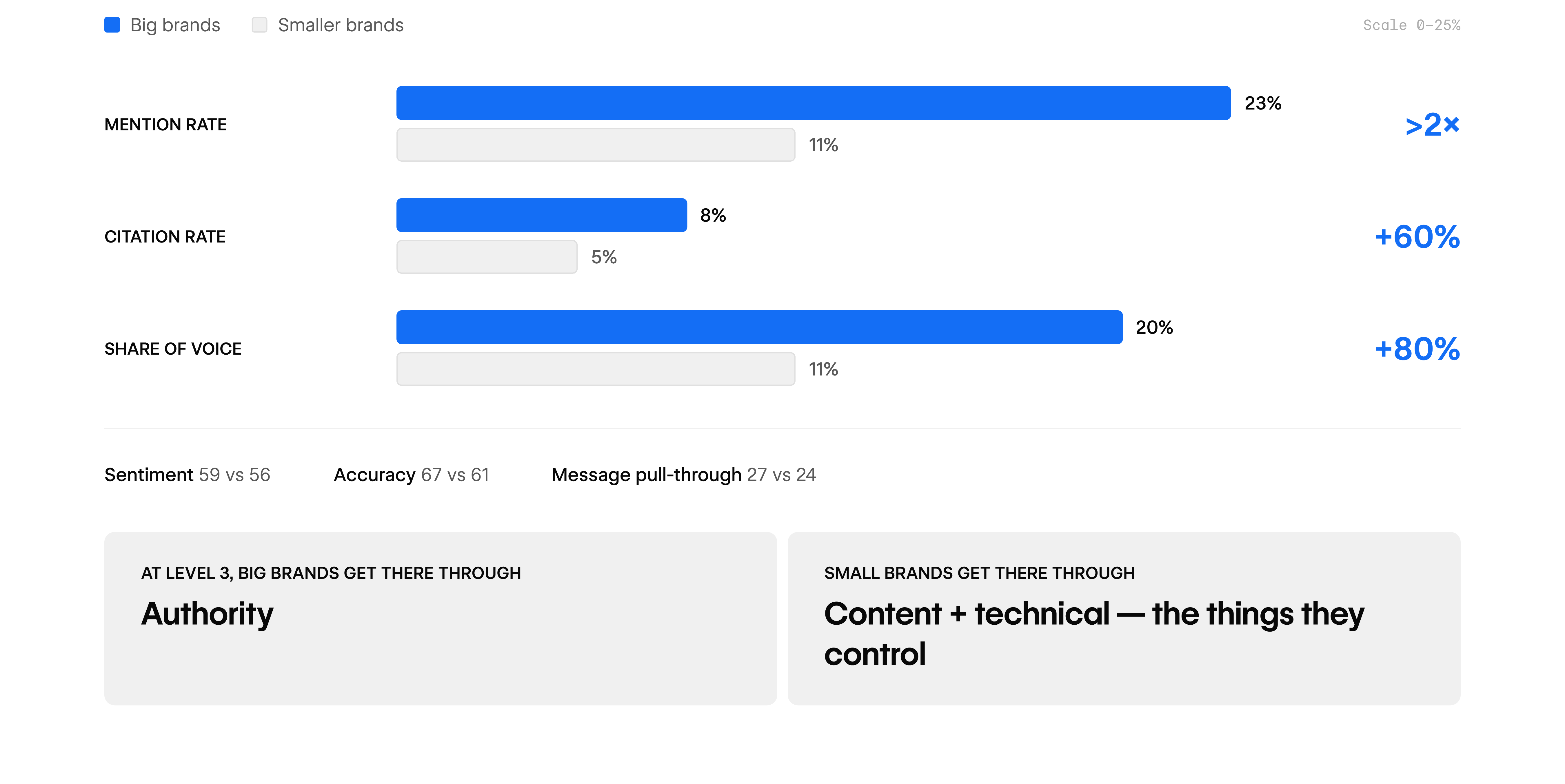
When we looked more deeply at the data, we noticed that big, well-known brands have great visibility compared to smaller brands. At every level of AEO maturity. Brand matters. Here’s how much:
- Mention rate is >2x (23% vs 11%)
- Citation rate is +60% (8% vs 5%)
- Share of voice is +80% (20% vs 11%)
Larger brands were also better understood by LLMs, with higher sentiment (59 vs 56 out of 100), accuracy (67 vs 61 out of 100), and message pull-through (27 vs 24 out of 100).
Interestingly, for the companies doing the best on AEO (Level 3 overall AEO maturity), the way big (and small) brands got there is different. Big brands are more widely recognized (higher Authority maturity). Small brands do more with what they control (higher content and technical maturity).
This means that any brand can drive more traffic and appear more effectively in LLMs by managing what’s under their control and influencing what is not. Small brands can look more like big brands by practicing good AEO.
Tech-forward companies excel
Our research has found that not all industries are seeing equal success in AEO.
The more tech-forward the sector, the more visible its companies.
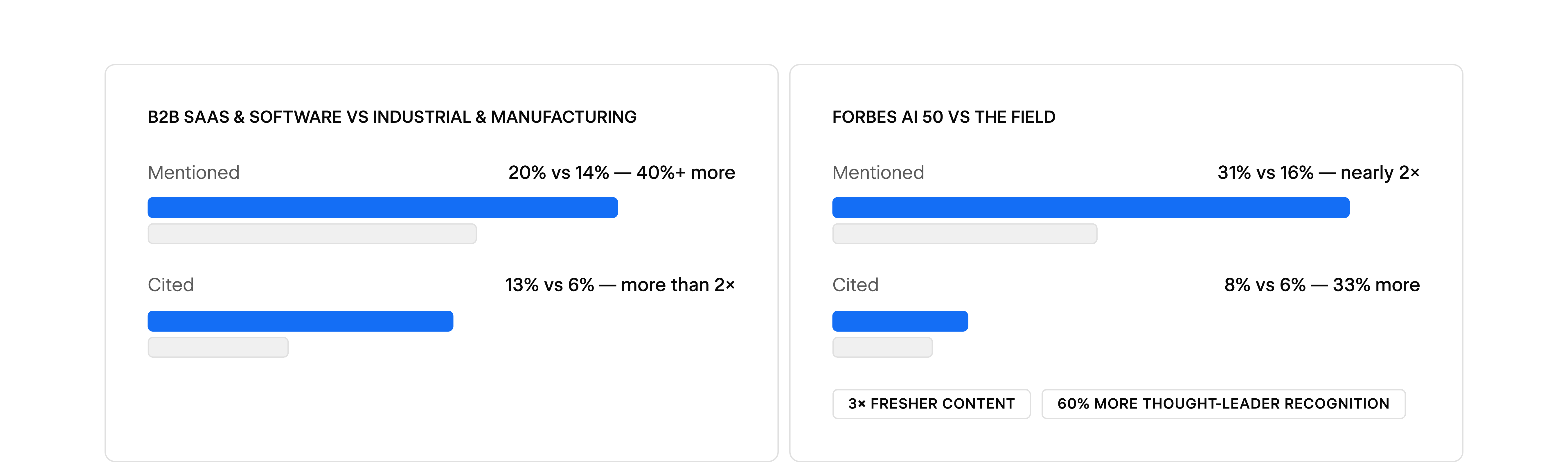
B2B SaaS and software firms were mentioned 40%+ more often than B2B industrial and manufacturing companies (20% vs 14%) and cited more than twice as often (13% vs 6%).
Push that tech-forward approach to its limit, and you arrive at companies built AI-first. Measured against our full 2,000-site sample, the Forbes AI 50 are in a different league on visibility, mentioned almost twice as often (31% vs 16%). They are cited 33% more often (8% vs 6%) and have higher share of voice, sentiment, accuracy, and message pull through.
Why? Forbes AI 50 companies have higher content maturity than the internet broadly (as embodied by the 2,000 domains) and they are doing a better job of cultivating authority, primarily via off-site mentions. Forbes AI 50 content was 3x fresher (% updated in the last six months), and they were recognized as thought leaders in the industry 60% more.
So which brands are doing this well?
To bring this to life, we thought it would be fun to see who is doing it best among some notable groups. So here goes! Here are the most AEO mature companies in several different groups and some about why.
MANGOS
Among the newly minted “MANGOS” (Meta, Anthropic, Nvidia, Google, OpenAI, and SpaceX), Webflow’s analysis found Google (embodied by deepmind.google) to be the most mature, driven by absolute top marks on authority (5 out of 5), strong technical setup (3 out of 5), and good content (2 out of 5). Nvidia is next with great mention rates (86%) driven by strong authority (4 out of 5) and good content (2 out of 5).
Forbes AI 50
krea.ai took the lone 4 out of 5 overall maturity in this group, driven by excellent content (4 out of 5), top notch authority (5 out of 5), and good technical setup (2 out of 5). Behind them were Abridge, BaseTen, and Cohere.
Ad Age Top 50 US Ad Spenders
AllState took top honors, driven by uniquely great authority (5 out of 5). They have work to do on content and technical, and authority carried the day for them. Next were CapitalOne, Pfizer, and Progressive (who had the top visibility in this subset at 44%). All have outstanding authority and most have decent content. All have work to do on their technical AEO setup.
2026 Cannes Grand Prix Winners
In our assessment, none of this group scored in the top tier, showing that even the most awarded creative brands have room to grow in AEO. Their creativity is excellent (as evidenced by their wins), and they can get more visibility on that creativity by improving how that creativity manifests in answering prospects questions in their content, in the technical setup that makes it easy for LLMs to appreciate that creativity, and in authoritative sources citing that creative effort. Tops among this group were (in order) Columbia, Heineken, Suncorp Insurance, and Adidas.
AEO is a team sport. Time to field a full team.
The things holding companies back from driving more revenue from and better managing their brands in answer engines are fixable fundamentals rather than “dark arts.”
Clean up internal broken links. Give your content structure, including SEO metadata and schema. Answer questions buyers really ask. Keep content fresh. Earn credible mentions, and measure what the engines see.
Smaller brands who don’t yet have a built in brand halo punch above their weight in AEO through better content and stronger technical setup.
No one team can do all of that alone, and no one company is doing all at the highest level yet. It is early days in a new medium, and the companies that win in AEO discovery will almost certainly be the ones that get content, product marketing, engineering, product, brand, PR, marketing ops, and analytics working together and/or empowering each other to work separately and safely.
This is part of why we built a free assessment to show any company where it stands on- and off-site that you can take here. AEO is a problem that 93% of execs say will impact their entire business in the next two years, so we’re very focused on helping teams collaborate to solve it.
AEO is a team sport. It’s time to field the full team.
How we built this
This assessment ran across 2,000 websites on 123 scoring gates fed by roughly 325,000 lines of code, ~29,000+ automated tests, 5,200+ lines of prompts, and 100 source modules, built across more than 500 LLM sessions. This is the third major version of the system, and every figure in this report reflects Webflow's own analysis of publicly available information.
We sampled companies to reflect the real economy, US-based, spread across industries and company sizes using publicly available data, so the picture isn't skewed toward any one type of business. Every score comes from analyzing a company's live website in essentially the same way an AI system would.
The analysis itself is run using a purpose-built code base that deterministically assesses websites and using large language models that qualitatively assess websites. To measure visibility and quality, we queried four leading answer engines (ChatGPT, Gemini, Claude, and Perplexity) with the questions a real buyer would ask throughout the funnel, then used code and LLM-based graders to score the responses against a consistent rubric. We used only publicly available information, and no private or customer data.
Visibility metrics (mention rate, citation rate, and share of voice) are measured across all 2,000 domains. Quality metrics (sentiment, accuracy, and message pull-through) are measured across the 1,579 domains that were mentioned at all, since a company with zero mentions offers nothing to assess.
Want to see where you stand? Run your own assessment at webflow.com/aeoma.
A note on method: no assessments submitted through webflow.com/aeoma were used in this research. Every data point here comes from our independent sample.