






Your AEO Assessment: platformscience.com
Overall AEO Maturity score: 2 out of 5





Your top 3 priorities
Here's where platformscience.com can make the fastest gains in AEO visibility, accuracy, and traffic. If you only did three things, do these:
Expand key content pages beyond 300 words and build toward 500+ word depth with specific data, examples, and expert insights. Most pages currently lack the substance AI engines need to extract and ...
Complete SEO metadata across key pages and organize heading structures with clear h1/h2/h3 hierarchies. You're close to technical level 2—fixing metadata gaps and heading logic will significantly b...
Add author bylines with credentials and person schema markup to at least 15% of content pages. This strengthens your already-strong authority signals and gives AI platforms the named-expertise cues...
AI visibility snapshot
Top competitors mentioned alongside you
What your AEO Assessment covers
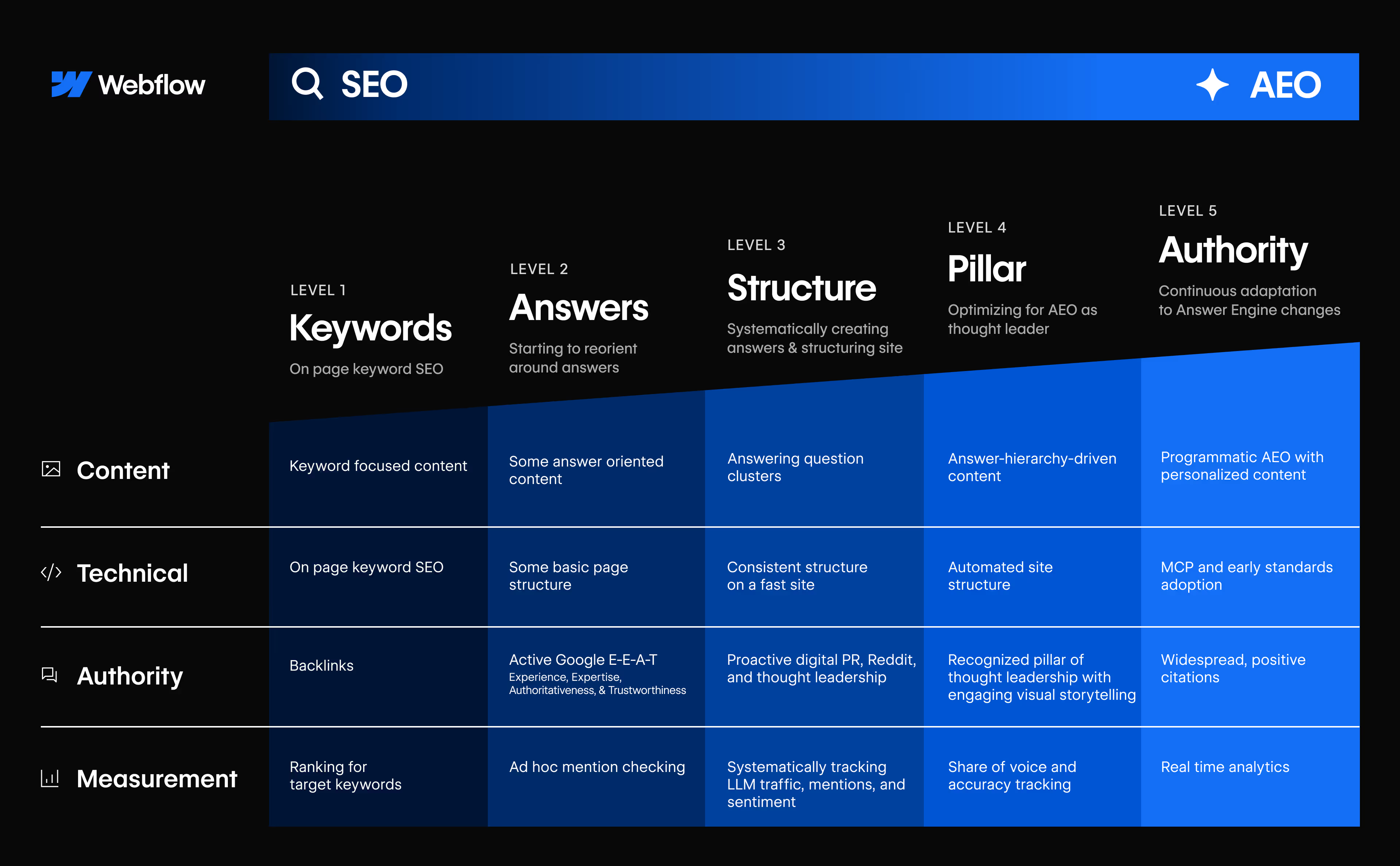
Your personalized AEO assessment measures how well platformscience.com is positioned for AI-driven discovery. It evaluates your site’s performance across four key categories—Content, Technical, Authority, and Measurement—to show how effectively AI systems can understand, cite, and recommend your brand.

Content
Content: Build the source AI trusts
We evaluated how your content performs across freshness, structure, depth, and clarity to see how well it helps AI understand what you do and why you matter.
Content Category Score
Platform Science has a solid foundation with 70 content pages, 11 content types, and FAQ sections on over 50% of pages. However, most pages contain very little text, limiting AI engines' ability to extract and cite meaningful answers. Adding depth is the top priority.
Expand pages beyond 300 words
Most content pages currently have minimal text, making it difficult for AI engines to extract useful answers. Expanding key pages to at least 300 words gives LLMs enough substance to understand and...
Build deeper, 500-word content
Aim for an average of 500+ words on content pages by adding examples, data points, and context. This depth helps AI engines confidently cite your pages as authoritative sources.
Add substance and specificity
Go beyond surface-level descriptions by including specific data, step-by-step processes, comparisons, and expert insights. AI models favor content that provides concrete, detailed answers over gene...
Question Coverage Percentage
Coverage of the 100 most likely questions your target audience will ask related to the topics visible on your site.

Technical
Technical: Structure wins
We evaluated how well your site uses schema, other metadata, accessibility, and speed, and more to help LLMs understand the structure and meaning of your content and establish one part of your authority in AI-driven search.
Technical Category Score
Platform Science has solid technical foundations in place—HTTPS, valid sitemap, and robots.txt are all set. You're close to Level 2! Completing SEO metadata across key pages and improving heading structure are the clearest next steps to boost AI engine visibility.
Complete key page metadata
About 62% of your key pages have full SEO metadata—aim for 80%+. Audit your homepage, product, and contact pages to ensure each has a unique title tag, meta description, and H1 heading.
Organize page heading structure
Most pages lack a logical heading hierarchy. Structure each page with a single H1 for the main topic, H2s for major sections, and H3s for subtopics—this helps AI engines parse and cite your content...
Expand sitewide metadata coverage
Your overall SEO metadata coverage is at 71%—pushing to 80%+ across all pages will unlock Level 2. Use CMS templates to auto-populate title tags, meta descriptions, and H1s so new pages are covered...
Schema Coverage Percentage
Share of pages with schema.org metadata for improved LLM and search engine understanding.

Authority
Authority: Earn trust, everywhere
We evaluated how your site establishes authority by looking at how and how frequently others talk about you, the associated sentiment, and more.
Authority Category Score
Platform Science has built a strong authoritative presence with solid organizational signals, active social channels, and broad AI recognition. Two key gaps at Level 4—author bylines and Wikipedia presence—are the clearest opportunities to strengthen authority further.
Add author bylines to content
Expand author attribution to at least 15% of content pages. Include author bios with credentials and use Person schema markup to give AI platforms structured authorship signals.
Pursue a wikipedia page
Work toward establishing a Wikipedia page by building coverage in reliable, independent sources. Wikipedia is a primary training source for all major LLMs and dramatically increases AI accuracy abo...
Scale bylines across all content
Aim for 50%+ author attribution across content pages, linking author profiles to social accounts. This signals named expertise and builds trust with both prospects and AI platforms evaluating your ...
Authority Coverage Percentage
Percent of top 50 industry sites that mention you.

Measurement
Measurement: From rankings to representation
This score reflects how well you monitor your visibility across AI systems; from tracking brand mentions and citations to understanding sentiment and share of voice.
Measurement Category Score
Platform Science has a strong analytics foundation with 100% sitewide coverage and 11 tracking tools in place. The next step is layering in AEO-specific monitoring to measure how AI platforms drive visibility and traffic to your brand.
Adopt a dedicated AEO tool
Invest in a purpose-built AEO monitoring tool that systematically tracks AI citation rates, LLM brand mentions, and AI-referred traffic. Manual spot-checking doesn't scale — dedicated tools automat...
Start tracking AEO metrics
If not already in place (we cannot tell from the outside), begin monitoring AI bot traffic in server logs, LLM-referred visitor sessions from platforms like ChatGPT and Perplexity, and brand mentio...
Maintain full analytics coverage
Your 100% sitewide analytics coverage is excellent — keep it there. This complete visibility ensures you can accurately measure AI-referred traffic patterns across every page as AEO tracking matures.


Measurement Coverage
Presence of externally visible signs on your website that you are using measurement tools.